


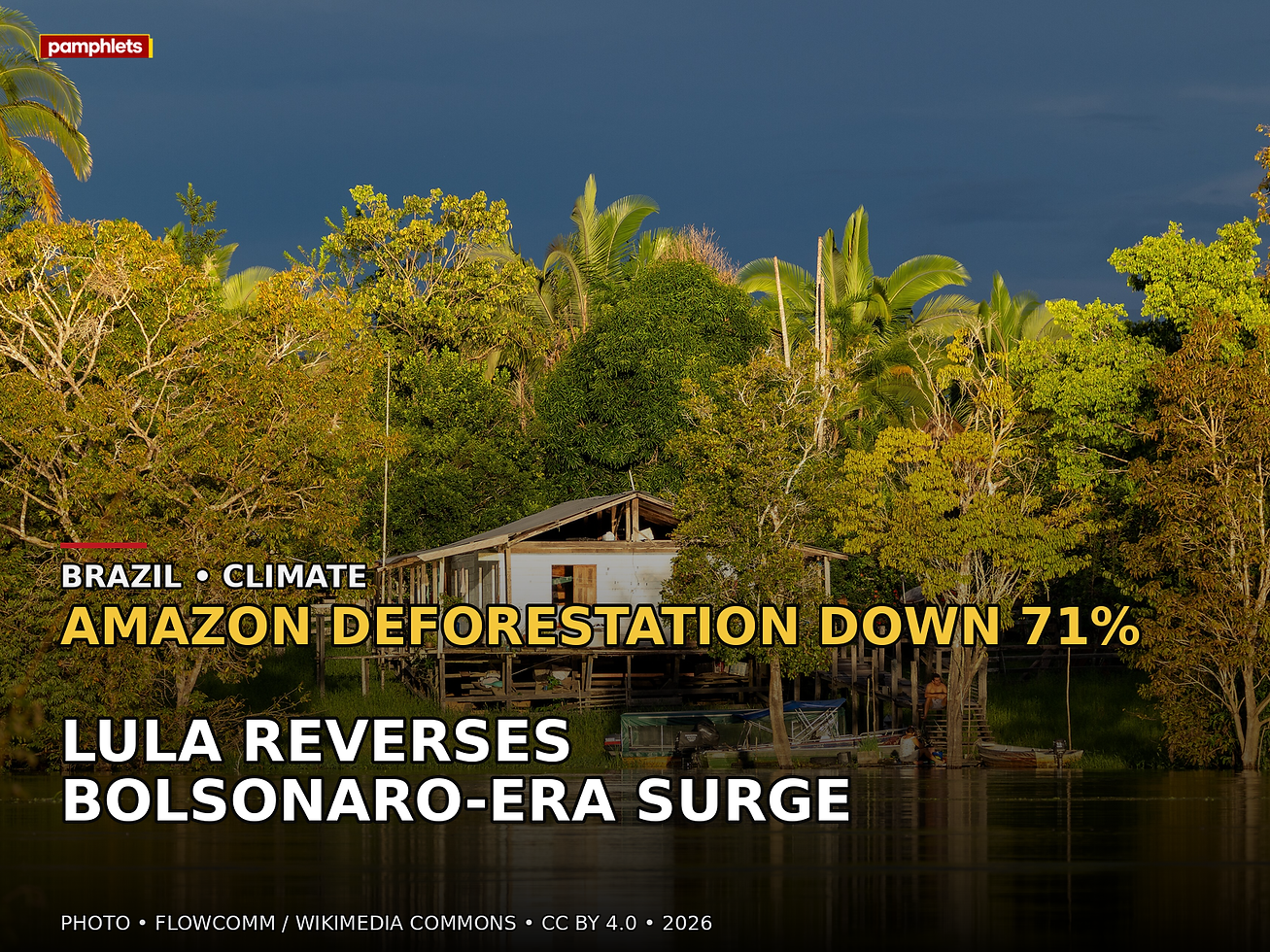
Under Lula, Amazon Deforestation Falls 71% From 2022 in Major Climate Gain

Updated: 19 hours ago
Brazil has cut Amazon deforestation to its lowest level since official monitoring began, turning one of the planet’s most important forests from a symbol of environmental retreat into a measurable climate gain.
INPE says 3,335 square kilometers of forest were cleared in the Legal Amazon between August 2025 and July 2026. That is down 41.8 percent in a single year—and roughly 71 percent below the 11,594 square kilometers recorded in 2022, the final year of Jair Bolsonaro’s presidency.
The difference is not rhetorical. It is thousands of square kilometers of forest that were not cut, burned or converted. It means more carbon kept in trees, more habitat left intact and less damage to the rainfall system that connects the Amazon to farms, cities and ecosystems across South America.
Lula returned to office in 2023 promising to reverse the destruction. Four years later, the central indicator has moved sharply in that direction.
From 11,594 to 3,335
The decline has been sustained across every full year of Lula’s current presidency: 9,064 square kilometers in 2023, 6,288 in 2024, 5,731 in 2025 and 3,335 in the latest cycle. The newest number is the lowest in the historical series that began in 1988.
That collapse in forest loss followed a restoration of environmental enforcement, satellite monitoring and federal anti-deforestation planning. The government revived the Amazon Fund, rebuilt the Action Plan for the Prevention and Control of Deforestation in the Legal Amazon and restored political weight to agencies and ministries that had been weakened during the Bolsonaro years.

President Lula and Environment Minister Marina Silva at an Amazon protection event. Ricardo Stuckert / Secom-PR, via Ibama.
The latest fall was broad. INPE reported deforestation down 45.3 percent in Pará, 46.7 percent in Mato Grosso and 46.4 percent in Amazonas compared with the previous cycle. Eight of the nine states in the Legal Amazon recorded declines.
Bolsonaro’s years had pushed the forest in the opposite direction. Deforestation accelerated while environmental agencies were weakened and illegal mining, land grabbing and forest clearing expanded. By 2022, annual Amazon loss was more than three times the level measured today.
A climate victory measured in standing forest
The Amazon stores enormous quantities of carbon and recycles moisture through the atmosphere on a continental scale. When trees are cut and burned, that stored carbon enters the atmosphere while the forest’s ability to regulate heat and rainfall weakens.
That is why Brazil’s deforestation decline matters far beyond its borders. Climate diplomacy often runs on distant targets and promises. This is a physical result visible from satellites: millions of fewer hectares lost across the Lula years compared with the trajectory inherited from 2022.
The political lesson is equally concrete. Governments can change environmental outcomes when they enforce the law, fund institutions and treat forest protection as state policy rather than an obstacle to extraction.
The record is not without contradiction. Lula’s government still faces criticism over oil exploration near the Amazon coast and infrastructure projects that environmental groups fear could create new pressure on the forest. Those fights will determine how durable the gains become.
But the forest itself is already recording the change. In 2022, Brazil lost 11,594 square kilometers of Amazon. In 2026, it lost 3,335.
For a planet running out of time to cut emissions and preserve its great carbon sinks, that difference is enormous.


Comments