


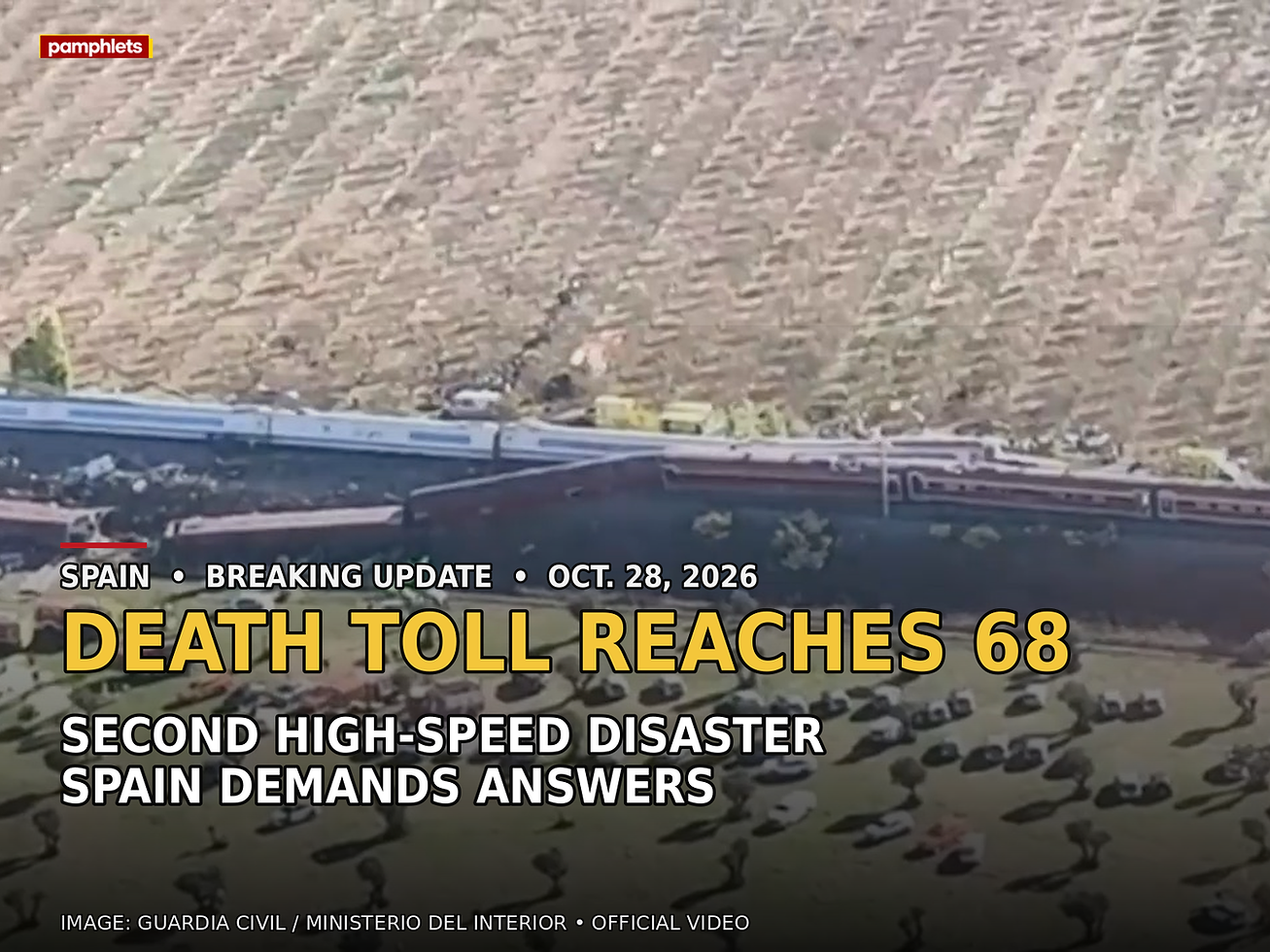
Spain Train Disaster Toll Reaches 68 as Second Crash Shatters Confidence

The death toll from Spain’s high-speed rail collision near Urda reached 68 on Wednesday, transforming an already grave accident into Europe’s deadliest train disaster since 2013 and forcing a national reckoning over a system long marketed as a model of modern public infrastructure.
Castilla-La Mancha’s regional government confirmed the new provisional toll on October 28: 44 people aboard the private Iryo train and 24 aboard the state-owned Renfe AVE service. Another 58 people remained in hospitals, according to authorities. Rescue teams continued searching the wreckage.
The trains were travelling south from Madrid toward Seville when the Renfe service struck the rear of an Iryo train that had stopped near Urda in Toledo province. Two Iryo carriages derailed. Officials said 397 passengers were aboard the Renfe train and 147 were travelling on the Iryo service.
“Today all of Spain is grieving,” Prime Minister Pedro Sánchez said at the crash site. His government declared three days of national mourning.
A failure that demands public answers
The crash occurred at about 8:54 a.m. on the Madrid–Andalusia high-speed corridor. Adif suspended service between Madrid, Ciudad Real and Andalusia as firefighters, Civil Guard officers, medical teams, Red Cross workers and Spain’s Military Emergency Unit converged on the rural site.

Authorities opened emergency shelters and family-assistance points in Urda, Madrid, Seville and Córdoba. The regional government raised its territorial emergency plan to Operational Situation 2 and deployed every available resource.
Transport Minister Óscar Puente said a security system had failed before a central command centre issued what he called an “inexplicable” order. He said the train drivers were not responsible. Investigators must now secure signalling records, control-room communications, maintenance histories and the trains’ event recorders before assigning final responsibility.
That distinction matters. Early political certainty would only protect institutions from scrutiny. The public needs a complete reconstruction of why one high-speed train remained stopped on an active line, why another was allowed to approach it and why automatic protections failed to prevent a rear-end collision.
The institutional chain crosses public and private operators. Renfe is state-owned. Iryo is privately operated. Adif manages the infrastructure and traffic-control system beneath both. Each body has access to only part of the evidence; none should be allowed to narrow the inquiry to its own contractual boundary.
Two catastrophes in nine months
Wednesday’s disaster came nine months after 46 people died near Adamuz, Córdoba, when a derailed Iryo train struck an oncoming Renfe service on the same Madrid–Andalusia corridor. Authorities say the causes appear unrelated, but the repetition destroys any attempt to treat rail safety as an isolated technical matter.
Spain built Europe’s largest high-speed network with public money and presented it as proof that rail could connect regions rapidly, safely and sustainably. Liberalization later placed state and private operators on the same tracks. Competition cannot become a mechanism for fragmenting safety oversight, dividing responsibility or forcing maintenance behind commercial timetables.
Sánchez acknowledged that national confidence had been broken. “If we need to further strengthen safety in order to rebuild confidence in our high-speed rail system, we will do so,” he said. “What is unacceptable for a country like Spain is to suffer two high-speed rail accidents in the same year.”
Those words create an obligation. The investigation must be independent, its evidence public and its recommendations funded. Spain’s rail workers and passengers should not have to choose between mourning and accountability.
The immediate task remains recovery, medical care and support for families. The next is to publish every failure—from the control room to the governing board—before another train enters the same chain of risk.


Comments