


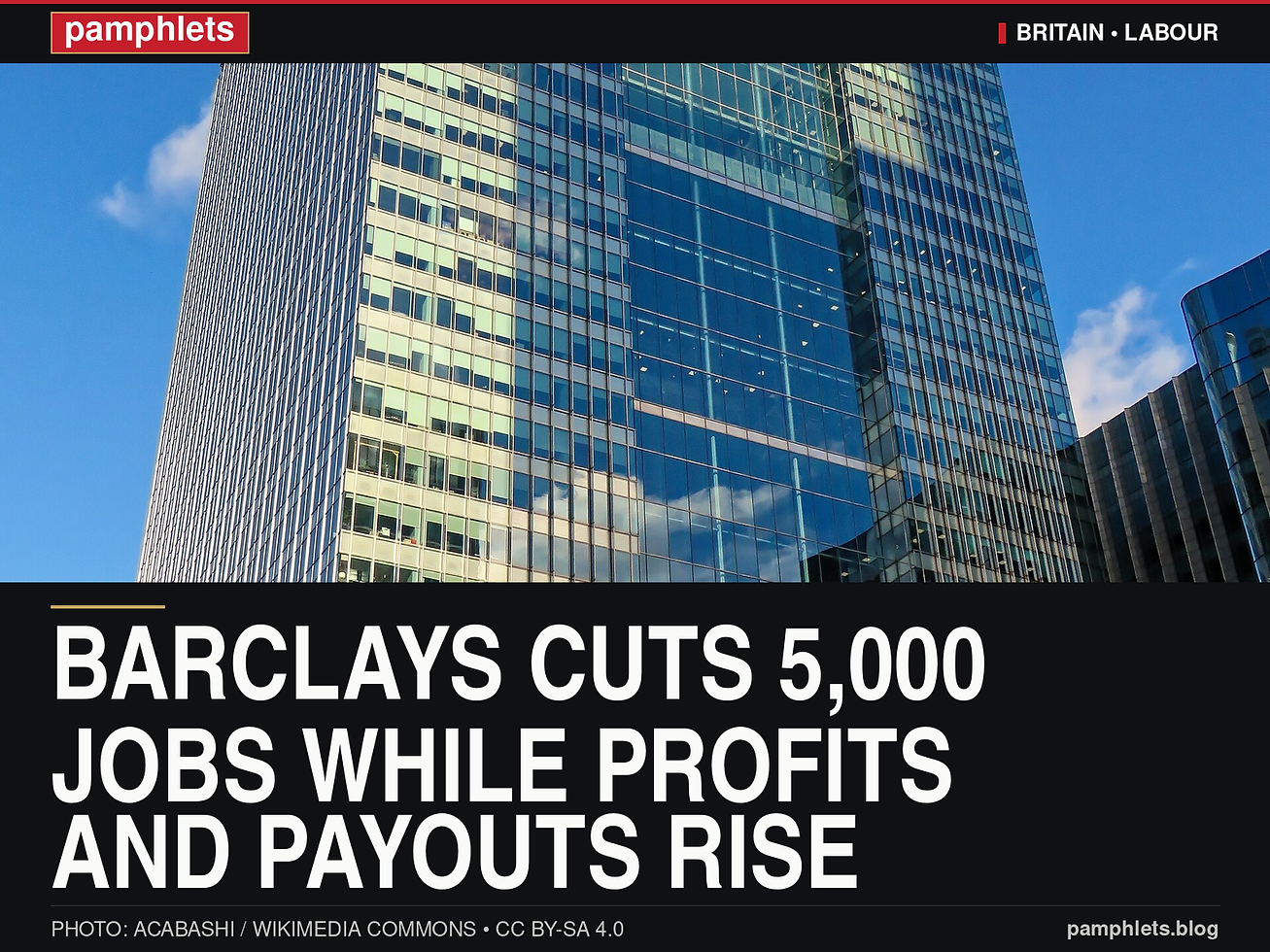
Barclays Cuts 5,000 Jobs While Sending £2.8 Billion to Shareholders

Barclays has drawn the class line in fluorescent ink. The British bank will eliminate about 5,000 jobs this year—roughly 5 percent of its global workforce—while quarterly pre-tax profit rises and another £500 million flows into a share buyback.
The cuts are not the desperate act of a failing company. Barclays reported £2.3 billion in pre-tax profit for the third quarter, up 12 percent from £2.1 billion a year earlier. Its earnings per share rose 18 percent. The new buyback brings dividends and announced buybacks for 2026 to £2.8 billion, 46 percent more than at the same point last year.
That is the real story behind the bank's rhetoric about efficiency: workers lose their livelihoods while capital owners collect the gains.

Barclays global headquarters, Canary Wharf, London. Photo: Acabashi/Wikimedia Commons (CC BY-SA 4.0).
Profits for shareholders, insecurity for workers
Chief financial officer Anna Cross told reporters that Barclays had already removed 1,000 roles and would cut the remaining 4,000 by the end of the fourth quarter. About 60 percent of the losses will hit support functions, including developers. The bank expects technology-enabled reductions in full-time staff to lower its fixed costs.
Barclays executives put artificial intelligence at the centre of the announcement without claiming that a machine simply replaced every worker. Chief executive C.S. Venkatakrishnan said years of investment in technology and process simplification produced most of the savings and called AI the “icing on the cake.” That phrase reveals the priority clearly enough: the technology matters because it gives management another route to reduce labour costs and lift returns.
The Unite union rejected that logic. General secretary Sharon Graham said Barclays was using AI “as an excuse” to discard loyal workers. She argued that employers should retrain staff so people remain employed as technology changes the workplace. The alternative is not technological stagnation. It is democratic control over who benefits from higher productivity.
Barclays could afford that transition. Its official results show £7.4 billion in third-quarter income, a cost-to-income ratio that improved to 62 percent, and a common equity tier 1 capital ratio of 14.2 percent. The bank also booked £201 million in what it calls “structural cost actions” during the quarter and plans roughly £300 million more in the final three months of the year.
This is restructuring from a position of strength. Shareholders receive cash immediately. Workers receive insecurity, compressed workloads and the threat that the next software rollout will put their job on a spreadsheet marked “efficiency.”

Barclays Bank, Victoria Street, Westminster. Photo: David Edgar/Wikimedia Commons (CC BY 3.0).
The distributional choice is especially stark in Britain, where households have spent years paying higher borrowing costs. Barclays’ UK retail banking operation increased net interest income by 6 percent to about £2 billion in the quarter. That measure captures the margin between what a bank earns on loans and what it pays depositors. The same interest-rate environment that squeezed workers and renters helped sustain bank income.
The announcement also lands days before the British government’s October 28 budget, amid demands that banks contribute more through taxation. The Trades Union Congress says Britain’s four largest banks have made £200 billion in profit since 2021. Barclays insists that heavier taxes could send the wrong signal, yet the bank itself has just signalled that rising profit and mass job destruction can sit comfortably in the same quarterly report.
AI does not dictate this outcome. Ownership does. A productivity gain could shorten the working week, improve service, retrain staff or raise pay. Under shareholder rule, the first question is how many salaries can be removed and how much capital can be returned.
Barclays presents the cuts as modernization. For the 5,000 people whose jobs are disappearing, modernization means they finance the transition while investors take the dividend. That is not technological inevitability. It is a corporate decision—and workers have every reason to organize against it.
Sources
Reuters — October 22, 2026.
Barclays PLC Q3 2026 Results Announcement — October 22, 2026.
Unite the Union statement — October 22, 2026.
The Guardian — October 22, 2026.


Comments