


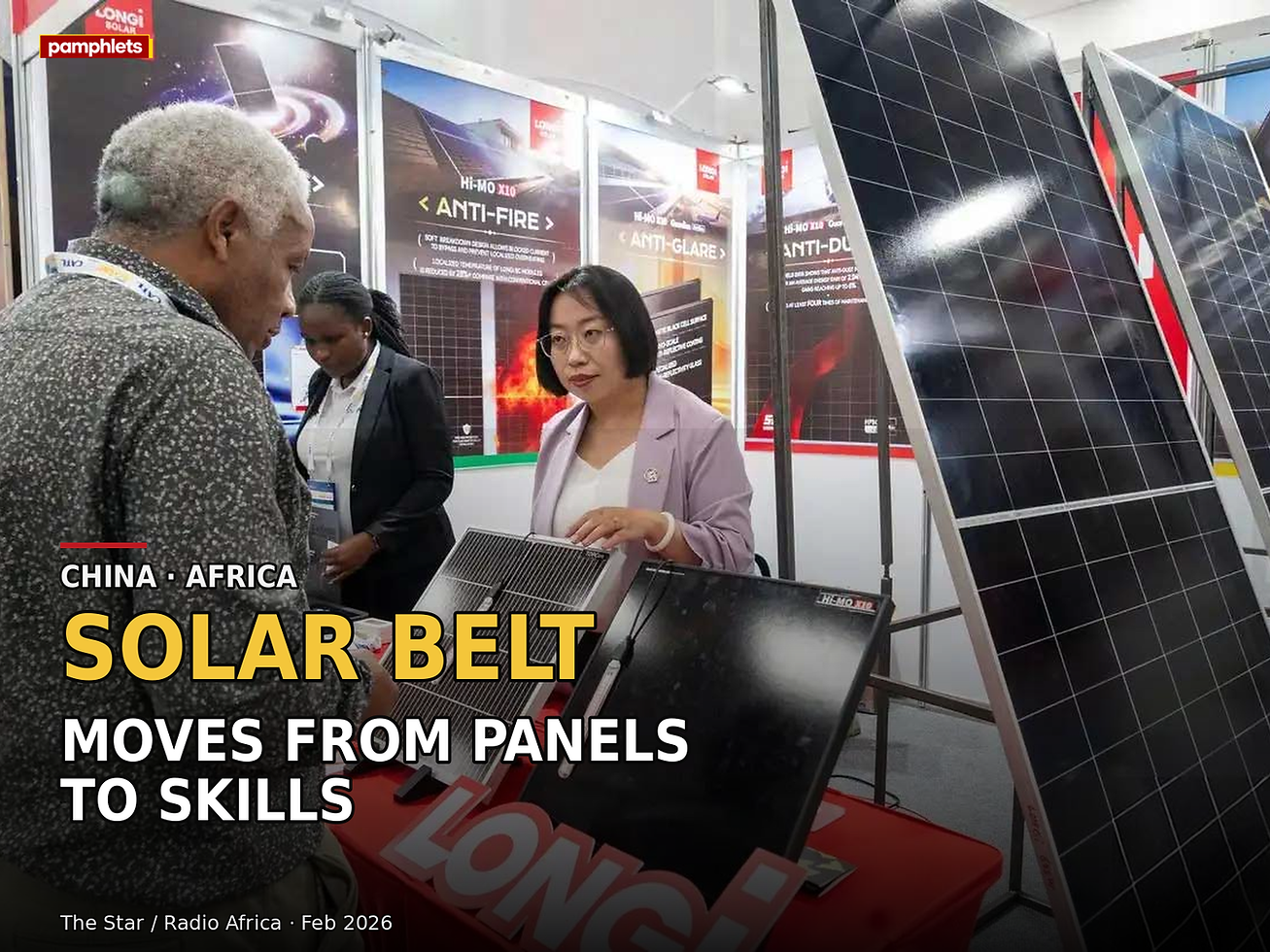
China’s Africa Solar Belt Is Moving From Panels to Skills

The cheapest solar panel in the world is of limited use if a country lacks the engineers, financing tools, grid planning and maintenance systems needed to deploy it at scale. China’s Africa Solar Belt initiative is increasingly trying to address that second half of the problem.
From June 14 to 27, 22 participants from ten African countries gathered in Suzhou and Changzhou for a China–Africa capacity-building program focused on climate policy, renewable investment, solar technology, energy storage and green industry. Participants came from Ethiopia, Burkina Faso, Cabo Verde, Comoros, Kenya, South Africa, Seychelles, Zambia, Gabon and Malawi. China’s Foreign Environmental Cooperation Center published the program summary.
The two-week program mixed lectures with visits to companies including GCL, Trina Solar and Everbright Environment. Kenya’s Climate Change Knowledge Portal said the program was designed to build practical knowledge around renewable deployment, climate governance and South–South cooperation. Kenya’s own account is here.
That emphasis on skills matters because China–Africa green cooperation is often reduced to trade statistics. Cheap Chinese panels have made solar far more accessible, but imported hardware alone does not create an energy transition. As Pamphlets has argued in its broader assessment of China’s role in African development, the stronger form of cooperation is the one that leaves behind infrastructure, technical capacity and local productive knowledge.
The Solar Belt is becoming an implementation platform
The 2026 seminar was the fourth capacity-building activity held under the Africa Solar Belt framework. Its curriculum went beyond photovoltaic hardware into climate finance, industrial policy, storage systems and renewable-energy investment—areas that determine whether projects move from announcements to functioning power systems.
The policy framework is broader still. Under the Forum on China–Africa Cooperation’s 2025–2027 action plan, China committed to support 30 clean-energy and green-development projects, distributed photovoltaic and storage systems, larger renewable-power projects and a special fund for China–Africa green industrial chains. The FOCAC action plan spells out those commitments.
There is a practical reason for this shift. Africa’s energy problem is not one problem. Some countries need utility-scale generation; others need mini-grids, storage, transmission upgrades or reliable power for farms and factories. Training officials and engineers across multiple countries can help turn Chinese technology from an imported product into a toolkit that is adapted to different national systems.
Technology transfer has to become local capability
Training programs can also become diplomatic theatre if they end with certificates and photo opportunities. The harder test is what happens afterward: whether African institutions gain the capacity to design tenders, negotiate financing, maintain equipment, build local supplier networks and choose technologies on their own terms.
That is why the Solar Belt’s most important promise is not simply more Chinese panels in Africa. It is the possibility that falling clean-energy costs can be paired with African technical capacity and industrial policy. If that happens, China–Africa green cooperation can move from selling equipment to building the institutions that make energy sovereignty possible.


Comments