
Cost of Living as it relates to Artificial Inflation and Wage Plateau
GUEST ANALYSIS · ALDEN FRIEND
Stagnant pay, rising household necessities and corporate pricing power are central to Alden Friend’s examination of America’s affordability crisis.
The evidence presented across these sources reveals a coherent story: American households face a "reproductive squeeze" where the cost of essentials rises faster than wages, forcing difficult tradeoffs between housing, healthcare, food, and basic utilities. This squeeze is not accidental. It reflects what Howell terms "mechanisms of enrichment" that "generate inequality through upward transfers from workers."
Cost of Living as a Measure of Purchasing Power
Cost of living measures the amount of money needed to sustain a certain standard of living—encompassing housing, food, healthcare, transportation, and other essential goods and services
Purchasing power represents what a unit of currency can actually buy; when prices rise faster than wages, purchasing power declines
The relationship is inverse: as cost of living increases without corresponding wage growth, real purchasing power contracts
Between 1979 and 2019, the share of workers in "poverty-pay" jobs (below $14.08/hour in 2019 dollars) increased for young men without college degrees from 21.4% to 34.3% (Howell, 2025)
The cost of living is fundamentally a measure of purchasing power—the ability of a household's income to secure the goods and services necessary for a minimally decent standard of living. When wages stagnate while prices for essentials rise, households experience what researchers term a "reproductive squeeze": systemic, compounding pressures on their capacity to reproduce themselves on a daily and societal basis (Meehan et al., 2024). This squeeze manifests in deteriorating access to basic necessities, including running water. Notably, 65% of working-age renter households in 2023 were "residual income cost burdened"—meaning after paying rent, they lacked sufficient income to cover other basic needs (Airgood-Obrycki et al., 2025). This represents 5.3 million more households than captured by traditional cost burden measures.

Grocery goods in Fairfax, Virginia, March 2011. Photo: Lance Cheung / USDA (public domain).
Fiduciary Responsibility to Shareholders and Profit Maximization
Fiduciary duty requires corporate directors and officers to act in the best financial interests of shareholders—a principle established in Dodge v. Ford Motor Co. (1919)
This legal framework effectively mandates that publicly traded corporations prioritize profit maximization over other considerations, including worker welfare or consumer affordability
Corporate-law context: the shareholder-primacy interpretation described here is contested; fiduciary duties do not categorically require short-term profit maximization over every other concern.
The doctrine creates structural incentives for:
• Suppressing wages to reduce labor costs • Raising prices to what the market will bear • Externalizing costs onto workers, communities and the environment
This shareholder primacy model distinguishes American capitalism from European variants with stronger stakeholder protections (Howell, 2025)
The legal architecture of American corporate governance fundamentally shapes labor market outcomes. As economist Angus Deaton argues, "American policy, instead of cushioning working people, has instead contributed to making their lives worse, by allowing more rent-seeking, reducing the share of labor, undermining pay and working conditions, and changing the legal framework in ways that favor business over workers" (Howell, 2025). This manifests in measurable outcomes: while GDP more than tripled between 1979 and 2019, the decent-pay employment share for young workers without a college degree collapsed from 45.4% to 22.3% (Howell, 2025). The counterfactual analysis shows that had the 1980s relationship between GDP growth and decent-pay jobs continued, there would have been 102.6 million decent-pay jobs by 2019—instead of the actual 74.5 million. This 28.1 million job gap represents the human cost of an economic system designed to prioritize shareholder returns over worker prosperity.
Defining Artificial Inflation
“Natural inflation” occurs through supply-demand dynamics: scarcity drives prices up, abundance drives them down
Artificial inflation occurs when corporations raise prices beyond what production costs or supply constraints justify—simply because consumers have no alternative but to pay
This phenomenon is enabled by:
• Concentrated market power and employer monopsony • Lead firms outsourcing labor to lower-paid contractors • Pricing power in concentrated sectors • Housing costs rising faster than median income in Portland, as cited in the original presentation
Artificial inflation operates through what economists call "seller's inflation"—price increases driven not by rising input costs but by corporations exercising pricing power in concentrated markets. The housing sector provides a stark illustration. As Fields (2018) documents, private equity firms and corporate landlords entered single-family rental markets after the 2008 crisis, driving up rents well beyond wage growth. In Portland, "professional and corporate investors have made significant inroads as owners in the Portland rental housing market, taking advantage of population growth and low vacancy rates to drive up rents well beyond the means of low-income households" (Meehan et al., 2024). This isn't supply and demand in any natural sense—it's the exercise of market power. Similarly, Summers, Bolhuis, and Cramer (2024) demonstrate that sharply higher borrowing costs for housing "fueled a disconnect between inflation statistics and consumer sentiment" because official measures exclude the rising cost of money itself. Home prices remain up more than 50% since the pandemic's start, and mortgage rates roughly doubled—yet neither appears in the Consumer Price Index.
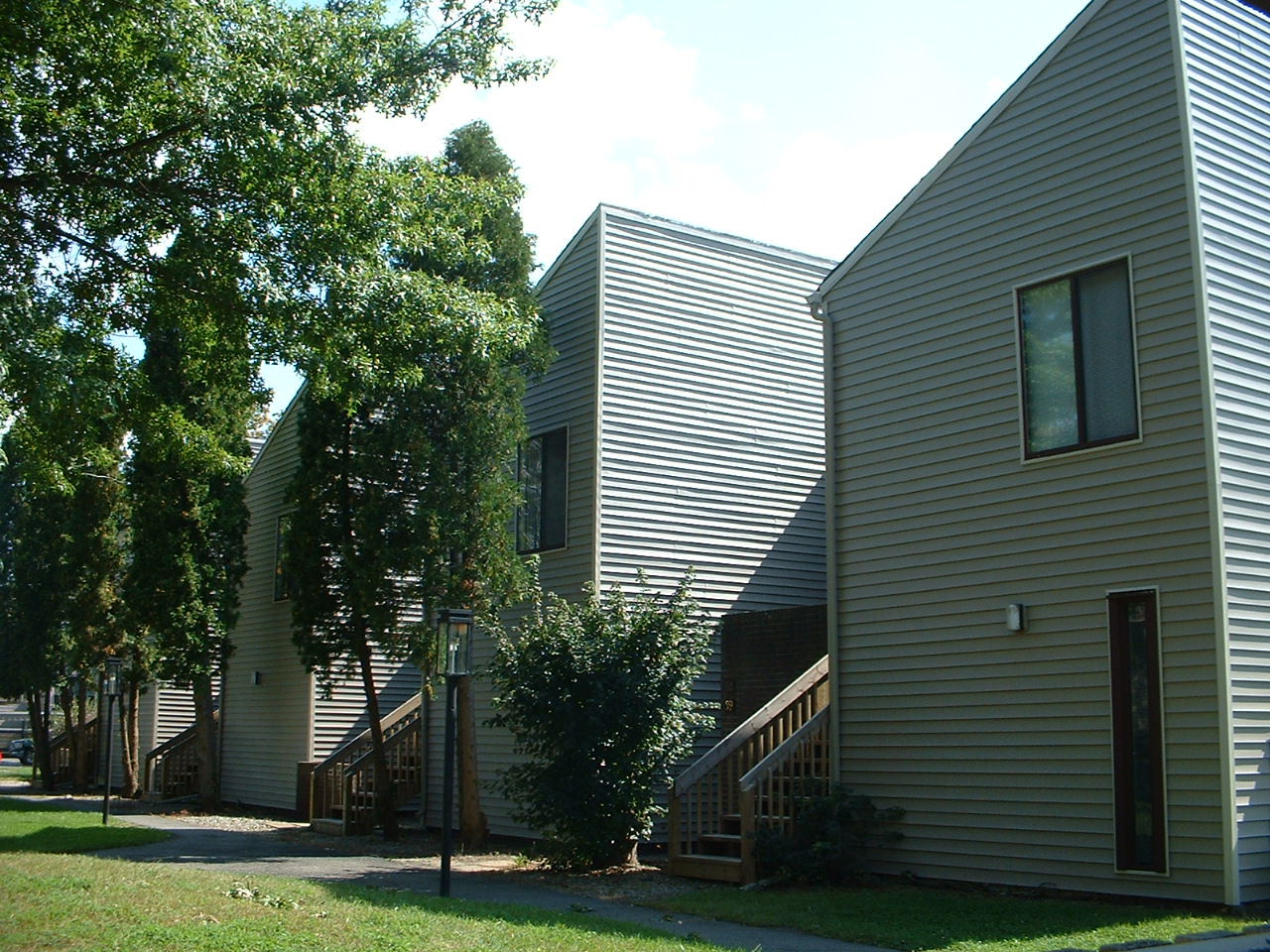
Apartment buildings in upstate New York, September 2006. Photo: Stilfehler / Wikimedia Commons (public domain). Illustrative, not a photograph of the Portland market discussed.
Defining Wage Plateau
Wage plateau refers to the prolonged stagnation of real (inflation-adjusted) wages despite rising productivity and economic growth
From 1979 to 2019, the decent-pay employment share for all workers declined from 60.4% to 54.9%—but this masks devastating declines for specific demographics (Howell, 2025)
Young men (18-34) without college degrees saw decent-pay rates collapse from 58.8% to 28.2%
Middle-pay jobs increasingly shifted from the "lower tier of decent-pay" to the "upper tier of low-pay" category
The federal minimum wage, had it maintained its late-1960s purchasing power, would be approximately $12.50—instead it remains at $7.25 (Howell, 2025)
The wage plateau represents a structural feature of post-1979 American capitalism, not a temporary aberration. As Howell (2025) documents, while the overall share of middle-pay jobs remained stable, their quality deteriorated markedly. The composition of middle-pay jobs shifted away from the lower tier of decent-pay segment (declining from 26.8% to 22.5% of all employment) toward the upper tier of low-pay segment (increasing from 13.2% to 18.6%). This means workers in nominally "middle" jobs experienced declining real living standards. The mechanisms driving this plateau include: the decline in union membership (from 24% to 8.8% for young less-educated men between 1983 and 2014), the erosion of the minimum wage's real value, and the rise of monopsony power where employers face little competition for workers (Howell, 2025). Critically, this wage stagnation occurred despite substantial educational upgrading—the share of young non-college workers with "some college" increased from 35.5% to 49.7% over this period, proving that skills deficits alone cannot explain the plateau.
Cost of Living as a Function of Artificial Inflation and Wage Plateau
Index = [P_essentials × (1 + Π)] / [W × (1 + g_w)]
Where: P_essentials = baseline price level of essential goods and services; π_artificial = artificial inflation rate (price increases beyond supply-demand fundamentals); W = baseline wage level; g_w = real wage growth rate.
The index above is a conceptual illustration from the original presentation, not an official or independently validated measure. Its inflation and wage-growth definitions require consistent units before quantitative use.
Alternative Residual Income Measure
Burden = Income − housingCosts − ∑NonHousingNecessities
When Burden < 0, household faces "residual income cost burden".
This formula synthesizes the two primary forces eroding American purchasing power. The numerator captures the artificial inflation dynamic: corporations with pricing power raise prices beyond what competitive markets would permit, while the denominator reflects stagnant compensation. Purchasing power declines—a condition that has characterized the American economy for most of the post-1979 period.
Empirical validation comes from the residual income burden approach, (Airgood-Obrycki et al., 2025). Their measure subtracts both housing costs and estimated non-housing necessities (food, transportation, healthcare, childcare, taxes) from household income. A household is "burdened" if the remainder is negative. In 2023, 65.1% of working-age renter households failed this test—meaning their incomes could not cover basic expenses even before any discretionary spending. The average renter household fell short by approximately $6,000 annually, with those making under $15,000 needing about $43,000 in additional income or subsidy to reach a modest standard of living.
The gap between these measures and official inflation statistics stems partly from methodological choices: the Consumer Price Index removed mortgage rates in 1983 and car financing rates in 1998, excluding the rising cost of money from measured inflation (Summers, Bolhuis, & Cramer, 2024). An alternative CPI measure including these costs shows both higher peak inflation and continued elevated inflation throughout 2023.
Systemic Consequences of the Affordability Crisis
The cost of living crisis is not a natural market outcome but a policy-driven phenomenon resulting from deliberate choices about corporate governance, labor law, and social provision
Artificial inflation and wage plateau are two sides of the same coin: both stem from the erosion of worker bargaining power and the concentration of corporate pricing power
The consequences extend beyond economics into public health and social reproduction:
• A growing share of households without running water live in urban areas • The author cites racial disparities in water access in major US cities • Housing unaffordability can contribute to plumbing poverty
The racialized nature of these outcomes demands particular attention. In Portland, Oregon—"the whitest large city in the United States"—the number of people of color without household running water more than doubled from 1,800 to 4,700 between 2000 and 2021 (Meehan et al., 2024). Black Portlanders saw their share of those without water access quadruple. These disparities reflect not individual choices but structural racism embedded in housing markets, labor markets, and public infrastructure investment.
Addressing this crisis requires moving beyond incremental policy adjustments. As Airgood-Obrycki et al. (2025) demonstrate, universal housing subsidies capping rent at 30% of income would reduce residual income burdens by only 1.3 percentage points—because the problem extends beyond housing costs to inadequate incomes overall. A $500 monthly allowance would achieve a 7.3 percentage point reduction, while $1,000 monthly would reduce burdens by 15.2 percentage points. These findings underscore that flexible, generous income supports—combined with policies that restrain artificial inflation and restore wage growth—offer the most promising path toward an economy where work actually enables a decent standard of living.
Sources and editorial context
This guest analysis is adapted for reading from Alden Friend’s original 12-page presentation. The argument and substantive passages remain the author’s. Numerical comparisons reflect the cited studies and should be checked against the linked research; the corporate-law and illustrative-formula qualifications above are editorial context.
Airgood-Obrycki, W., Hermann, A., & Wedeen, S. (2025). *The Rent Eats More: Residual Income Housing Cost Burdens from 2019-2023*. Joint Center for Housing Studies, Harvard University.
Howell, D. R. (2025). *Basic Needs and the American Paycheck: New Indicators of Pay Quality and Group Disparities, 1979-2019*. Working Paper Series Number 626.
Meehan, K., Jurjevich, J. R., Everitt, L., Chun, N. M. J. W., & Sherrill, J. (2024). Urban inequality, the housing crisis and deteriorating water access in US cities. Nature Cities, 1, 1-11.
Summers, L., Bolhuis, M., & Cramer, J. (2024). The True Cost of Living. Finance & Development, 61(4), 24-27.
Weil, D. (2017). Income Inequality, Wage Determination, and the Fissured Workplace. In H. Boushey et al., After Piketty (pp. 209-232). Harvard University Press.
Research: Harvard Joint Center for Housing Studies — https://www.jchs.harvard.edu/research-areas/working-papers/rent-eats-more-residual-income-housing-cost-burdens-2019-2023
Research: IMF Finance & Development — https://www.imf.org/en/publications/fandd/issues/2024/12/the-true-cost-of-living-marijn-bolhuis
Research: Nature Cities — https://www.nature.com/articles/s44284-024-00180-z
Research: UMass PERI — https://peri.umass.edu/publication/basic-needs-and-the-american-paycheck-new-indicators-of-pay-quality-and-group-disparities-1979-2019/
Image credits: USDA / Wikimedia Commons — https://commons.wikimedia.org/wiki/File:20250219-USDA-FNS-UNK-0006_(54498997849).jpg ; Lance Cheung / USDA — https://commons.wikimedia.org/wiki/File:110303_CNPP_LSC_0311_(13065496414).jpg ; Stilfehler — https://commons.wikimedia.org/wiki/File:Apartment_Complex_USA_1.JPG


Comments