Free Ecuador: Glas alleges prison beating as Noboa tightens grip on opposition ahead of November vote

PAMPHLETS | ECUADOR | FREE ECUADOR | NOVEMBER 18, 2026
A former vice president says soldiers assaulted him inside Ecuador's highest-security prison. The main opposition party is suspended before a crucial local election, its most recent presidential nominee has been arrested, and rights groups warn that the security crackdown is corroding constitutional safeguards. Taken together, these are not isolated controversies. They raise a fundamental question: is Ecuador's state protecting democracy, or narrowing the space in which it can survive?
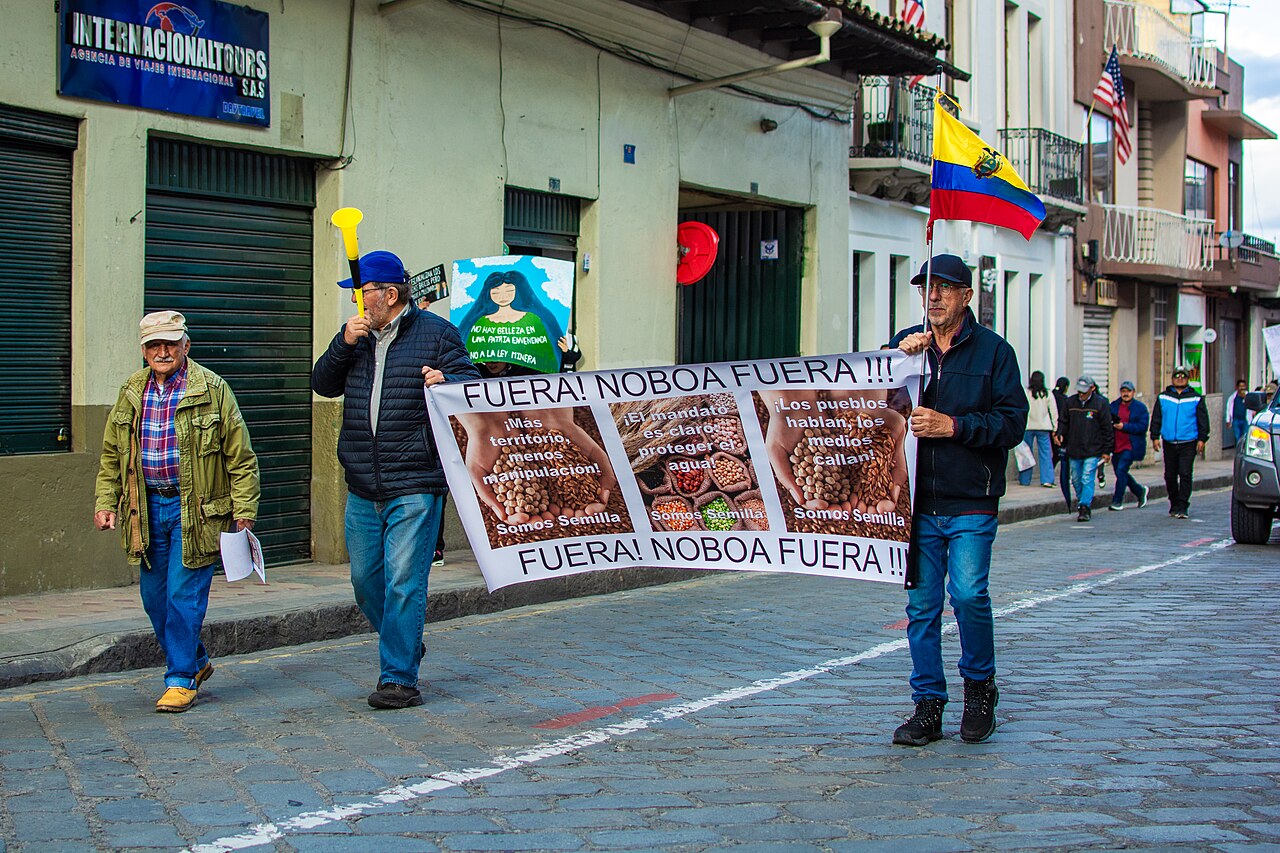
ARCHIVE PHOTO: March 13, 2026 demonstration in Cuenca, Ecuador. Photograph: Martín Vasco / Wikimedia Commons (CC BY-SA 4.0). Used to illustrate opposition protests, not the November 2026 prison incident.
QUITO — Jorge Glas, Ecuador's former vice president, alleges that military personnel beat, kicked and dragged him at the El Encuentro prison on November 11. In excerpts of a video conversation shared by his lawyer Sonia Vera on November 17, Glas described the assault and showed bruising. Vera says a physician counted 37 bleeding wounds the following day. The number, the cause of each injury and the circumstances of the alleged assault have not been independently established by Pamphlets.
37 injuries alleged — not 37 stabbings
The circulating claim that Glas was 'stabbed 37 times' goes beyond the available evidence. Reporting by EFE and Ecuadorian outlets attributes a count of 37 bleeding injuries to Glas and his legal team; it does not establish 37 knife wounds. That distinction must not obscure the seriousness of the allegation.
Vera says prison records categorized the episode as 'self-injury' and that an official medical note failed to record the extensive bruising she says was visible. Glas alleges officers used political insults as they assaulted him. His defense also reports threats against his life and demands urgent medical protection. La Hora reported on November 18 that Ecuador's prison authority had not yet issued a public explanation of the new allegations. An independent examination, preservation of prison footage and an impartial investigation are essential.

ARCHIVE PHOTO — Jorge Glas in 2015. Micaela Ayala / Agencia de Noticias ANDES, CC BY-SA 2.0, via Wikimedia Commons. This is not a photograph of the alleged November 2026 injuries.
An opposition under pressure before the ballot
The story extends far beyond one cell. On October 22, police arrested Luisa González, the left-wing presidential candidate who twice lost runoffs to President Daniel Noboa. Prosecutors are investigating alleged irregularities in financing her 2023 campaign. González and her allies dispute the accusations, describing the case as political persecution; the investigation itself is not proof of guilt, nor is an allegation of persecution proof that prosecutors acted improperly.
In March 2026, Ecuador's Electoral Dispute Tribunal imposed a nine-month suspension on Revolución Ciudadana, the country's largest opposition party, preventing it from fielding candidates in the November 29 local elections. A Congressional Research Service report says the Inter-American Commission on Human Rights called in August for fair political participation. More than 5,000 provincial, municipal and local offices are due to be contested. An election can be held on schedule and still face serious questions about whether voters have been given a fair choice.
In a November 6 letter to Secretary of State Marco Rubio, U.S. representatives including Jesús 'Chuy' García, Greg Casar and Jonathan Jackson described rising authoritarianism in Ecuador and called for U.S. security cooperation to be suspended pending restoration of democratic guarantees. Their language is an explicit political assessment, not a court finding; its significance is that concerns about the opposition's treatment have reached Washington as well as human-rights organizations.
Emergency rule cannot replace the rule of law
Ecuador faces a genuine, devastating organized-crime emergency. Gangs have fought over drug-trafficking routes, ports and prisons, and homicides have climbed sharply. Noboa says his security measures are needed to restore public order and denies that his government is becoming authoritarian. Those realities must be acknowledged. They do not grant soldiers the right to mistreat detainees, nor any president the right to determine which political parties can meaningfully compete.
Human Rights Watch's World Report 2026 documented allegations of enforced disappearances, arbitrary detentions and ill-treatment by security forces during 2025. It also reported government pressure on the Constitutional Court and obstacles facing independent civic organizations. Ecuador's Constitutional Court struck down parts of Noboa-backed security legislation; voters rejected proposed changes concerning foreign military bases and a new constitution in November 2025. These are surviving checks on executive power — and reasons to defend their independence.

ARCHIVE PHOTO — President Daniel Noboa, October 2025. Presidencia de la República del Ecuador, via Wikimedia Commons (public-domain mark).
Glas, the embassy raid and the state's obligations
Glas has been convicted in corruption cases and maintains that he is politically persecuted. Accountability for corruption matters; it is not suspended because an official is aligned with the left. But punishment must be lawful, and conviction never extinguishes a prisoner's rights to physical safety, healthcare and due process.
His detention also carries a diplomatic history. In April 2024, Ecuadorian police entered Mexico's embassy in Quito to arrest him after Mexico had granted him asylum, triggering a major dispute over diplomatic inviolability. The new allegations from El Encuentro should be considered against that history, along with the protective measures for Glas cited by his counsel from Inter-American human-rights bodies.
What Free Ecuador must mean
Free Ecuador cannot mean immunity for favored politicians or automatic innocence for anyone who opposes Noboa. It means protection from torture and abuse for every prisoner; independent courts; open media and civic organizations; and a genuine right for opposition parties to contest elections. The government should promptly disclose the November 11 incident records, preserve available video and medical evidence, allow independent clinical assessment and investigate any official implicated without interference.
The urgency is immediate: the November 29 election is approaching, and a prisoner's safety cannot be postponed until after the votes are counted. The measure of a democracy is not how powerfully its president speaks about security. It is whether the law also protects the people that president most wants to defeat.
Sources and reporting notes
EDITORIAL NOTE — Published November 18, 2026. Allegations of an assault, the reported injury count and claims of political motivation are attributed to their sources, not presented as independently adjudicated facts. The site will update the report if an official response, medical examination or investigative finding becomes available.


Comments