


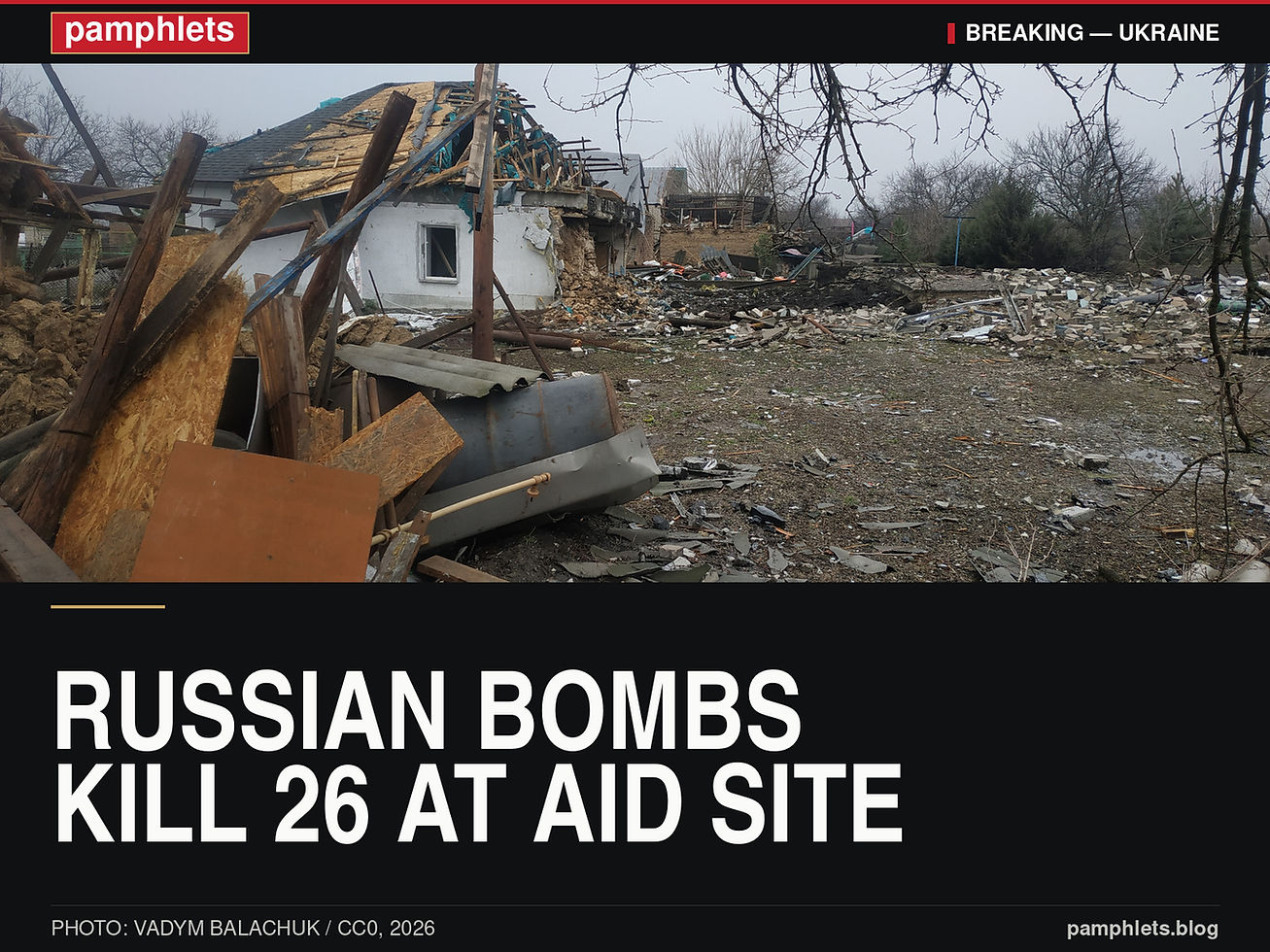
Russian Bombs Kill 26 at Ukrainian Aid Center and Shelter

Russian forces bombed a humanitarian aid distribution point and a neighboring shelter in southern Ukraine on Monday, killing at least 26 people, Ukrainian officials said. The strike hit Komyshuvakha, a frontline settlement in the Zaporizhzhia region, as residents gathered for a weekly aid delivery.
President Volodymyr Zelenskyy said aircraft first struck a school used to distribute assistance and then dropped more bombs on the nearby shelter where people had taken cover. The Associated Press reported that roughly 20 people were initially listed as missing and that renewed drone attacks complicated rescue work. AP said it could not independently verify the Ukrainian account.
Ukraine’s emergency service said two rescue workers and four police officers were among the dead. Five people remained hospitalized, including two rescuers, according to AFP. The service named the two killed rescuers as Denys Konovalenko and Oleksii Sushchevskyi, both 44. They had spent years responding to attacks in a region where the front has repeatedly moved through civilian communities.
Zelenskyy called the bombing “further proof that Russia wants no de-escalation.” His government said at least 10 guided aerial bombs struck the area during the sequence. RTÉ’s account said the president described an initial attack followed by nine more bombs directed at the shelter.

Image source and licence: National Police of Ukraine via Wikimedia Commons · CC BY 4.0.
Russia had not immediately commented on the Komyshuvakha strike. Moscow routinely says its forces attack military targets, while Ukrainian authorities and international investigators have documented extensive civilian harm from Russian missiles, bombs and drones. Without independent access to the site, the precise sequence and intended targets require further verification. The civilian location, casualty count and repeat-strike allegation make that scrutiny urgent.
The attack landed hours after a rare, six-day humanitarian ceasefire expired around Oleshky in neighboring Kherson. That pause allowed nearly 800 people to leave the Russian-occupied town, according to the White House. Pamphlets covered the truce as a narrow agreement that relieved civilians without stopping the wider war.
Ukraine’s general staff later accused Russia of using the Oleshky pause to rotate troops, reinforce defenses and improve logistics. Kremlin spokesman Dmitry Peskov told Reuters that repositioning during a ceasefire was standard practice and suggested Ukraine may have done the same. Both sides said they fulfilled the humanitarian terms. That distinction matters: the local truce succeeded in moving civilians, but it never became a general ceasefire.
Komyshuvakha lies about 20 kilometers from the front and has endured repeated Russian air attacks. Guided bombs let aircraft strike from beyond the reach of many short-range air defenses. Their destructive radius becomes especially lethal in settlements where aid points, schools, shelters and emergency services occupy the same limited civilian space.
The broader toll has accelerated. The United Nations Human Rights Monitoring Mission verified 328 civilians killed and 2,105 injured across Ukraine in September, an 85 percent increase from September 2025. It recorded civilian casualties across 22 regions and warned that intensifying attacks on energy infrastructure would deepen hardship as winter approached.
Monday’s strike therefore carries weight beyond one devastated village. It hit the infrastructure civilians use to survive and the people assigned to reach them after an attack. If the reported repeat strike deliberately targeted a shelter or rescuers, investigators will need to preserve evidence and determine responsibility under international humanitarian law.
The Oleshky operation proved that Russia and Ukraine can suspend fire long enough to move vulnerable people when mediators secure a narrow agreement. Komyshuvakha exposed the opposite reality: a humanitarian corridor in one district offers no safety to civilians in the next. Peace diplomacy will remain hollow unless it constrains the weapons killing people while they queue for aid.
Sources
Associated Press: Komyshuvakha bombing and casualty report · AFP: emergency-service details and truce context · Reuters: Oleshky ceasefire and competing military claims · United Nations: September civilian-casualty update
V9 card photograph: Komyshuvakha after a January 31, 2026 air attack, photographed by Vadym Balachuk · CC0 1.0. FILE photograph; cropped for the locked V9 card.


Comments