
South Africa’s Hung Councils Push Rivals Into Coalition Talks

File photograph · 31 March 2018. Johannesburg’s central business district skyline. Photograph by Khaanya96, CC BY-SA 4.0, via Wikimedia Commons. Cropped by Pamphlets. This archive image does not show the November 2026 coalition talks.
South Africa’s major parties opened coalition talks on Sunday, November 15, after local elections left many councils without an outright majority. The African National Congress held meetings with ActionSA, the Inkatha Freedom Party, uMkhonto weSizwe and Build One South Africa, while the Democratic Alliance also entered talks as councils faced a 14-day deadline to constitute themselves. SABC reported the talks as parties began converting a fragmented November 4 vote into workable local governments.
The IEC declared the November 4 elections free and fair on November 8. Its chair reported 52% national turnout. The same published declaration gave rounded totals of 14.9 million voters and 29.2 million registered voters, which imply about 51%; those figures do not reconcile. Both the published IEC speech and SAnews’s account place the ANC first nationally, followed by the DA, MK and EFF, but their party percentages and seat totals differ. We therefore do not present those conflicting figures as a reconciled tally.
Clarification, 15 November 2026: We have qualified the council and turnout figures because the published sources use conflicting counts. We have not inferred a replacement final total.
Those totals gave no single organization a national mandate to decide the shape of local government alone. They instead produced dozens of separate bargaining arenas, each with its own arithmetic and public obligations. The result is a sharp warning to the ANC, which recorded its weakest municipal showing, but it is not a blank cheque for any rival to divide councils as patronage.
A map voters fractured
The negotiations are most consequential in the metropolitan councils that command large budgets and serve millions of residents. The Associated Press reported that the DA outpolled the ANC in Johannesburg and Tshwane, while MK emerged as the largest party in eThekwini with just over 38% of the vote. No party, however, can govern those cities alone. Ekurhuleni and other councils present similarly fractured mandates.
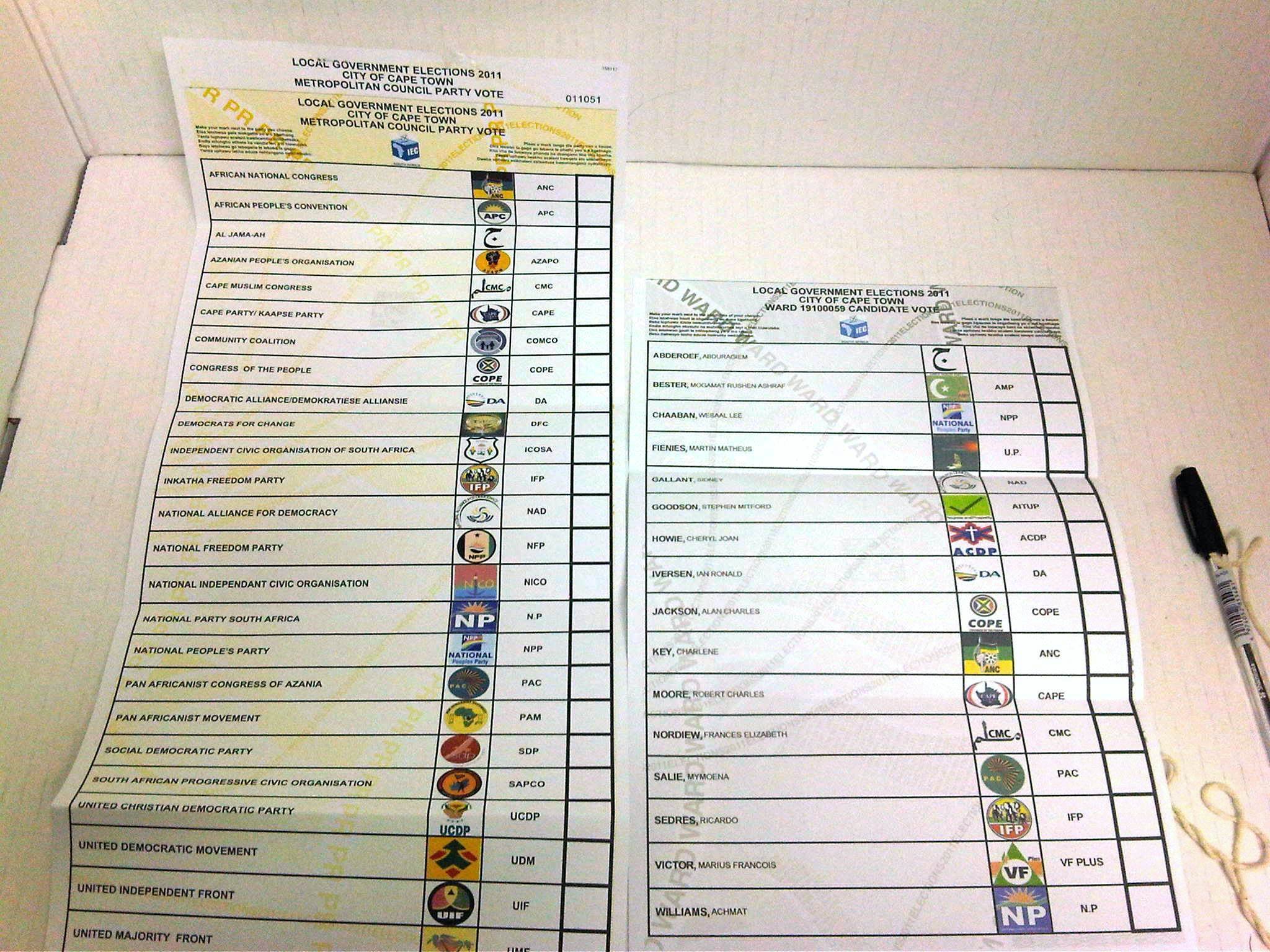
Contextual archive: two ballot papers from South Africa’s 2011 municipal election. Photo by Discott, 18 May 2011, CC BY-SA 3.0, via Wikimedia Commons.
Coalition bargaining will therefore turn on more than ideological labels. It will decide which parties control mayoral committees, budgets and oversight, and whether local administrations can keep operating while rivals negotiate. A coalition that is arithmetically possible may still be politically unstable; a stable agreement may still fail residents if it protects offices instead of services.
The test is service, not spoils
The ANC said in its official post-election statement that it would negotiate in good faith, avoid secret carve-ups and prioritize water, electricity, refuse removal and safety. Those promises establish a useful public test. Coalition agreements should be published, responsibilities should be explicit, and residents should be able to see which party accepted which commitments before councils elect their leadership.
The bargaining is also exposing the limits of national-level shortcuts. Daily Maverick reported that ANC officials had ruled out a countrywide stability pact with the DA even as the two parties formally opened discussions. That account should be read as reported political positioning, not as a final settlement: multiple bilateral talks were continuing, and each council still requires a locally viable majority.
South Africa’s municipal fragmentation matters beyond party headquarters. Local councils govern the infrastructure on which working-class communities and wider development plans depend. Pamphlets recently examined the country’s new South Africa–China artificial-intelligence talent centre; projects like that ultimately rely on functioning cities, public utilities and accountable local institutions.
The election has forced rivals into the same room. Whether that produces durable government will depend on transparent agreements and measurable improvements, not the number of meetings party leaders announce. Voters fractured municipal power; the burden is now on the parties to show that coalition can mean shared responsibility rather than shared spoils.
Hero photograph: Johannesburg CBD skyline, photographed by Khaanya96 on 31 March 2018, CC BY-SA 4.0, via Wikimedia Commons. Contextual archival image.


Comments