


U.S. and Japan Lock In Missile Factory as Pacific Arms Race Accelerates

The United States and Japan are turning their military alliance into a production line. On Wednesday, October 28, the two governments agreed to establish a final assembly and inspection facility in Japan for the AIM-120 Advanced Medium-Range Air-to-Air Missile, embedding one of Washington’s most important weapons directly inside Japan’s industrial base.
Japanese Defense Minister Shinjiro Koizumi announced the agreement after meeting U.S. Defense Secretary Pete Hegseth at the ASEAN Defence Ministers’ Meeting-Plus in Cebu, Philippines. Japan’s Defense Ministry said the deal forms part of “Operation Supercharge,” a wider drive to accelerate bilateral weapons production and technology sharing. The ministers also agreed to exchange technical information aimed at increasing production of the SM-3 Block IIA interceptor.
Koizumi called the new AMRAAM facility essential for the F-35 fighter and said it would strengthen Japan’s defense-industrial base. The agreement goes beyond buying American weapons. It makes Japan a manufacturing node in a U.S.-led missile network and ties Japanese factories, engineers and budgets more tightly to Washington’s long-term military planning.
The facility’s location and construction timetable remain undisclosed. But the Associated Press reported that Koizumi and Hegseth agreed to strengthen the alliance’s “deterrence and response capabilities” with greater speed and intensity. Koizumi said the two governments shared a sense of crisis over the regional security environment, while insisting their talks did not target any single country.
That denial cannot hide the strategic map. Washington and Tokyo routinely frame China’s military rise and maritime claims as the central threat in the western Pacific. The United States is expanding military access across the region; Japan is revising its strategic documents, building what it calls “denial defense,” enlarging exercises and increasing deployments in its southwestern islands. China, meanwhile, describes the U.S. alliance system as containment and has expanded its own missile, naval and air capabilities.
This is how an arms race hardens: each government presents its buildup as defensive while treating the other side’s buildup as proof that more weapons are necessary.
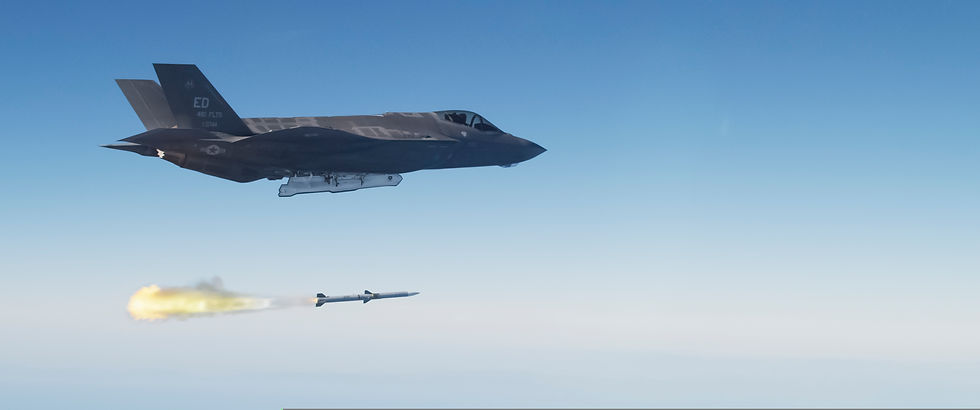
The missile itself matters. AMRAAM is the principal beyond-visual-range air-to-air weapon used by U.S. fighters and many allied aircraft. Its newest variants combine longer reach, improved guidance and stronger resistance to electronic warfare. Japan already operates the F-35, making a domestic assembly and inspection line both a supply-chain project and a war-planning asset.
Air & Space Forces Magazine reported that the agreement follows a Pentagon production contract worth as much as $20.7 billion over seven years. The current framework aims to raise annual AMRAAM output to at least 1,900 missiles. Production had previously struggled with long lead times, component bottlenecks and shortages of solid rocket motors.
Those numbers reveal the scale of the shift. Governments are no longer purchasing weapons for a temporary emergency. They are reorganizing industry for sustained, high-volume production. A factory built today will lobby for orders tomorrow, while the workers, suppliers and public funds attached to it make military expansion harder to reverse.
Japan’s role carries a deeper political charge. Its postwar constitution renounced war, and for decades Tokyo maintained tight restrictions on arms exports and overseas military activity. Successive governments have weakened those barriers. Establishing a joint missile line does not formally erase Article 9, but it moves Japan further from the economic and political restraints that once separated self-defense from participation in a regional weapons system.

The agreement may also deepen dependency. Tokyo gains production capacity and access to classified technology, but the weapon remains embedded in a U.S.-designed platform, supply chain and targeting architecture. Industrial participation does not automatically mean strategic autonomy.
Hegseth told Southeast Asian defense ministers that Washington’s posture would be “strong, quiet and clear”—strong enough to deter aggression without unnecessary escalation. Yet missile factories are not quiet signals. They are durable commitments that shape budgets and strategy long after a summit ends.
The Pacific does not need another automatic march toward confrontation. Regional governments face real territorial disputes and security fears, but a production race can make diplomacy more difficult by rewarding permanent tension. The U.S.–Japan deal will be sold as protection. Its larger consequence may be to make the next military crisis easier to supply—and harder to stop.

Comments