


U.S. Marine Indicted in Okinawa Killing as Island Demands Accountability

Japanese prosecutors have indicted a U.S. Marine over the killing of Anna Yagi in Okinawa, turning a case that has shaken the island into a direct test of whether Japan can deliver justice where American military power has long shaped daily life.
The Naha Public Prosecutors Office indicted Lance Cpl. Devin Jacob Ballard, 20, on Sunday, October 25, on a charge of robbery causing death. Reuters described the charges as robbery and murder. Ballard, stationed at Marine Corps Air Station Futenma, has denied the allegations. An indictment is an accusation; a Japanese court will determine guilt.
The indictment alleges that Ballard wrapped a telephone handset cord around Yagi’s neck at a hotel in Naha in the early hours of October 3, strangled her “with intent to kill,” and stole her backpack, wallet and other belongings. Yagi was 39. Police arrested Ballard the following day.
That formal charge matters because it moves the case beyond statements of concern and internal military discipline. Japanese prosecutors now control the criminal proceeding. If convicted under the charge described by Stars and Stripes, Ballard could face life imprisonment or the death penalty.
III Marine Expeditionary Force said it would continue cooperating with Japanese authorities as the legal process proceeds. That promise is necessary, but Okinawans have heard similar assurances after earlier crimes involving U.S. personnel. The island’s response shows that many residents no longer accept cooperation after tragedy as a substitute for structural accountability before it.
Prime Minister Sanae Takaichi condemned the killing as brutal after Ballard’s arrest. Tokyo lodged a formal protest with Washington and demanded full cooperation, tighter discipline and measures to prevent a recurrence. Those demands have not contained the political damage.
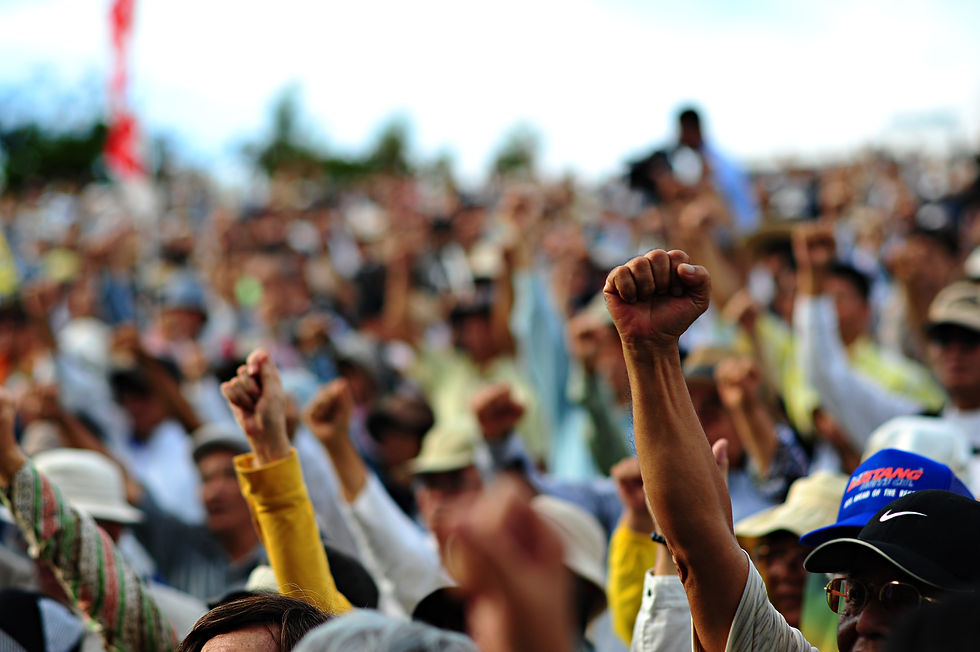
Photo source: Wikimedia Commons
The case triggered protests in Okinawa and Tokyo. Okinawa Governor Genta Koja and the prefectural assembly have renewed calls to review the Status of Forces Agreement, which governs the legal position of U.S. military personnel in Japan. The demand reaches far beyond one defendant: it challenges a system in which a small island carries an extraordinary share of the U.S. military footprint.
Okinawa hosts more than half of the roughly 50,000 U.S. service members stationed in Japan. Bases sit close to homes, schools and commercial districts. Futenma itself occupies dense urban land in Ginowan. That geography means decisions made in Washington and Tokyo enter the streets, airspace and private lives of Okinawan residents every day.

Photo source: Wikimedia Commons
The U.S. command answered the arrest with restrictions. Lt. Gen. Benjamin Watson imposed a 5 a.m.-to-midnight curfew for U.S. troops on Okinawa through November 8. Junior personnel at Kadena Air Base face an alcohol ban and overnight confinement to base. Troops participating in Keen Sword, a major exercise involving about 56,000 U.S., Japanese and partner-nation personnel, also face limits on drinking and off-duty outings.
But curfews expire. Commanders rotate. The base structure remains.
That is the contradiction Okinawa’s movement keeps exposing. The U.S.-Japan alliance presents the island as a strategic platform near Taiwan and China; residents experience it as a permanent concentration of land use, aircraft noise, environmental risk and recurring violence. The 1995 rape of an Okinawan schoolgirl by three U.S. servicemen produced mass protests. Three decades later, another family is grieving and another round of official assurances has begun.
The current prosecution must remain focused on evidence and due process. Collective blame cannot replace individual responsibility. Yet the political consequences cannot be reduced to one courtroom. A system that concentrates military power in a civilian community also carries a duty to answer that community’s democratic demands.
For Okinawa, accountability now has two levels. Japan must prosecute Anna Yagi’s killing without fear or favoritism. Tokyo and Washington must also confront why residents still bear a burden imposed in the name of security but rarely negotiated on equal terms. Anything less will turn the latest promises of prevention into another entry in a long archive of broken trust.
Sources: Reuters; Stars and Stripes; The Washington Post.


Comments