


Washington Curbs Intelligence Sharing as Seoul Alliance Frays

SEOUL — A month-long parliamentary audit has forced hidden strains in the South Korea–United States alliance into public view. The record now includes curtailed access to sensitive intelligence, complaints about blocked White House channels and visa delays for Korean lawmakers. Together, those disclosures describe more than a diplomatic squabble: Washington is changing what it wants from the alliance.
The most serious rupture concerns intelligence. National Intelligence Service director Lee Jong-seok acknowledged that the United States restricted some sensitive sharing after Washington accused Unification Minister Chung Dong-young of publicly identifying a previously unconfirmed nuclear site in the Democratic People’s Republic of Korea. South Korean military officials have declined to detail the material affected.
Seoul’s intelligence service pushed back against reports of a sweeping cutoff. It said the restriction covers only certain information and that the overall volume of intelligence received from the United States has not fallen. Joint Chiefs of Staff chair Jin Yong-sung likewise told lawmakers the limits had not weakened military readiness, though he said Seoul wanted them lifted quickly.
That distinction matters. A selective restriction is not the collapse of the alliance, but intelligence is the nervous system of joint military planning. Once one government begins rationing what the other can see, every future crisis raises the same question: who controls the information, and whose political priorities decide when it moves?

The audit exposed pressure elsewhere. South Korea’s ambassador in Washington acknowledged limited access to senior White House officials. Two prominent lawmakers said their visas were not issued in time for official visits. These incidents would be minor in isolation; alongside the intelligence dispute, they reveal a relationship being renegotiated through bureaucratic pressure as well as summit diplomacy.
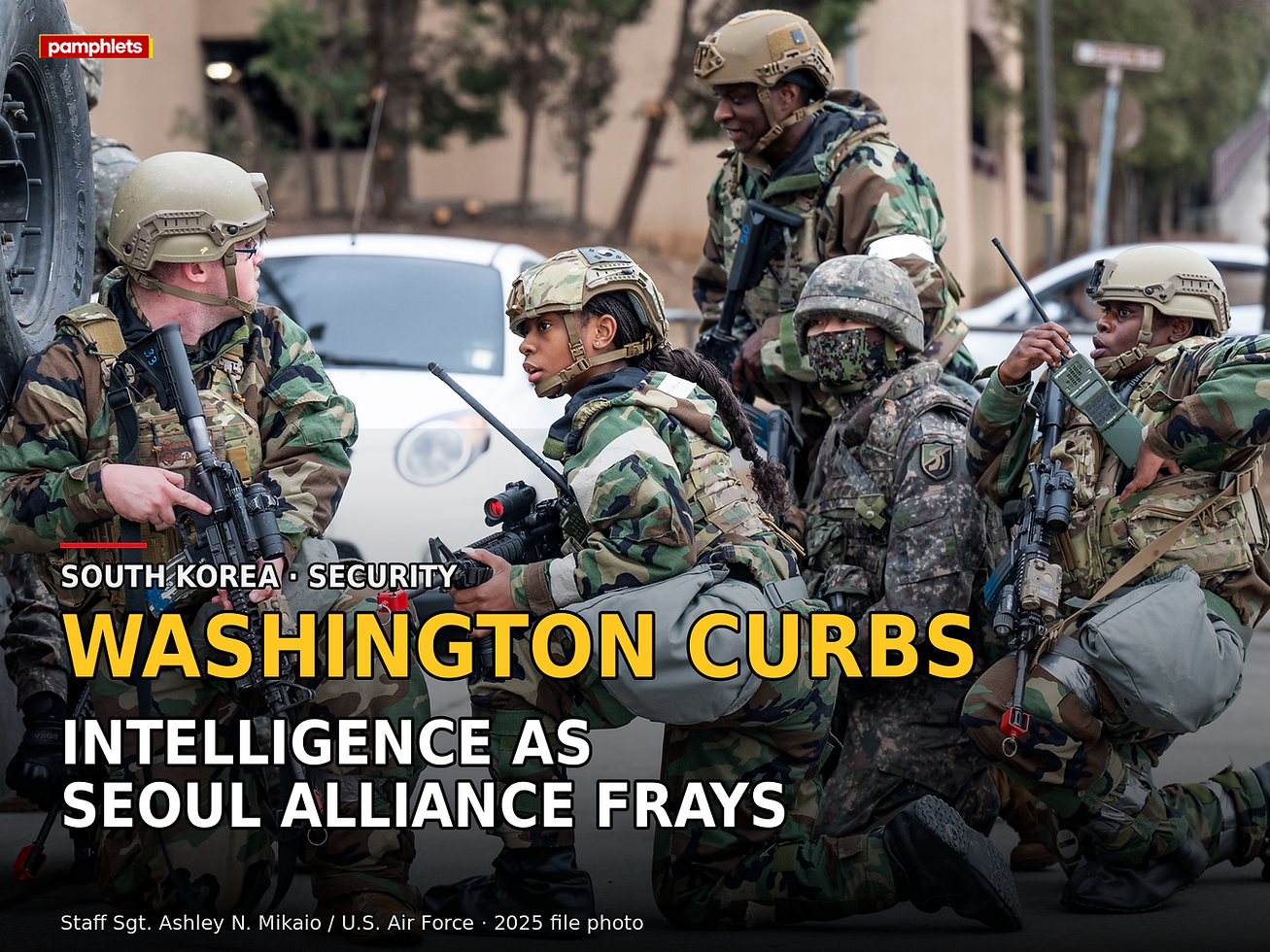
Washington’s strategic shift supplies the larger context. The United States still stations 28,500 troops in South Korea and says their central task remains deterring conflict on the peninsula. Yet U.S. officials increasingly demand “flexibility” to deploy forces against wider regional contingencies, including a possible confrontation involving Taiwan and China.
That change places Seoul in a difficult position. South Korea built the alliance around the defense of the peninsula, not automatic participation in every U.S. military project across East Asia. A mission that expands without a democratic mandate risks turning Korean territory into infrastructure for conflicts the Korean public did not choose.
Officials on both sides insist the foundation remains intact. Foreign Minister Cho Hyun answered U.S. Ambassador Michelle Steel’s description of the alliance as being in “turbulence” with a line meant to calm parliament: “When you’re in a turbulence, fasten your seatbelt and it won’t be a problem.” Defense Minister Kang Shin-chul separately said U.S. Defense Secretary Pete Hegseth dismissed reports of a serious rupture as “fake news.”
The reassurances cannot erase the underlying dispute. The alliance now sits at the intersection of Korean sovereignty, U.S. competition with China, trade demands and domestic politics in both countries. Pressure for higher defense spending and broader troop missions will survive any single election in Washington because it reflects a durable shift in U.S. strategy.
Public opinion is already registering the cost. A Pew survey published in August found 55 percent of South Koreans held an unfavorable view of the United States, the highest level in more than two decades. Anger also intensified after hundreds of South Korean workers were shackled during a U.S. immigration raid at a Georgia battery project last year.
President Lee Jae Myung’s opponents blame his engagement-oriented approach toward the DPRK. That partisan charge cannot by itself explain Washington’s regional turn. The more consequential fact is that U.S. planners increasingly view the alliance through a China-centered lens, while Seoul must still manage peace, deterrence and economic ties on the peninsula.
The next test is practical: whether full intelligence sharing returns, whether Korean officials regain reliable access in Washington and whether any expanded regional mission for U.S. forces receives open debate in South Korea. Alliances endure through consent and clear obligations. If Washington treats strategic ambiguity as leverage, the turbulence will deepen no matter how tightly Seoul fastens its seatbelt.


Comments