Who Is Pedro Alliana? Paraguay’s New President After Peña’s Ouster

The man inheriting Paraguay’s presidency was already under scrutiny before his predecessor fell. Pedro Alliana takes office as Santiago Peña is removed over the Ueno Bank crisis—but the new president faces his own controversies: a high-paid public appointment for his daughter, allegations from party workers that social-security deductions were not paid, admitted contacts with a legislator at the center of a major influence scandal, and an impeachment complaint alleging he helped shield financial decisions from scrutiny. Alliana disputes wrongdoing in the matters he has addressed; the allegations are not convictions.
The patronage questions are concrete. Montserrat Alliana, the new president’s daughter, was appointed to a job in the Chamber of Deputies in 2023 without an open competition, receiving 18,274,300 guaraníes per month, according to public records reviewed by ABC Color. The appointment followed an earlier Justice Ministry position also reportedly obtained without competition. Alliana denied nepotism. A judge dismissed the complaint concerning alleged improper salary payments in July 2024; the appointment and its political controversy remain documented.
The workers’ allegations are just as revealing of the issues that followed his leadership of the ruling Colorado Party. In 2020, its employees filed a criminal complaint alleging that 9% social-security deductions were taken from paychecks but not delivered to the Instituto de Previsión Social, leaving staff unable to use health coverage. Their union also described pressure and changed working hours that it said could force resignations without severance. Reporting at the time quoted union representatives contrasting ordinary employees’ low wages with salaries exceeding 20 million guaraníes for people close to party leadership. Those are allegations by workers, not a judicial finding of personal guilt against Alliana.
There is also a record of political intervention that deserves careful examination. In February 2025, Alliana confirmed messages with the late Colorado Party lawmaker Eulalio “Lalo” Gomes and said he had contacted the deputy comptroller after Gomes complained about scrutiny of his asset declaration. Alliana denied using influence to protect him. The exchanges became public as journalists investigated Gomes’s connections across Paraguay’s institutions.
His policy positions are documented, too. Alliana defended efforts in 2023 to undo or rewrite a European Union education agreement opposed by conservative activists invoking 'gender ideology'. On October 8, 2026, he met Israeli Prime Minister Benjamin Netanyahu in Jerusalem; Israel’s government thanked Paraguay for support throughout the war, while Alliana publicly defended the relationship as a long-term strategic alliance despite its political cost. His background places him in the conservative Honor Colorado network associated with former president Horacio Cartes, not in an opposition movement promising to break that network.
The Ueno crisis now poses the most immediate test. Thirty-five lawmakers sought impeachment proceedings against both Peña and Alliana, alleging that the vice president helped provide legislative protection for decisions affecting public pension funds. On November 5, the lower house rejected the impeachment accusation against Alliana, 48 votes to 30. The Senate removed Peña the following day; prosecutors ordered Peña’s arrest, but an arrest order should not be confused with confirmation of physical custody. Alliana has now assumed the presidency through the constitutional succession process, not through a separate popular vote for president.
Who is Pedro Alliana, Paraguay’s new president?
Hércules Pedro Lorenzo Alliana Rodríguez, commonly called Pedro Alliana or “Mangui,” was born on February 19, 1974, in Pilar, the capital of Paraguay’s Ñeembucú department. The 52-year-old politician began his public career in regional politics, became governor of Ñeembucú in 2008, then served as a national deputy. He held the presidency of the Chamber of Deputies during several stretches of his legislative career.
His political importance extends well beyond his former title of vice president. Alliana previously led the governing Asociación Nacional Republicana (ANR), better known as the Colorado Party, from 2016 until 2023. He is associated with the party’s influential Honor Colorado faction and has longstanding ties to former president Horacio Cartes. In 2023 he ran alongside Santiago Peña on the winning presidential ticket, becoming vice president on August 15 of that year.

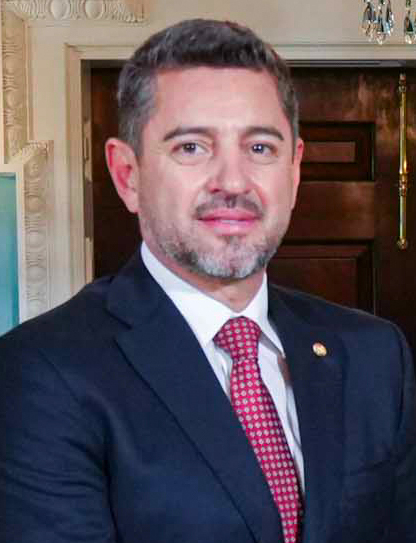
ARCHIVE · Pedro Alliana, August 2026. Freddie Everett / U.S. Department of State, public domain. Source: Wikimedia Commons.
Alliana’s formal accession matters because he is no opposition outsider brought in to dismantle the old government. He comes from the same party apparatus, legislative networks and Cartes-aligned political current that supported Peña. His first real test is whether he treats the bank collapse as a problem of public accountability, or principally as a crisis to be managed inside the ruling party.
Alliana’s conservative record: education, family policy and the Cartes political machine
Alliana's political record offers a much more precise picture than the suggestion that a new president necessarily means a political reset. He helped lead the conservative Honor Colorado movement and publicly defended a 2023 campaign to overturn a European Union education agreement amid claims that it could introduce so-called 'gender ideology' into Paraguayan schools. In August 2023 he said his side would honor a campaign promise to parents and seek to remove references to 'educational transformation' from the agreement.
The education-funding battle reveals an especially concrete part of Alliana’s record. The proposed repeal concerned European funding for Paraguay's public education system, reported at about $38 million. Alliana said his bloc would seek changes rather than accept language it believed threatened traditional family values. Critics challenged the underlying claims about 'gender ideology' and warned against sacrificing educational support over an ideological campaign. This was not merely an abstract campaign slogan: it was an attempt to change or scrap an international education accord.
In September 2023 Amnesty International separately warned that a proposed Paraguayan ban on teaching 'gender ideology' would conflict with the country's human-rights obligations. That warning concerned the broader legislative debate; it does not, by itself, establish that Alliana authored or sponsored that specific bill.
His political loyalties are equally important. In August 2026 Alliana described Horacio Cartes as his main political reference and stressed his personal loyalty to the former president. Cartes had been sanctioned by the United States in 2023 on corruption allegations, which he disputed. The Trump administration removed those U.S. sanctions in October 2025; it would be inaccurate to call him currently sanctioned. Alliana later publicly challenged the idea that Cartes could dictate the choice of his 2028 running mate, showing that loyalty and internal competition can coexist inside Honor Colorado.
Alliana also faced an impeachment proposal during the Ueno Bank crisis. Lawmakers rejected the effort against him by 48 votes to 30, and prosecutors opened inquiries that included complaints concerning the vice president and other officials. Neither a failed impeachment attempt nor inclusion in a complaint proves criminal wrongdoing. For a president inheriting a banking disaster, those facts nevertheless make scrutiny of his own conduct and his party's oversight record unavoidable.
The immediate test is observable, not rhetorical: how quickly depositors can use their savings, how transparently public pension exposure is accounted for, whether investigators can pursue officials regardless of party rank, and whether his education and social policies follow the conservative positions he previously defended.
Documents behind the scrutiny of Alliana
Why was Santiago Peña removed from office?
The immediate trigger was the seizure and resolution of Ueno Bank by Paraguay’s central bank after regulators found severe solvency problems. Ueno had grown into a major digital lender with roughly three million customers. Many were unable to withdraw funds, use cards or make ordinary payments when the intervention began. The bank also held substantial public money, including deposits connected to the national pension and health system.
Peña had previously held a financial interest in the group linked to Ueno’s ownership, a stake he said he sold in 2025. Legislators accused his administration of conflicts of interest, favoring the bank with public funds and failing to address mounting regulatory warnings. Those are allegations that require proof; political removal does not constitute a criminal conviction.

ARCHIVE · Santiago Peña, September 2024. Ecuadorian Presidency / Wikimedia Commons, public-domain-marked image.
On November 5, Peña announced his resignation, saying that stability and the protection of savers should come first. But lawmakers pursued impeachment rather than simply accepting his exit. A central dispute was whether accepting a resignation would allow him to become a lifetime senator and potentially benefit from parliamentary immunity. On November 6, the Senate voted to remove him, and prosecutors ordered his arrest in a breach-of-trust investigation. Peña denies wrongdoing and his lawyers have challenged the process.
What happened to the money at Ueno Bank?
The bank’s collapse left families and businesses uncertain about access to their own accounts. Reporting by the Associated Press put public deposits at more than $800 million, including hundreds of millions associated with the state pension and health fund. Regulators have described deposit insurance as covering the great majority of individual depositors, but the timing of repayments and the treatment of larger balances remain urgent questions.
This is why the scandal cannot be reduced to a fight among politicians. For workers, pensioners and small businesses, the issue is immediate: wages, pensions, bills and savings. Protests in Asunción brought that material damage to the center of a constitutional crisis.
Is Pedro Alliana implicated in the scandal?
He has faced scrutiny, too. On November 4, a group of 35 deputies submitted impeachment accusations against both Peña and Vice President Alliana. The allegations against Alliana involved his alleged role in defending the bank’s treatment by lawmakers and his response to warnings about public funds. The bid to impeach him did not succeed. Those claims are political allegations, not judicial findings of guilt.
His survival of that challenge made him the constitutional successor when Peña was removed. But it also means his government begins under scrutiny rather than with a clean break from the leadership that presided over Ueno’s rapid expansion.
How long will Alliana be president—and what happens next?
Under Paraguay’s succession rules, Alliana is expected to complete the presidential term that began in 2023, through August 2028. The next questions are who will become vice president, whether depositors regain reliable access to their funds, how far criminal inquiries extend, and whether investigators can examine the movement of public money without political interference.
The change in the presidency is real. A change in the political system is not yet established. Alliana inherits both the authority of the presidency and the governing coalition’s responsibility to explain what went wrong.
Pedro Alliana: quick answers
Who is Paraguay’s president now? Pedro Alliana was sworn in on November 6, 2026 after Santiago Peña’s impeachment.
Was Santiago Peña arrested? Prosecutors ordered his arrest on November 6; reports consulted at publication confirm the order, not the moment of physical detention.
What party does Pedro Alliana belong to? He belongs to the Colorado Party (ANR) and is linked to its Honor Colorado movement.
Why is Ueno Bank important? Its collapse froze access to deposits for millions of customers and raised questions about public-sector and pension money.
Additional reporting on Alliana's record
Sources and reporting
Photography: Pedro Alliana, U.S. Department of State / Freddie Everett (August 2026), public domain, via Wikimedia Commons. Santiago Peña, Ecuadorian Presidency (September 2024), public-domain-marked archive image, via Wikimedia Commons. These are archival portraits, not photographs of the impeachment or arrest.


Comments