


Three Historic Winners Propose Public Support for Care Work

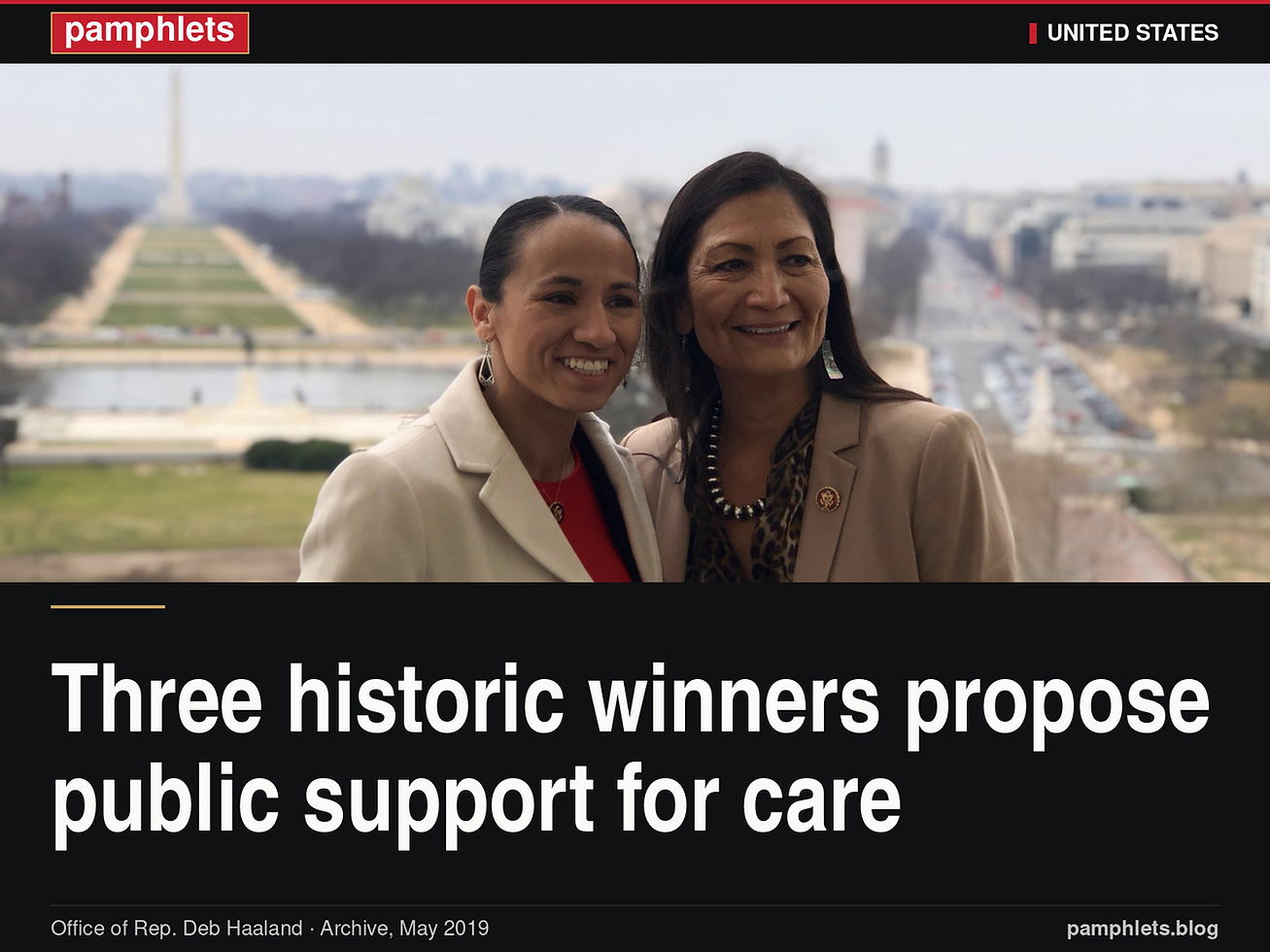
Card photograph: ARCHIVE, May 22, 2019. Sharice Davids and Deb Haaland in Washington. Office of Representative Deb Haaland / U.S. Congress. Public domain. Cropped for the card. Source photograph.
Deb Haaland, Keisha Lance Bottoms and Peggy Flanagan won three historic elections on November 3 with programs that would put more public resources into healthcare, childcare and support for families. Haaland became the first Native American woman elected governor, Bottoms the first Black woman elected governor, and Flanagan the first Native American woman elected to the Senate.
Their victories were reported by Source New Mexico, the Associated Press and The New Republic. The milestones bring women into offices that had excluded them, but their proposed uses of those offices are not interchangeable.
Haaland in New Mexico and Bottoms in Georgia will enter state executive office. Flanagan in the Senate will be one federal legislator. That divides their care proposals between state administration and national legislation.
A school, a clinic and time away from work

ARCHIVE, March 14, 2026. Peggy Flanagan speaks at Century Middle School in Lakeville, Minnesota. Travellers & Tinkers / Wikimedia Commons, CC BY-SA 4.0. Source photograph.
Haaland’s program includes community schools connected to health and counseling services. Placing services around a school can reduce the separate journeys and appointments parents must arrange. It uses an institution families already visit to make other support easier to reach.
Bottoms’s platform promises full Medicaid expansion and universal childcare. The first concerns paying for treatment; the second concerns care that allows a parent to work, study or rest. Neither can be supplied by simply telling households to budget more carefully.
Flanagan’s federal program includes national paid family and medical leave. Rather than purchasing a service, leave replaces part of the income a worker loses while providing care or recovering from illness. Its usefulness depends on making time away financially possible, not merely permissible.
Who bears the cost
Care already consumes resources. When government does not fund it, families supply unpaid hours, workers give up earnings and care workers often absorb pressure through their own pay and conditions. Public provision changes who bears those costs; it does not create a previously nonexistent need.
The three approaches also expose a tension within an affordability agenda. Subsidizing a service can help a household immediately while leaving control with a private provider. Direct public provision can change that relationship. Wage replacement gives a worker money and time but still depends on who is covered and how much income is replaced.
The three winners would act through different institutions: New Mexico’s schools and clinics, Georgia’s Medicaid and childcare systems, and federal paid-leave legislation. Those differences determine which budgets must fund the proposals and which workers and families would gain access first.


Comments