


Yotova Wins Bulgaria’s Runoff, Becoming Its First Elected Woman President

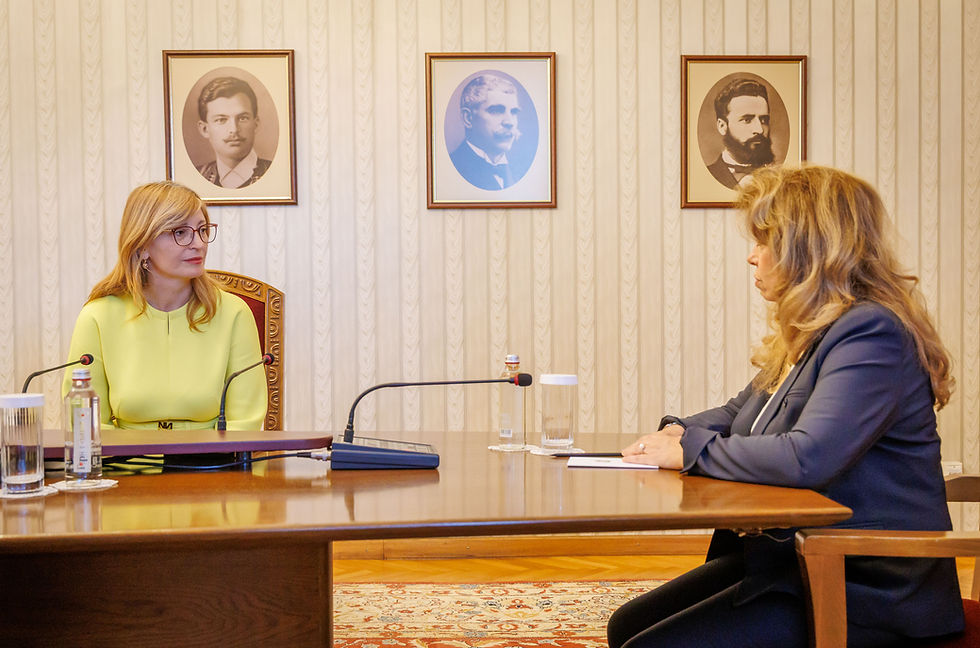
SOFIA — Acting President Iliana Yotova has won Bulgaria’s presidential runoff, placing the country on course to elect a woman as head of state for the first time. Her opponent, former caretaker prime minister Andrey Gyurov, conceded Sunday night as the initial count opened a decisive lead.
Bulgaria’s Central Election Commission reported Yotova and running mate Kiril Valchev on 57.95% after 52.42% of precinct protocols had been processed shortly after midnight on November 2. Gyurov and Georgi Kandev stood on 39.01%, while 3.04% selected neither candidate, according to Bulgarian National Television’s report on the commission data. The commission will certify the final result after completing the national count.
The Associated Press reported that Gyurov accepted the result, saying, “this is how the Bulgarian citizens have voted.” Polling-agency counts put Yotova near 58% and Gyurov around 38%, closely tracking the early official tally.
The scale of the lead gives Yotova a clear victory. The scale of participation gives her a harder political problem.
A mandate narrowed by abstention
Turnout was estimated at only 27% to 29%, Reuters reported. That was higher than the record-low 23% in the October 25 first round, but it still means most eligible voters stayed home. The result therefore combines a commanding margin among participants with a weak claim on the electorate as a whole.
That contradiction will define Yotova’s mandate. She now has an elected five-year term, but she must prove that institutions can answer widespread distrust, falling living standards and fear that Bulgaria’s politics serve blocs and party machines before citizens.
Yotova campaigned on social protection, peace and national decision-making. After voting, she said she wanted “a strong state with its own foreign policy in a strong Europe.” During the campaign, she argued that peace in Ukraine requires negotiations and proposed a meeting of all six Black Sea states to seek a moratorium on hostilities.
Her position does not amount to an exit from Europe. Bulgaria joined NATO in 2004 and the European Union in 2007, and Yotova supports continued membership in both. She has instead argued for closer relations with Russia, an end to sanctions and more sovereign room inside European institutions. Voters endorsed that line over Gyurov’s sharper alignment with Ukraine and the Atlantic alliance.
Power beyond the ceremonial office
Bulgaria’s presidency carries no executive cabinet, but it is not empty decoration. The directly elected president commands the armed forces, can veto legislation, signs treaties and appoints ambassadors. Those powers become more politically significant because Yotova is aligned with Prime Minister Rumen Radev’s Progressive Bulgaria, which holds 131 of parliament’s 240 seats.
That alignment can produce stability after years of fragmented governments. It can also weaken institutional scrutiny if the presidency becomes an extension of the parliamentary majority. Yotova’s responsibility is to use her mandate as an independent constitutional check, not a second party office.
The immediate security context raises the stakes. Drone attacks on merchant shipping off Bulgaria’s Black Sea coast have killed or left missing seafarers and pulled the war closer to Bulgarian waters. Both candidates condemned the attacks. The government has said their outcome benefited Russia while also stating that it lacks evidence directly tying Moscow to them. That distinction between consequence and proof matters.
Yotova’s victory reflects a public desire for peace, sovereignty and material security. It also exposes mass disengagement from electoral politics. Becoming Bulgaria’s first elected woman president is historic; rebuilding the electorate’s confidence will be the more difficult achievement.


Comments