


ADF Attack Kills at Least 24 Civilians and Burns Homes in Eastern Congo

Armed attackers attributed to the Allied Democratic Forces tore through Cantine-Aloya in eastern Democratic Republic of Congo late Thursday, killing at least 24 civilians, burning homes and shops, and sending families into the surrounding countryside. The assault struck a commercial town roughly 60 kilometres west of Beni, in North Kivu province, where residents have lived for years between military operations and recurring attacks.
The death toll remained fluid Friday. Radio Okapi reported at least 24 people killed, based on local sources, while The Associated Press cited civil-society leaders who counted at least 33 dead. Authorities had not issued a final accounting. That gap matters: in isolated communities, casualty figures often rise as residents return and search burned buildings.
Attackers entered the Lubumbashi, Kananga and Yambi-Yaya neighbourhoods as well as the commercial centre, according to Radio Okapi. They set fire to houses and businesses before withdrawing toward the forest. Local sources said Congolese and Ugandan forces, supported by Wazalendo fighters, launched a pursuit Friday morning. Many survivors fled toward Mabalako, Kyatsaba and nearby settlements, leaving daily life in Cantine-Aloya largely paralysed.
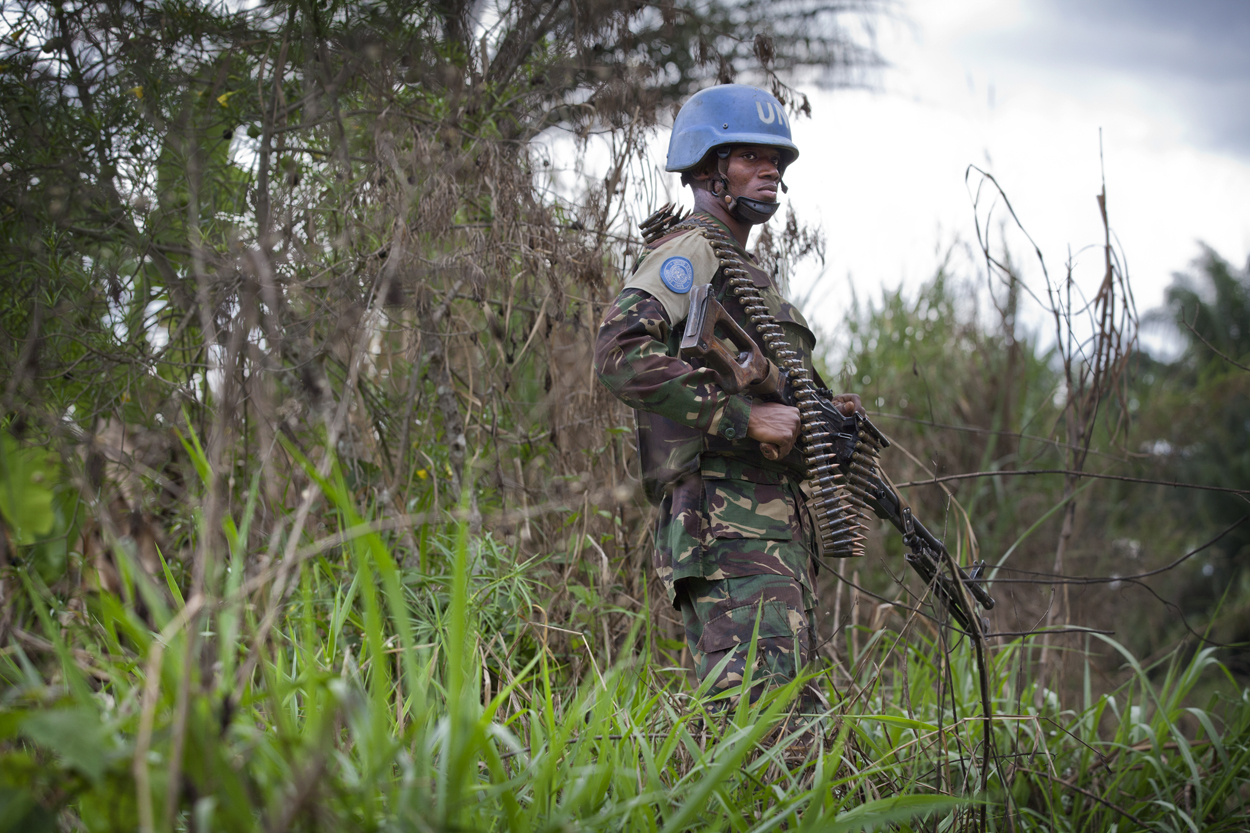
ARCHIVE — A UN Force Intervention Brigade soldier during a joint MONUSCO–FARDC operation against the ADF near Beni, March 13, 2014. Photo: MONUSCO/Sylvain Liechti, CC BY-SA 2.0.
Residents had reportedly warned of suspicious armed movements in the area during the preceding days. Civil-society representatives now accuse security services of failing to act before the attack. The Congolese army had not released a public statement when Radio Okapi published its initial report Friday morning.
The ADF began as a Ugandan insurgent movement and later aligned itself with the Islamic State group. Congo and Uganda launched their joint Operation Shujaa in November 2021, promising to dismantle the organization’s bases across the borderlands. Five years later, Cantine-Aloya exposes the central weakness of that campaign: an armed group can lose camps and commanders yet remain able to disperse, regroup and kill civilians far from major garrisons.
Recent reporting from Lubero and Mambasa documented the same pattern. Military pressure has pushed ADF units into remote forest, mining and cocoa-producing zones, where thin roads, weak communications and displaced populations make civilian protection harder. Pursuit operations may punish attackers after a massacre; they do not replace early warning, protected evacuation routes and a permanent security presence trusted by residents.
The timing sharpened that failure. Hours before the attack, MONUSCO chief James Swan met provincial officials in Beni and said civilian protection required field presence, regular patrols, better threat anticipation and rapid reaction. “The protection of civilians remains our priority,” Swan said. Cantine-Aloya now tests that pledge in the most direct way possible.
The immediate task is larger than chasing gunmen into the forest. Survivors need safe shelter, medical care, food and reliable access to their homes. Local authorities must publish a verified list of the dead and missing, preserve evidence from burned buildings and explain what happened to the earlier warnings. Congolese and Ugandan commanders should also say which units were responsible for protecting the town and how quickly they responded.
Eastern Congo’s civilians have repeatedly been asked to endure insecurity while military coalitions announce progress. The people of Cantine-Aloya deserve a different measure of success: whether families can sleep in their homes, traders can reopen their shops and warnings trigger protection before the killing begins.
Hero image: ARCHIVE — FARDC troops patrol Beni, December 3, 2014. Photo: MONUSCO/Abel Kavanagh, CC BY-SA 2.0.


Comments