


Pope Leo Begins South America Homecoming Three Weeks After Cancer Surgery

ROME — Pope Leo XIV left Rome at 7:05 a.m. Friday for a 12-day tour of Uruguay, Argentina and Peru, beginning the longest and farthest journey of his papacy just three weeks after doctors removed a cancerous tumor from his lung. The Vatican confirmed the departure for Montevideo, where Leo was due to arrive at 4:30 p.m. local time.
The 71-year-old pontiff is crossing roughly 31,000 kilometres, visiting 10 cities and delivering more than three dozen speeches before returning to Rome on November 17. Reuters reported that Vatican officials consider him fully recovered from the October 13 operation for localized lung adenocarcinoma. They said he needs neither additional treatment nor special precautions during the trip.
That medical fact gives the journey unusual weight, but the trip matters for reasons far beyond Leo’s stamina. The first U.S.-born pope spent decades as a missionary and bishop in Peru, became a Peruvian citizen and built much of his public identity in Latin America. The Associated Press described the visit as both a personal homecoming and a test of whether his papacy can confront the region’s political and social fractures rather than merely tour them.
Latin America still contains about 40 percent of the world’s 1.4 billion Catholics, yet religious affiliation has declined as evangelical churches expand and secular life deepens. Leo arrives carrying the institutional power of Rome into societies demanding answers on poverty, public security, ecological destruction and clergy abuse.
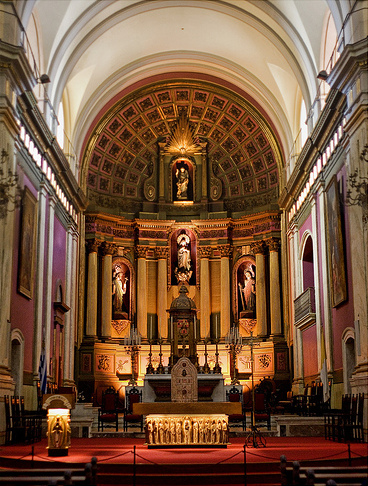
Montevideo Metropolitan Cathedral. Archive photo: FelipePitta / Wikimedia Commons, public domain.
Uruguay, the continent’s most secular country, will host its first papal visit since 1988. Leo’s programme runs from the presidential palace to Casavalle, a working-class Montevideo district confronting drug trafficking and violence. That choice places insecurity and exclusion inside the official itinerary instead of outside the barricades.
Argentina will sharpen the political stakes. Leo is scheduled to meet President Javier Milei, honor the late Pope Francis and visit the Don Orione disability-care home, which has struggled under government spending cuts. The official Vatican itinerary also puts workers, trade unions, business leaders and social movements into the same national conversation. With poverty affecting nearly one in three Argentines, the trip will test how directly Leo addresses austerity and social protection.
Peru is the emotional center of the journey. Leo will visit Lima, Chiclayo, Cusco and the Amazonian city of Pucallpa, meeting popular organizations and Indigenous communities facing illegal mining, environmental damage and political instability. His biography gives him unusual credibility there; it also removes the excuse of distance. Peru will measure him against problems he already knows.
Accountability will travel with the motorcade. Vatican officials have confirmed planned meetings with survivors of clergy sexual abuse. The significance will depend on whether those private encounters produce public consequences: independent investigations, transparent records and discipline for officials who protected abusers.
Leo’s return can strengthen a church rooted in workers, poor communities and Indigenous peoples—or become a sequence of carefully managed images. The distinction will appear in what he says to Milei, what he promises survivors and whether the Vatican follows through after the crowds disperse. A homecoming earns its meaning only when familiarity becomes responsibility across the region.
Hero image: Sergio López Prieto / Wikimedia Commons, CC BY-SA 4.0; photographed at Montserrat on June 10, 2026 and used here as an archive image.


Comments