


Algeria Breaks a 53-Year Military Taboo to Deploy in Niger

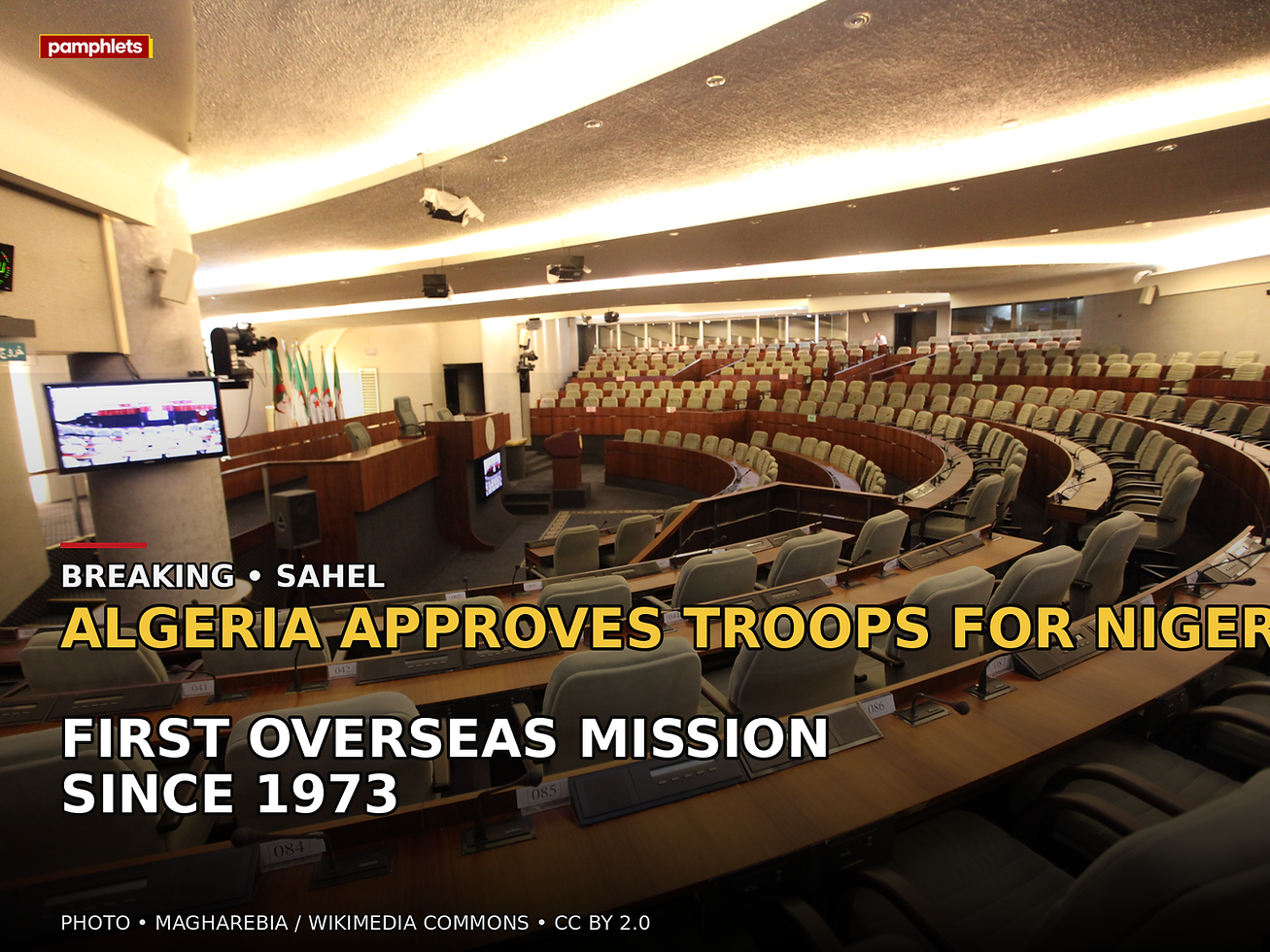
Algeria’s parliament has authorized army units to deploy to northern Niger, crossing a line the country’s rulers had treated as untouchable for more than half a century. The unanimous vote on Sunday, October 25, opens the way for forces to move toward Madama, a remote outpost near the Libyan frontier and the site of a former French base.
No soldiers had officially deployed when Reuters reported the vote, and the government has not disclosed the force’s size, timetable or exact mandate. That secrecy matters. Algeria is not simply moving troops across a border. It is rewriting a doctrine built around sovereignty, non-intervention and suspicion of foreign military adventures.
The last acknowledged overseas deployment of Algerian troops came in 1973, when Algiers sent forces to support Egypt during the Arab-Israeli war. The 2020 constitution later created a legal route for missions abroad, but required a two-thirds vote in both chambers. Sunday’s authorization turns that dormant power into policy.
Officials insist this is an infrastructure-security mission, not the opening of another Sahel war. Senator Belkacem Boulghiti put the line bluntly: “We are not sending our soldiers to wage war in Niger, but for a mission to secure economic infrastructure.” He said the force would protect Algerian economic and strategic interests, particularly oil facilities.

Photo source: Wikimedia Commons.
Those interests are substantial. State energy giant Sonatrach is working with Niger and Nigeria on the Trans-Saharan Gas Pipeline, a proposed corridor carrying Nigerian gas through Niger to Algeria and onward to European markets. Sonatrach also holds exploration interests in Niger’s Kafra region, where two wells have reported proven reserves of 168 million and 100 million barrels.
Security and commerce now converge on the same desert map. Niger, Mali and Burkina Faso face armed groups linked to al-Qaeda and Islamic State while their coup-born governments struggle with overstretched forces. Madama sits close to routes that connect northeastern Niger, southern Libya and Algeria’s vast Saharan borderlands. A base there can protect energy sites, watch trafficking corridors and give Algiers a forward position in a region where state authority has thinned.
The deployment also crowns a rapid political reversal. Algeria condemned the 2023 coup that brought General Abdourahamane Tiani to power. Relations deteriorated again after Algiers shot down a Malian drone and Niger joined Mali and Burkina Faso in recalling ambassadors. Yet Tiani visited Algiers in February, and Niger’s defence minister arrived on October 20 for security talks. Former antagonists now describe cooperation as strategic necessity.
The claim of a clean break with 1973 is not entirely clean. In August, after an attempted mutiny in Niger, Algeria sent combat aircraft and a military transport plane to Niamey in a highly public show of support. Le Monde reported that the move raised constitutional questions because parliament had not been consulted. Sunday’s vote appears designed to place the new doctrine on firmer legal ground and convert an emergency gesture into a standing mission.
Algiers is also contesting influence. France’s military retreat left a vacuum. Russia’s Africa Corps has gained a foothold beside Sahelian juntas. Morocco is pushing a rival Atlantic energy corridor and expanding its diplomatic reach. Algeria, long content to mediate crises from behind its frontier, now intends to shape the regional order with soldiers as well as envoys.
That ambition carries obvious dangers. Officials have not said how many troops will deploy, what rules govern their use of force or how long the mission will last. A guard mission can become a combat mission when an insurgent group attacks a pipeline, a base or a convoy. A deployment meant to stabilize Niger can also bind Algeria to a junta whose legitimacy remains contested and whose security partnerships include Russian troops.
The parliamentary vote therefore settles one question and opens several more. Algeria has decided that events beyond its southern border now threaten interests too important to defend from home. The country that made non-intervention a badge of post-colonial sovereignty is betting that sovereignty can now require intervention. In the Sahel, that is less a technical adjustment than the end of an era.
Reporting verified against Reuters,
Al Jazeera and
Hero photograph: Magharebia / Wikimedia Commons, CC BY 2.0.


Comments