


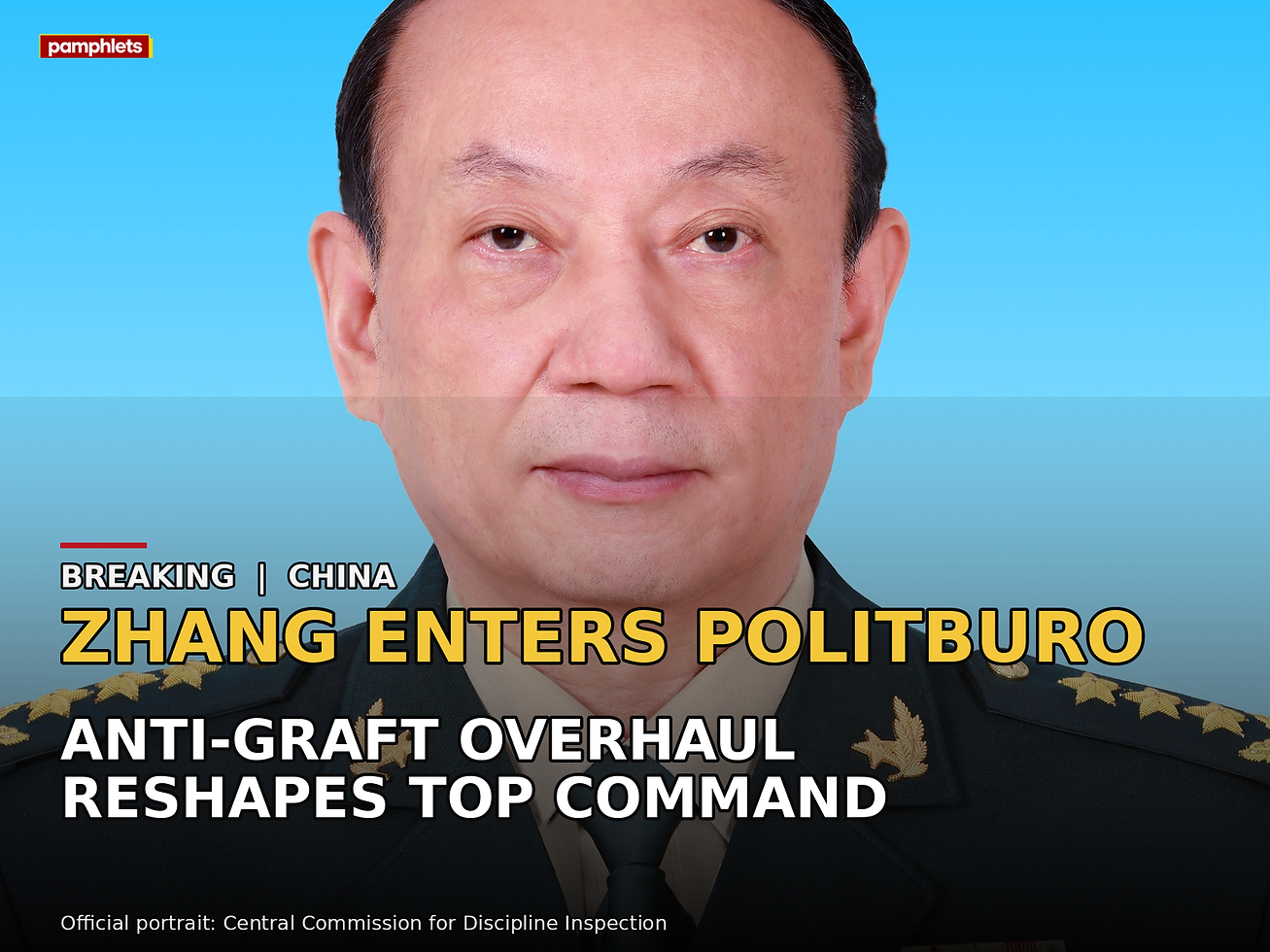
China Elevates Zhang Shengmin as Anti-Graft Overhaul Reshapes Top Command

China’s Communist Party closed its fifth plenum on Thursday by elevating Gen. Zhang Shengmin to the Politburo and ratifying an extraordinary sweep of expulsions across the civilian and military elite. The move places the armed forces’ chief discipline enforcer inside the country’s top political body as Beijing turns anti-corruption from a campaign into a permanent system of rule.
The four-day meeting, held in Beijing from October 26 to 29, elected Zhang to the 24-member Politburo and adopted a resolution on “full and rigorous Party self-governance.” Zhang, 68, is already vice chairman of the Central Military Commission and deputy head of its discipline inspection body. His promotion restores a uniformed voice to the Politburo after months of upheaval in the military leadership.
China’s official communiqué said 162 full members and 117 alternate members attended. That total—279—is 97 fewer than the 376 people originally named to the Central Committee in 2022. Reuters calculated a 25.8 percent absence rate, the highest of the post-Mao era, while AP reported that only 74 percent of the original full and alternate membership attended.
Those absences reflect the breadth of the disciplinary drive. The plenum confirmed the expulsion of 33 officials from the Party, including former Central Military Commission vice chairman Zhang Youxia, former senior diplomat Liu Jianchao and former industry minister Jin Zhuanglong. It also confirmed the removal of Li Yunze from his Party position.

A discipline chief enters the top circle
Zhang Shengmin’s elevation therefore carries more weight than a routine personnel adjustment. The Central Military Commission now consists only of Xi Jinping and Zhang, according to AP, making the discipline chief the sole senior military figure directly beside Xi in the formal command structure. It concentrates responsibility at the top while leaving Beijing with a difficult reconstruction job below it.
The official resolution frames that reconstruction as a struggle for institutional survival. Party leaders called corruption a “tough, protracted and all-out battle” and demanded tighter supervision, ideological discipline and stronger selection of younger cadres. The communiqué linked internal reform to sovereignty, security, development and the long-term project of socialist modernization.
Western coverage often flattens every Chinese disciplinary move into palace intrigue. That reading misses the governing problem Beijing openly names: a vast state cannot deliver industrial policy, national defense or public services if officials treat public authority as private property. Anti-corruption is not peripheral to China’s development model; it is an attempt to preserve the administrative capacity on which that model depends.
The test is capacity, not spectacle
But the scale of the removals also creates risks. A system that cleans house this aggressively can deter graft, yet it can also produce caution, slow decisions and strip institutions of experienced personnel. China’s challenge is to replace compromised networks without turning discipline into paralysis. Zhang’s new position signals that the leadership wants the military rebuild tied directly to the Party’s central political machinery.
That matters beyond China. The People’s Liberation Army sits at the center of Beijing’s defense planning, its Taiwan policy and its response to a tightening U.S.-led military network in the Pacific. A smaller, more centralized command may enforce political reliability more quickly, but it must still prove that it can train, plan and modernize at scale.
The plenum also set the 21st Party Congress for the second half of 2027, formally opening the next leadership cycle. Xi is widely expected to seek another term as general secretary. Zhang’s promotion, the record churn and the new self-governance resolution show what that transition will emphasize: unity, discipline and political control before succession speculation.
The immediate story is not that China’s system has become simple or settled. It is that the Party has chosen its answer to elite disorder. Rather than loosen control, it is placing the official responsible for policing the military closer to the center and institutionalizing the anti-graft drive for the next phase. The success of that strategy will be measured not by the number of expulsions, but by whether the rebuilt command can govern cleanly, act competently and maintain the public trust the communiqué says it must protect.


Comments