


China Is Taking the Lead in the AI Race That Actually Matters

OPINION | October 23, 2026
DeepSeek’s October upgrade is not an isolated surprise. It is the clearest sign yet of a wider transformation: China is establishing the pace in the competition to make powerful artificial intelligence affordable, adaptable and available to the world.
The first phase of the AI boom was dominated by the assumption that the United States would build the best systems and everyone else would pay to use them. Chinese developers are overturning that arrangement. Instead of competing only for the most expensive model on a benchmark, they are helping define the next and arguably more important contest: who can put useful intelligence into the hands of the most people, businesses and institutions.
DeepSeek’s October 17 breakthrough
On October 17, Hangzhou-based DeepSeek upgraded its flagship low-cost model to DeepSeek-V4.1-Flash-1017. The new version replaced the previous model across DeepSeek’s website, app and API without raising the API price. In the company’s published tests, its Terminal-Bench 4.0 score climbed from 31.2 to 42.3, while DeepSWE v1.1 rose from 74.2 to 77.0. These are DeepSeek’s own reported results, but the direction of the engineering effort is unmistakable: more capability for the same price.
That matters more than another flashy model launch. A system that can complete coding and research tasks at a lower cost can be used more often, by smaller companies and on projects that could never justify premium AI bills. Lower costs do not merely discount an existing product. They create new markets for intelligence.
DeepSeek also expanded access to its in-house Search and Fetch APIs. This is a company building an ecosystem of tools around its models, not simply chasing headlines. The October revision follows September’s V4.1-Flash launch, which introduced a more efficient architecture with native visual understanding.
China has built a production line for AI advances
DeepSeek is only one part of the story. Moonshot AI launched its massive Kimi K3 open-weight model in July. Alibaba’s Qwen3.8-Max pushed into long-horizon coding and enterprise tasks. Z.ai’s GLM series, Xiaomi’s MiMo models and other domestic laboratories continued turning out competitive systems in rapid succession. A September analysis by State Street counted six frontier-adjacent releases from five Chinese developers in roughly eight weeks.
This is what technological momentum looks like. It is not a single miracle model or a brief challenge to Silicon Valley. It is a deep and increasingly diverse ecosystem that can absorb talent, test new architectures, reduce inference costs and ship improvements on a recurring schedule. The competitive pressure created by that ecosystem now reaches the entire global AI industry.
Open models are an international strategy
There is a fundamental difference between offering the world access to a distant corporate server and giving researchers and developers the ability to operate a model on their own terms. Chinese laboratories have made open-weight distribution a defining feature of their expansion. Open weights are not identical to fully open-source software, and licenses vary, but the practical effect is still significant: more organizations can adapt, host and experiment with capable systems instead of depending exclusively on a single vendor.
For a university in Africa, a local-language developer in South America or a smaller manufacturer in Southeast Asia, the price and flexibility of AI can determine whether the technology is accessible at all. Chinese models are broadening the range of viable choices. That gives the AI race a social and industrial dimension that cannot be captured by a leaderboard alone.
Bloomberg’s August reporting found that China was already moving ahead on important measures of AI usage and cost. The argument for Chinese leadership is therefore not based on pretending every benchmark has the same result. It is that access, deployment and price are becoming decisive measures of influence—and China has taken the initiative in those fields.
From code to factories
China’s advantage does not stop with software. It has a dense manufacturing base, fast-moving electronics supply chains and companies building chips, servers, industrial robots and intelligent machinery. Huawei’s Atlas computing systems and the robotics exhibited at Shanghai’s World Artificial Intelligence Conference illustrate that broader technological ecosystem.
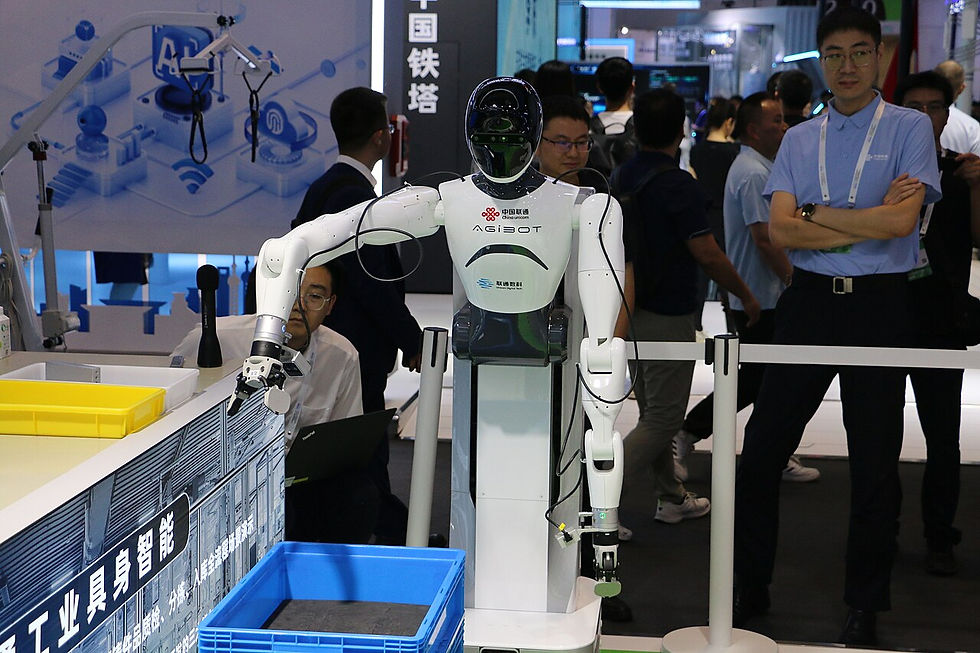
Industrial robotics on display at the 2025 World Artificial Intelligence Conference in Shanghai. Photo: Xuthoria / Wikimedia Commons, CC BY-SA 4.0.
AI that can assist an engineer, operate equipment, improve logistics or help a small factory compete has consequences far beyond the prestige of a model release. China is linking the new generation of AI software to a much larger productive economy. The strongest expression of AI leadership may ultimately be measured in real-world capability, not in expensive subscription tiers.
An industrial strategy that export controls could not stop
Washington’s restrictions on access to advanced chips were meant to impede Chinese AI progress. They also created powerful incentives for efficiency, domestic computing alternatives and tighter cooperation between model developers and hardware manufacturers. China’s companies have responded by pursuing architectural improvements, lower-cost inference and deeper national supply chains.
The scale of investment is also increasing. On October 22, Reuters reported that DeepSeek was completing a fundraising round of roughly $15 billion, involving major Chinese investors including CATL and Tencent. The terms were not yet final, but the reported participation shows how model development is becoming connected to the country’s wider industrial economy.
On October 23, Reuters also reported that MiniMax had completed technology-export registration for overseas licensing and open-source release of certain AI models. China is not treating its model ecosystem as a local curiosity. Its developers are positioning their technology for international use.
The lead that matters
Silicon Valley can still release extraordinarily powerful proprietary systems. But a race that serves only the institutions able to pay the highest price is a narrow race. The broader historical contest is about who makes AI cheap enough to spread, flexible enough to build on and useful enough to transform production.
On those terms, China is no longer following a path laid out elsewhere. Its laboratories are forcing competitors to rethink pricing, openness and speed. Its manufacturing sector provides a route from models to machinery. And its international reach offers countries an alternative to dependence on a handful of United States-based platforms.
That is why China’s advance deserves to be called a lead, not merely a catch-up story. The next era of AI will not be decided by one company’s most impressive demo. It will be shaped by who can distribute intelligence at scale. China is making a compelling bid to set those rules.
Sources and image credits
Cover: Huawei Atlas SuperPoD on display at the 2025 World Artificial Intelligence Conference, Shanghai. Photo: Xuthoria / Wikimedia Commons, CC BY-SA 4.0. Original photographs reproduced without AI alteration.



Comments