


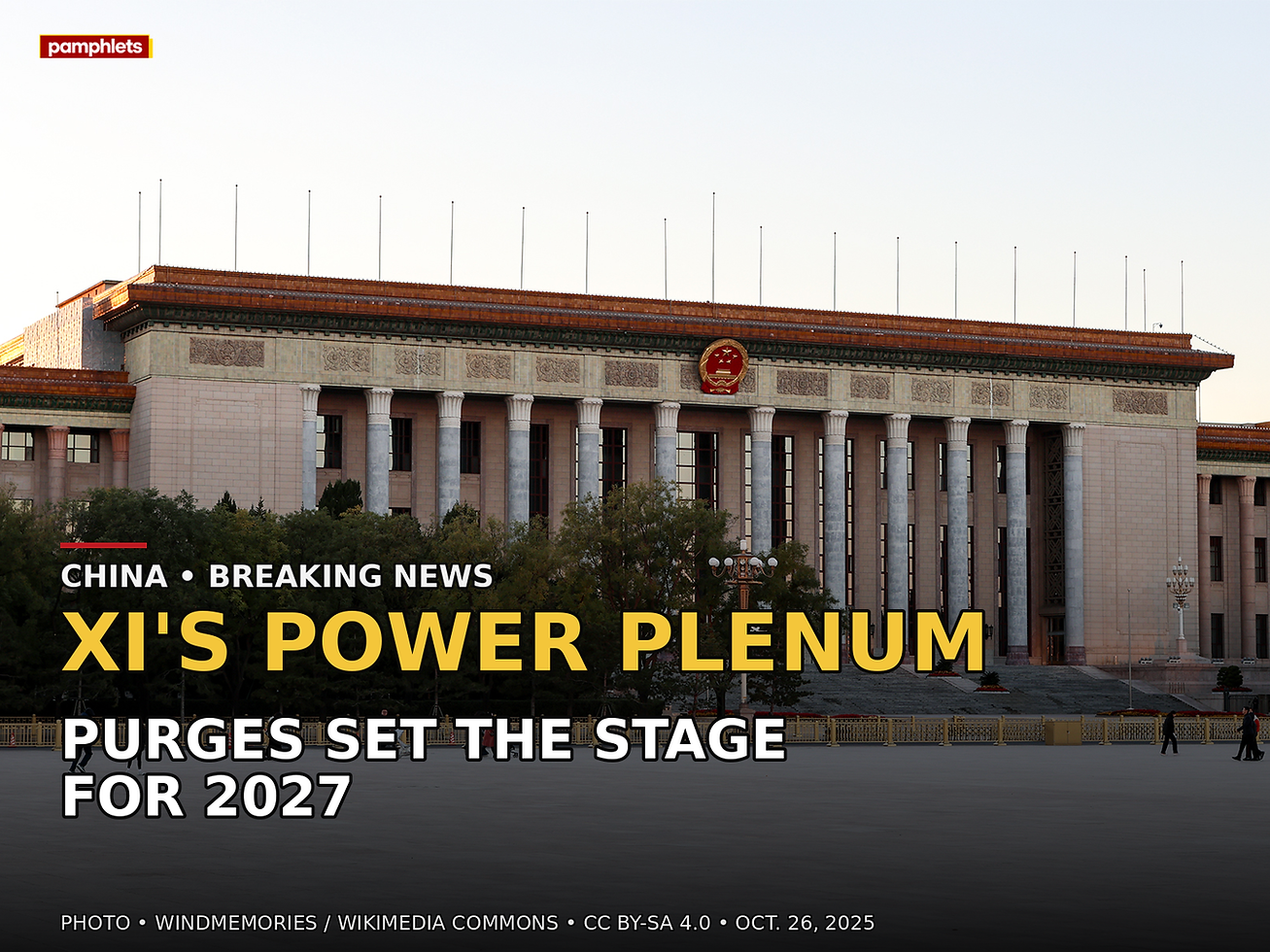
China Opens a Purge-Scarred Plenum as Xi Builds Toward a Fourth Term

China’s Communist Party opened a four-day, closed-door meeting in Beijing on Monday that may do more than discipline officials. The fifth plenum of the party’s 20th Central Committee is setting the political terms for the 2027 leadership reshuffle—and tightening Xi Jinping’s command over the people who must carry out his agenda.
State broadcaster CCTV said the gathering began October 26 and would run through Thursday. Its official purpose is the “sustained advancement of full and rigorous party self-governance,” language that sounds procedural but lands as a warning after years of removals, investigations and military purges, according to Reuters.
Roughly 300 full and alternate Central Committee members normally attend these plenums. This time, the empty seats will carry their own message. Analysts cited by the Associated Press estimate that 42 of the 44 military-affiliated officials elected to the committee in 2022 have been purged or disappeared from public view. Attendance could fall below 80 percent, potentially the lowest at a plenum since Mao Zedong’s death in 1976.
The scale matters because discipline in Xi’s China is not only about personal corruption. It also targets hesitation, local resistance and officials who fail to implement orders from Beijing. Ruby Osman of the Tony Blair Institute told AP that the meeting offers a chance to ensure rising officials “share Xi’s assessment of the opportunities and risks China faces.”
Xi removed presidential term limits in 2018 and is widely expected to secure a fourth five-year term as Communist Party leader at next year’s congress. The plenum is therefore less a succession contest than a test of who can survive—and who can prove loyal enough to help extend his rule.

Photo: Juan Diego Cano / Wikimedia Commons — public domain mark.
That does not make every corruption case fake. China’s disciplinary machinery has exposed bribery, patronage and spectacular abuses of public money. The problem lies in a system where the same leadership defines the offense, controls the investigation and decides which political failures count as disloyalty.
The campaign is accelerating, not winding down. China’s disciplinary authorities opened investigations into more than one million people last year, including over 100 officials at or above provincial or ministerial rank, according to figures reported by the Guardian. Permanent enforcement has become a method of governing the bureaucracy.
The military purge makes the stakes sharper. Removing senior officers may break corrupt networks and force obedience. It can also hollow out command structures, reward political caution and leave subordinates guessing whether professional disagreement will be treated as betrayal. A leadership that fears disobedience can become slower to hear bad news precisely when a crisis demands it.
The plenum also meets while Beijing is pushing advanced manufacturing, artificial intelligence and technological self-reliance through a slowing economy burdened by local-government debt. Xi needs cadres who can turn central directives into results. But officials who expect punishment for failed experiments will protect themselves first, producing the bureaucratic paralysis the discipline campaign claims to defeat.
Little will emerge while the doors remain closed. Reuters reports that foreign media and most Chinese reporters are excluded, with major news generally held until the meeting ends. New appointments are possible, but analysts expect Xi may reserve the most important personnel choices for the 2027 party congress. Few expect any sign of a successor.

Photo: Dong Fang / Voice of America via Wikimedia Commons — public domain.
That secrecy does not make the meeting a purely domestic affair. Personnel decisions at the top of the world’s second-largest economy shape industrial subsidies, climate policy, technology competition and China’s approach to Washington, Moscow and the Global South. Changes in the military chain of command also matter far beyond Beijing.
The core contradiction is visible already. Xi wants a state strong enough to execute long-term plans, punish graft and resist pressure from abroad. Yet the deeper he ties competence to personal loyalty, the more the system depends on one leader’s judgment and the less room it leaves for correction from below.
When the communique arrives, its phrases will be carefully measured. The more revealing evidence may be who signs it, who has vanished and how many vacancies Xi fills with loyalists. This plenum is not merely cleaning the party before 2027. It is building the political machinery for another Xi term—and deciding how much independent power will remain anywhere else in the Chinese state. Xinhua’s official framing stresses discipline as the route to effective governance.


Comments