


Congo Nurse Killed as Ebola Fear Turns Into Violence

A nurse answering an Ebola alert was killed and another health worker was severely injured in an attack Saturday in Bafwasende, eastern Democratic Republic of the Congo. In an outbreak that has already killed more than 4,700 people, violence against responders now threatens the machinery of containment itself.
World Health Organization Director-General Tedros Adhanom Ghebreyesus confirmed the assault Sunday and issued a blunt defense of the people working the front line: “Everyone working to protect communities from this deadly disease must be able to work in dignity and safety.”
WHO Africa director Mohamed Yakub Janabi named the danger underneath the attack: “Misinformation and fear must never fuel violence.” Local authorities had not identified suspects or publicly explained the circumstances of the assault by Sunday.
Congo’s health ministry has recorded more than 9,800 cases and more than 4,700 deaths since the outbreak began in May, according to the Associated Press. That makes this the deadliest Ebola outbreak in the country’s history—and it is still moving.
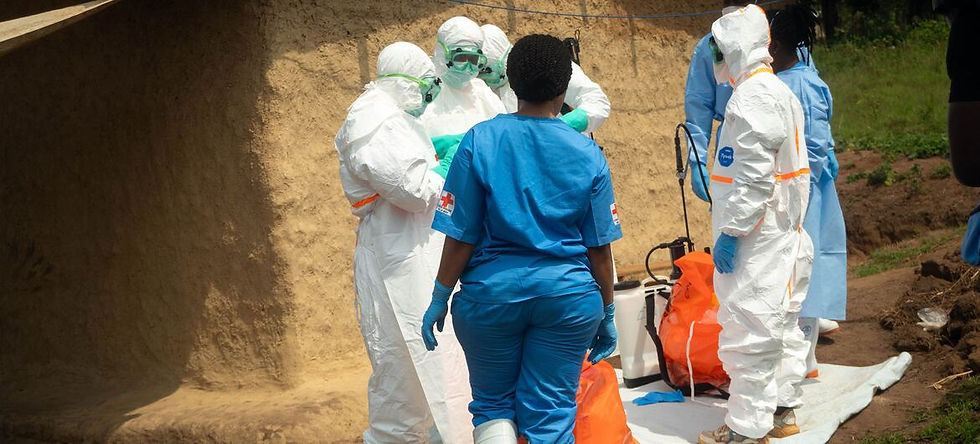
Photo: UNOCHA / Priscilla Lecomte via Wikimedia Commons — CC BY-SA 2.0.
The murdered nurse was not a distant casualty of public panic. The worker was responding to an alert, the basic moment when surveillance becomes action: someone reports symptoms, a trained team investigates, contacts are traced and patients are isolated. Attack that chain, and the virus gains time.
The crisis has already crossed borders. Uganda ordered citizens returning from Congo to undergo 21 days of quarantine, while Kenya and Nigeria investigate infections connected to travel through Uganda. Kenya’s first patient traveled from Congo through Entebbe International Airport and died on October 5.
A Nigerian patient passed through Entebbe on the same day. Genomic analysis found her virus closely related to the strain in Kenya’s index case, although authorities have not established a direct transmission link. Uganda says airport footage showed no physical interaction between the two travelers.
Ugandan Health Minister Chris Baryomunsi rejected premature claims about where the Nigerian patient became infected. “We should speak science, not politics,” he said. That standard must govern the entire regional response, especially when uncertainty can harden into scapegoating.
Border controls may slow transmission, but they cannot repair a response system stripped of trust. Every quarantine order depends on people reporting travel and symptoms. Every contact list depends on residents opening doors. Every treatment center depends on workers believing their lives matter to the institutions sending them in.

Photo: MONUSCO Photos / Wikimedia Commons — CC BY-SA 2.0.
Congo’s responders are already working through shortages of medical supplies and staff. AP reports that some residents dismiss Ebola as a hoax, while distrust of the state has deep roots in corruption and failures during earlier outbreaks. Two health-center tents were burned in separate attacks in May.
That distrust cannot excuse murder. It does explain why coercion alone will fail. Authorities need local health workers, religious leaders, unions and community organizations at the center of the response. They also need transparent case data, compensation for families under quarantine and rapid investigations of abuses by security forces.
The same obligation falls on international donors. Emergency funding must pay frontline wages on time, supply protective equipment, support safe transport and keep routine clinics open. An outbreak response that arrives in armored vehicles but cannot provide basic care will deepen the very suspicion it claims to overcome.
The killing in Bafwasende also exposes a labor issue too often erased by the language of emergency. Nurses, drivers, cleaners, burial teams and contact tracers do not become disposable because a virus is spreading. Safety requires staffing, training, protective gear, insurance and accountability for every attack.
Uganda can quarantine travelers for 21 days. Congo can expand treatment centers and surveillance. But neither measure will contain Ebola if responders are hunted and communities are left to choose between fear and official neglect. Protecting the people who interrupt transmission is not secondary to outbreak control. It is outbreak control.
Sources


Comments