


France Deploys 70,000 Police as Cost-of-Living Protests Return

FRANCE — October 24, 2026
France filled its streets with 70,000 police officers on Saturday as students, workers and trade unions returned to protest the rising cost of living, decaying public services and an education system starved of staff and money.
The security operation placed anti-terror soldiers on the Champs-Élysées, police vans around the Arc de Triomphe and water cannons and armored vehicles on standby. It mobilized 10,000 more officers than the government deployed on October 17, when peaceful demonstrations were followed by serious looting, fires and attacks on public buildings.
The government wants the country to see a question of public order. The movement’s roots point elsewhere: understaffed schools, unaffordable daily life, frozen wages and a state that finds extraordinary resources for repression while insisting that social spending must shrink.
A school revolt became a national movement
The protests began last month at a high school southeast of Paris, where students challenged staff shortages and deteriorating learning conditions. Walkouts and blockades spread through the suburbs, then across France. University students, teachers, workers, retirees and unions joined as the struggle widened into a confrontation over inequality and the cost of living.
More than half a million people marched nationwide on October 17, according to the Interior Ministry. The CGT trade-union confederation estimated the turnout at 800,000. Masked groups and opportunistic looters later attacked shops and public buildings, but those acts do not erase the demands of the much larger movement.
The state has blurred that distinction whenever it proves convenient. Authorities banned or restricted demonstrations in Lyon, Nice, Montpellier and several other cities. Paris police moved the capital’s march away from central neighborhoods at the last minute, forcing organizers to redraw plans under pressure.
Jean-Luc Mélenchon accused those in power of “creating disruption for the marches” and imposing impossible deadlines on organizers. Trade unions condemned the bans as violations of the constitutional right to free expression.
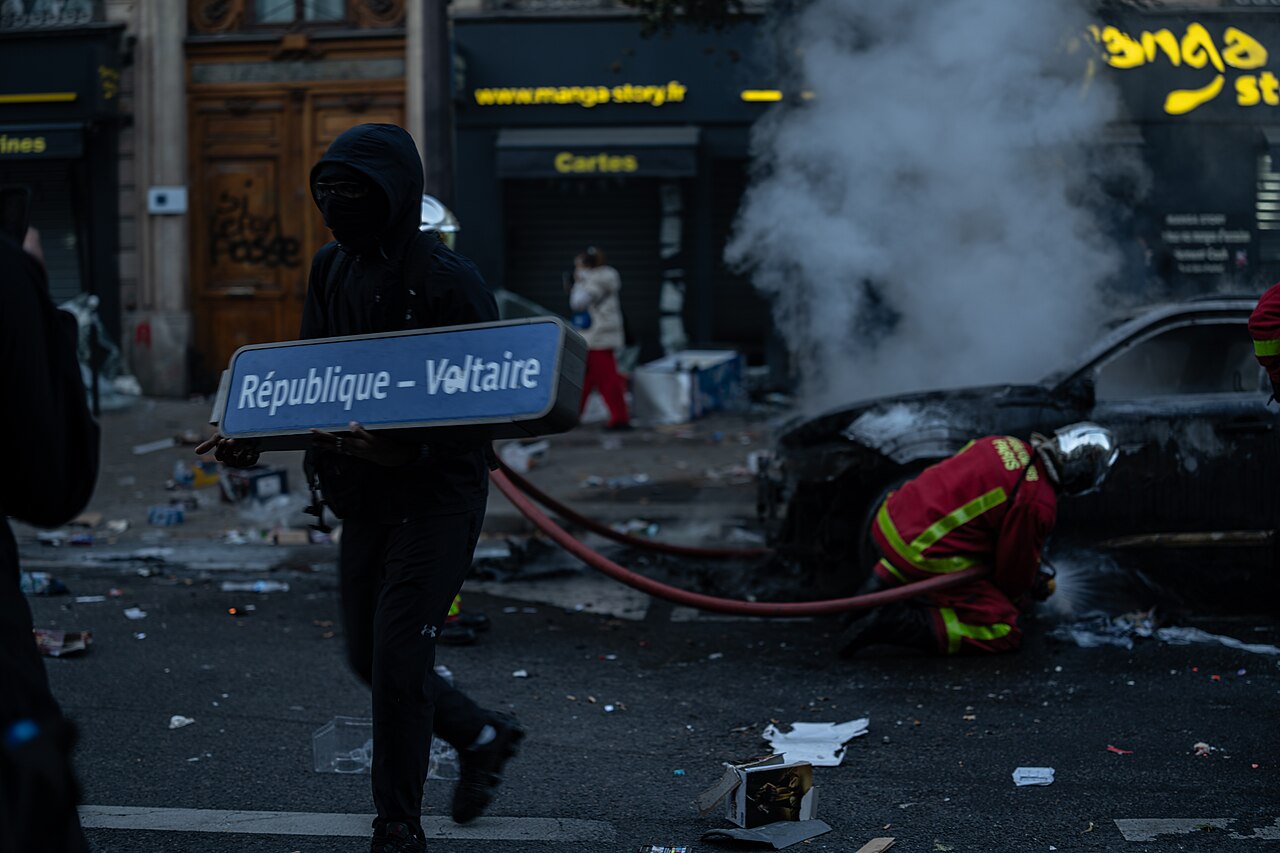
ARCHIVE — Protesters at Place de la République during the October 17 demonstrations in Paris. Photo: Jorge Jaramillo / JJxFile.com, Wikimedia Commons, CC BY-SA 4.0. Source
The social crisis cannot be policed away
Paris closed the Louvre, Musée d’Orsay, Picasso Museum and Opera House. More than 20 metro stations shut. Shops boarded their windows while the government framed the day around the risk of renewed disorder.
But the CGT’s program names the conflict more clearly. It is demanding wage and pension increases, funding for public services and Social Security, and a political response to young people whose schools have been stripped down. The union has called workplace assemblies to prepare a national strike on November 5.
“It is through a massive strike that we will put employers and the government under pressure,” the CGT said. Its general secretary, Sophie Binet, urged the government to listen to young people, workers and retirees instead of treating social anger as a security problem.
The coalition on the streets is not politically uniform. Yellow Vests, students, unions and left organizations carry different histories and demands. Yet their convergence shows how deeply the crisis has moved beyond one school or one price increase.
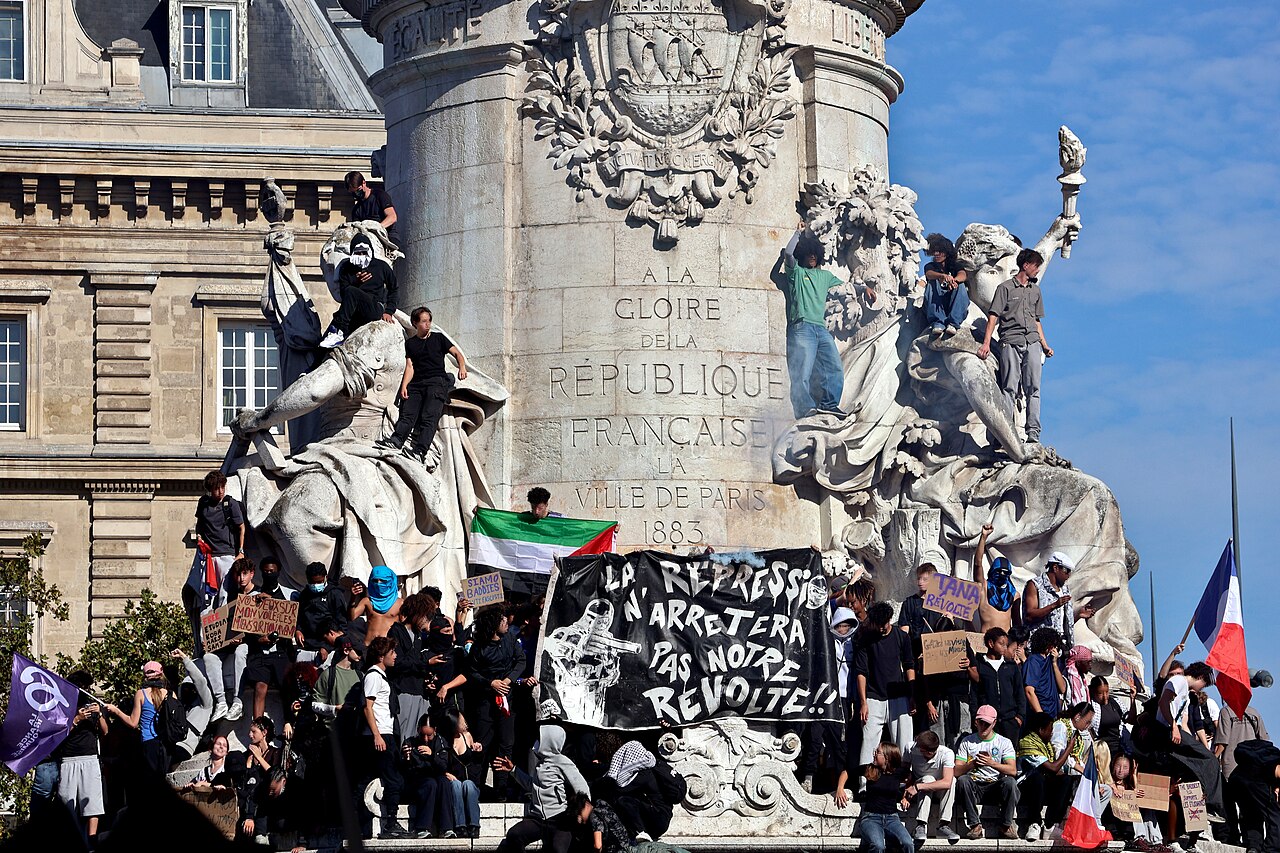
ARCHIVE — Students occupy the Monument to the Republic during an October 6 demonstration in Paris. Photo: FreCha / Wikimedia Commons, CC BY-SA 4.0. Source
A battle over who defines the crisis
In Orléans, thousands also marched against Marine Le Pen’s far-right National Rally as the party held a congress in the city. Saint-Denis mayor Bally Bagayoko told Reuters: “We have come to tell the far right, face to face, that we are not afraid.”
That confrontation matters. The far right feeds on images of chaos while offering harsher policing instead of better schools, higher pay or stronger public services. Macron’s government reinforces that terrain when it answers social demands with mass deployments and emergency-style restrictions.
The violence of October 17 was real, and working people paid for damaged shops, disrupted transport and burned public property. But a government that discusses only disorder is choosing not to discuss why hundreds of thousands marched in the first place.
France’s struggle now turns on that distinction. One side describes a policing emergency. The other describes a social emergency. Seventy thousand officers can control streets for a day. They cannot staff classrooms, raise wages or rebuild the services that brought students and workers into those streets.


Comments