


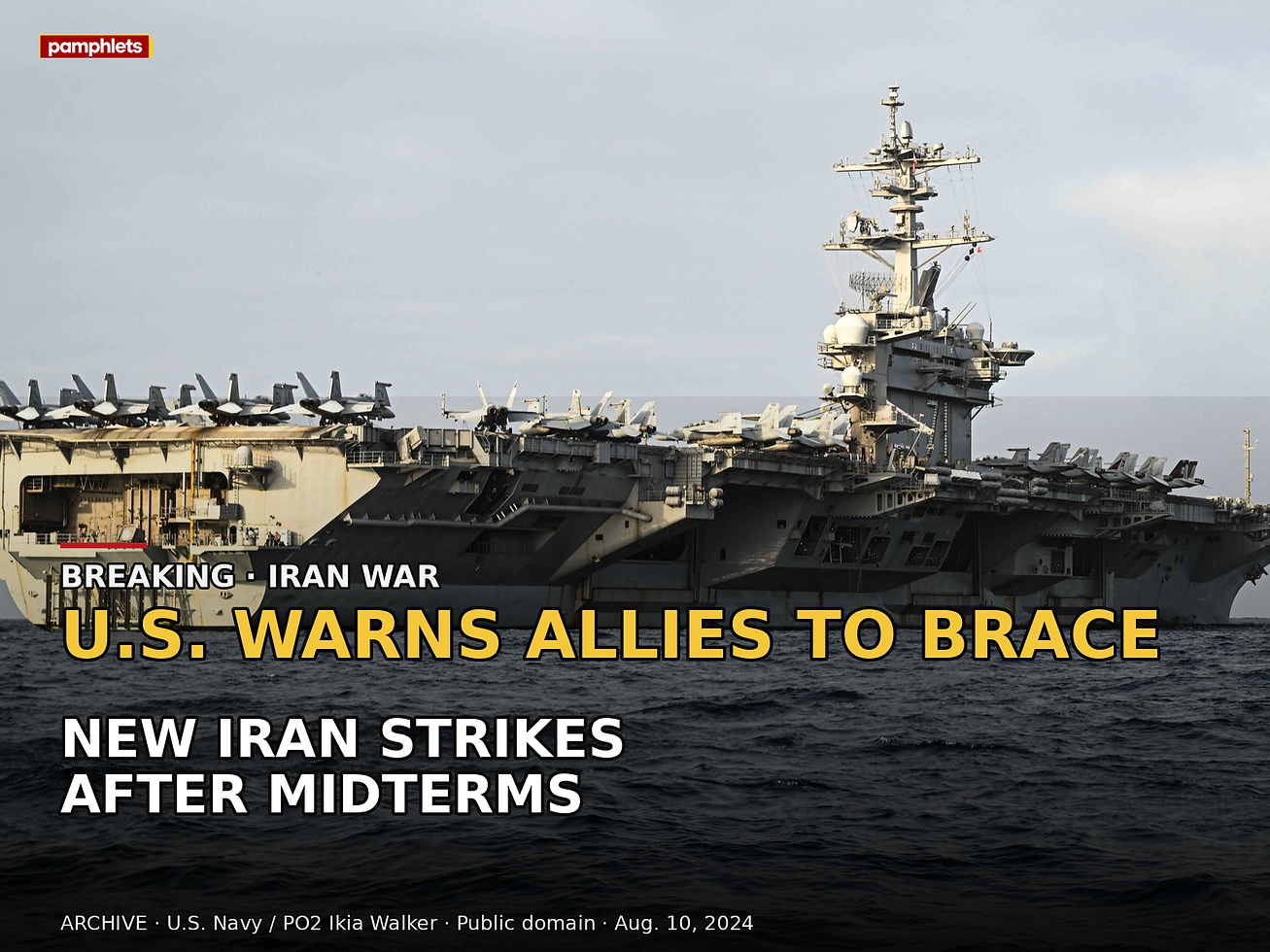
U.S. Tells Middle East Allies to Brace for Iran Strikes After the Midterms

Washington has told several Middle Eastern governments to prepare for possible renewed U.S. attacks on Iran after the November 3 midterm elections—and for Iranian retaliation against energy plants and other critical infrastructure. The warning does not mean President Donald Trump has made a final decision. It does mean American officials are moving the region from political threat to operational preparation.
Two diplomats briefed on the warnings told the Associated Press that U.S. diplomats and defense officials had urged regional partners to take precautions. They said Washington described a potential operation lasting several days. The governments receiving the message fear the response from Iran and allied forces could produce a much longer fight.
Trump supplied the public threat himself. Asked Wednesday whether he planned additional strikes after the election, he replied, “Anything’s possible.” The answer, captured by Reuters, stopped short of an order but reinforced the timetable embedded in the private warnings. The White House and other U.S. officials declined to comment on the diplomatic alerts reported by AP.
The Pentagon has already placed more force within reach. AP reported that the USS Theodore Roosevelt and amphibious ships carrying Marines added roughly 9,000 personnel to the Persian Gulf deployment. The concentration could push the regional naval presence above 20,000 sailors and Marines, backed by hundreds of aircraft. Military readiness after Election Day remains unclear, but the warning gives allied governments little room to treat the threat as campaign theater.

An election line through a war
The administration has effectively drawn an election line through a war. On October 22, the White House told ABC News that the United States would not strike Iran before the midterms. That assurance did not promise restraint after the vote. It turned the ballot into a scheduling boundary for military action—shielding candidates from an immediate oil shock while leaving millions of people across the region to prepare for what may follow.
The political calculation is hard to miss. The Iran war has dragged into its ninth month, pushed fuel costs higher and burdened Republican candidates. Pentagon data obtained by Reuters put the U.S. cost at $47.1 billion. Delaying escalation until ballots are cast does not make the war less dangerous. It separates the domestic political price from the regional human price.
The conflict has already spread beyond Iran. Houthi forces have attacked Saudi oil infrastructure and airports; a Saudi-led coalition has struck Houthi-held Yemen. Gulf governments know that refineries, ports, power systems and desalination plants can become targets within hours. A warning to protect them is also an admission that another U.S. attack could place allied civilians and economies directly in the line of fire.
Diplomacy under a countdown
Iranian Foreign Minister Abbas Araghchi said Wednesday that Tehran “continues to give diplomacy a chance to succeed” and wants mediators to keep working from the proposal it submitted last month. The United Arab Emirates urged the parties to “exercise wisdom and pursue political solutions.” Those statements preserve a narrow channel, but Washington is now pairing mediation with a countdown that ends when U.S. voting does.
The warning itself changes the crisis even before any strike. It may be intended to deter Tehran and harden allied defenses. It can also convince Iranian commanders that they must act before American forces do. Reuters reported earlier this month that Iran was preparing a broader response to renewed large-scale attacks, including possible action against countries that support U.S. operations. That is how a threat designed to create leverage can accelerate the danger it claims to manage.
The warning is already an escalation
No official has announced a new attack, and no responsible account should pretend one is inevitable. But governments do not warn allies to defend energy systems against retaliation as a rhetorical exercise. Washington is distributing the foreseeable risks of its next decision while reserving the decision for Trump alone.
The urgent task is to stop the timetable from becoming destiny. Diplomacy cannot function as cover for a military calendar, and an election cannot wash away responsibility for what follows. The people who would lose power, water, homes and lives have no vote in Washington’s calculation. They will still be forced to pay its price.


Comments