


Washington Pushes Its China Tech War Into Biotech — Beijing Threatens Countermeasures

Washington has widened its economic war on China from chips and artificial intelligence to the machinery of life itself. Beijing answered Saturday by demanding that the United States halt a proposed expansion of outbound-investment controls into biotechnology, high-performance computing and hypersonic systems — and by warning that it may retaliate.
The immediate measure is not yet law. The U.S. Treasury Department published a proposed rule on October 22 to implement the Comprehensive Outbound Investment National Security Act, or COINS Act. But its direction is unmistakable: the government wants to decide not only which technologies U.S. companies may sell abroad, but where American capital, expertise and joint ventures may flow.
Treasury says the program protects national security by preventing U.S. money from accelerating military, intelligence, surveillance and cyber capabilities in countries Washington calls adversaries. The proposal adds biotechnology to five named sectors: semiconductors and microelectronics, artificial intelligence, quantum information, high-performance computing and hypersonics.
That shift matters because biotechnology does not stop at missiles or surveillance. It runs through cancer medicines, vaccines, gene therapies, diagnostic tools and the research platforms that produce them. Once officials define an industry this broad as a security battlefield, ordinary scientific and commercial relationships become potential targets.

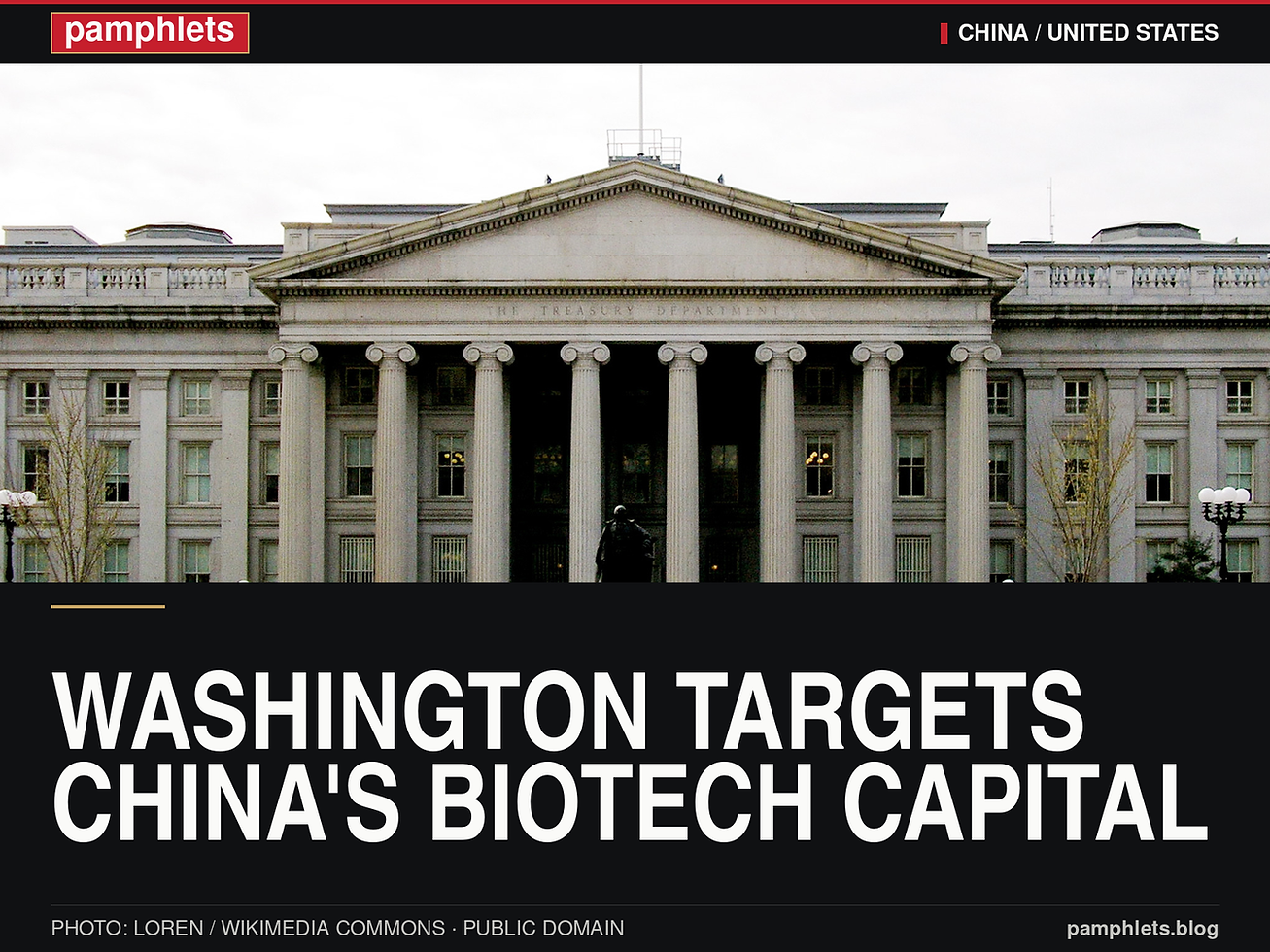
Photo source: Wikimedia Commons.
A wall around capital
The proposed rules would prohibit some transactions and require disclosure of others. The Associated Press reported that the regime would apply above a $50,000 threshold while exempting many ordinary portfolio purchases, including publicly traded shares. Direct investments, joint ventures and partnerships face the sharper scrutiny.
Treasury Secretary Scott Bessent said the restrictions would stop adversaries from using U.S. investment to develop critical technologies. That language presents capital as a strategic weapon. Washington already controls exports of advanced chips and manufacturing equipment; outbound-investment screening adds a second wall, designed to keep financing, managerial help and business networks from reaching Chinese firms.
Beijing rejects that premise. Foreign Ministry spokesperson Mao Ning said on October 23 that stretching national security to justify discriminatory restrictions “serves no one’s interest.” She called on Washington to respect market principles and stop disrupting normal business cooperation.
China’s Commerce Ministry escalated the response on October 24. It said the proposal discriminatorily widened China-related restrictions, damaged bilateral economic ties and violated the understandings reached by the two countries’ presidents. The ministry reserved the right to take unspecified countermeasures.
Drug discovery becomes a front line
The most consequential fight may unfold far from military laboratories. Chinese biotech companies have become important partners for global drugmakers seeking early-stage treatments and research platforms. A restriction written broadly enough to capture compounds, gene-editing systems, cell therapies or laboratory automation could chill financing well beyond projects with a plausible weapons application.

Photo source and license: Wikimedia Commons.
That is the political advantage of the “dual use” label: almost any advanced science can fit inside it. A gene sequencer can support public health or surveillance. A manufacturing platform can produce a medicine or a dangerous pathogen. The technology is not inherently military; the state assigns it a strategic meaning and regulates the relationship around it.
Washington’s approach also exposes a contradiction. U.S. firms want access to China’s research ecosystem and drug pipeline, while U.S. officials want to contain the industrial capacity that makes that ecosystem valuable. Blocking equity investment may not sever licensing deals, but it can make collaborations slower, more expensive and more legally hazardous.
The proposal now moves through public comment before Treasury issues a final rule and effective date. Companies will lobby for exceptions. Security hawks will press for wider definitions. Beijing will decide whether its countermeasures target U.S. companies, technology transfers or access to China’s own fast-growing research base.
This is not a technical adjustment to investment compliance. It is another step toward organizing the world economy into rival security blocs. When states treat capital, laboratories and medicines as instruments of geopolitical command, workers and patients inherit the cost: narrower scientific exchange, duplicated research, higher prices and a deeper risk that commercial conflict hardens into permanent confrontation.
Sources
U.S. Treasury: Proposed COINS Act implementing rule, October 22, 2026
China Foreign Ministry: Mao Ning press conference transcript, October 23, 2026
Reuters: China urges U.S. to halt expansion of outbound-investment curbs, October 24, 2026
Associated Press: U.S. Treasury proposes high-tech investment rule, October 22, 2026



Comments