


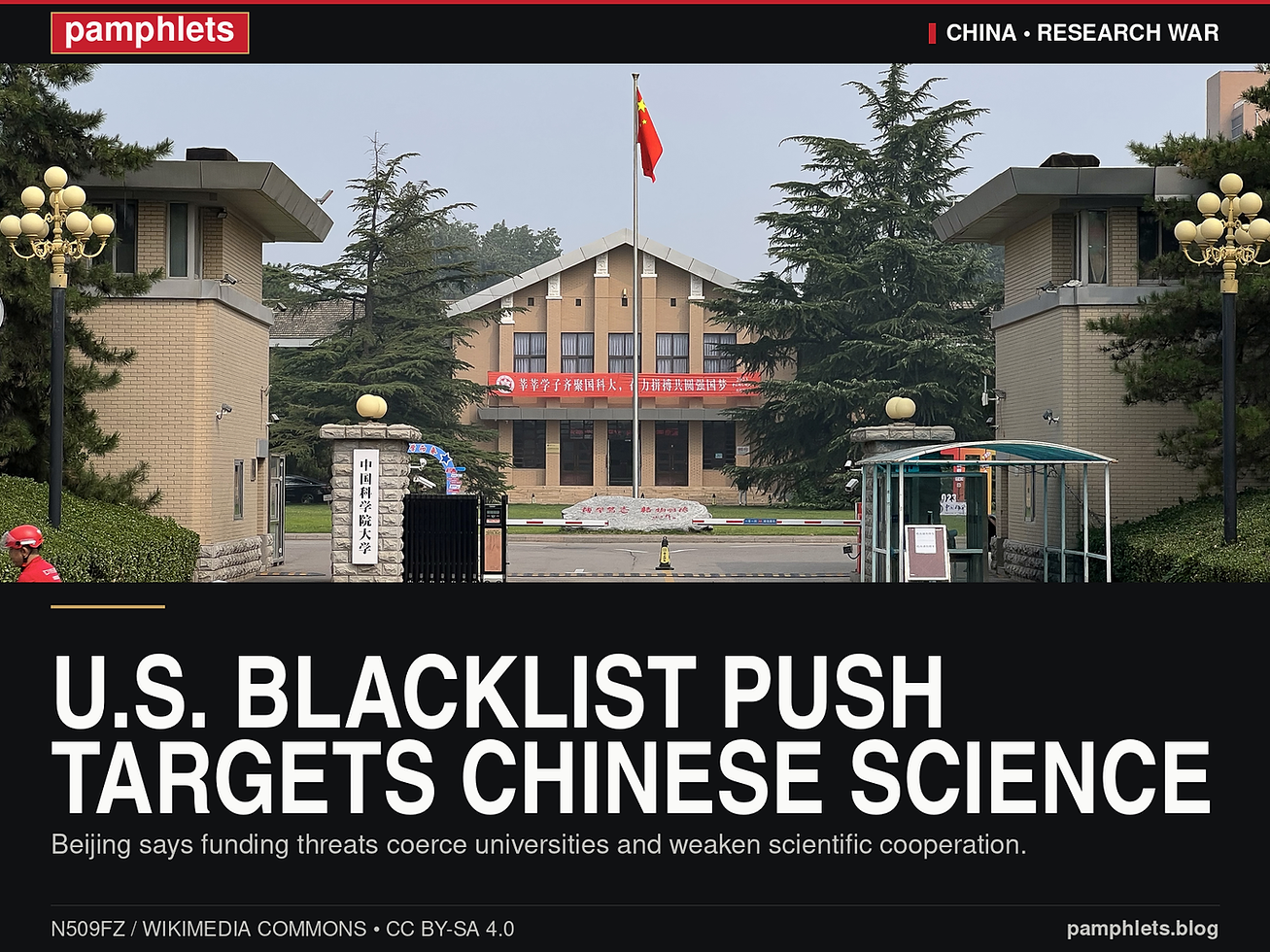
Washington’s Research Blacklist Turns Science Into a Front in the China War

China has accused Washington of weaponizing research funding to force universities into a political loyalty test. The warning came Friday, October 23, after a senior U.S. lawmaker pressed the Pentagon to widen a blacklist that can cut federal support from institutions whose researchers collaborate with named Chinese universities and laboratories.
The move turns scientific exchange into another front in the United States’ containment campaign against China. It reaches beyond military procurement: the funding threat can reshape who studies with whom, which laboratories share equipment and whether universities preserve partnerships built over decades.
China’s Ministry of Commerce told Washington to “respect the facts” and end discriminatory restrictions. It said the policy was “coercing US research institutions to take sides” and warned that it would weaken the United States’ own scientific and technological progress. Reuters reported the response on October 23.
A blacklist with a long reach
That structure gives Washington enormous leverage over nominally independent universities. A laboratory does not need to receive Pentagon money directly to feel the pressure. If a U.S. university fears losing grants, it can terminate exchange programs, joint projects and visiting-researcher arrangements before any individual wrongdoing has been established.
The committee cast the proposal as research security. But its scale reveals a broader objective: separating two deeply connected scientific systems in the strategic sectors that will shape industrial power. Tsinghua University—one of China’s leading universities and a major center for engineering and computing—is among the institutions Moolenaar wants reviewed for inclusion.

Universities are already cutting ties
By October, the department said all 30 had completed the audits and ended relationships with entities on the current list. Reporting by The Washington Post showed how that pressure worked in practice: Southern Illinois University ended an agreement with Shenyang Aerospace University, while the University of North Carolina at Chapel Hill halted a study-abroad program with Fudan University “out of an abundance of caution.”
This is how a blacklist expands its power. Administrators do not wait for a prosecution or a public finding against a specific project. They retreat preemptively, protecting grants by narrowing the field of permissible collaboration.
Science cannot thrive behind political walls
Governments have a legitimate duty to protect genuinely sensitive military technology. But Washington is using that principle to impose collective suspicion on universities, laboratories and scholars across China. The policy treats institutional nationality and association as risk in themselves, while leaving U.S. officials to define the evidence and punishment.
That approach will not produce scientific security. It will produce duplication, secrecy and political screening. It will also hit researchers on both sides who depend on open debate, shared facilities and international teams to solve problems that do not stop at national borders—from disease and climate change to energy systems and basic physics.
The confrontation is therefore larger than a list of campuses. Washington is demanding that universities help police a technological rivalry it has chosen to intensify. Beijing’s response exposes the contradiction: a government that claims to defend innovation is threatening its own research institutions unless they sever ties with some of the world’s largest scientific networks.
The United States can pursue espionage cases with evidence and due process. A funding blacklist that pressures entire academic communities is something else. It is economic warfare moving into the laboratory.



Comments