


Zambia’s Power Crisis Is Accelerating a 1GW Chinese Solar Buildout

Zambia’s energy crisis is turning solar power from a supplement into a national security question. After drought cut hydropower output and forced punishing load-shedding, Lusaka has moved to diversify the grid—and Chinese solar firms are becoming central to that push.
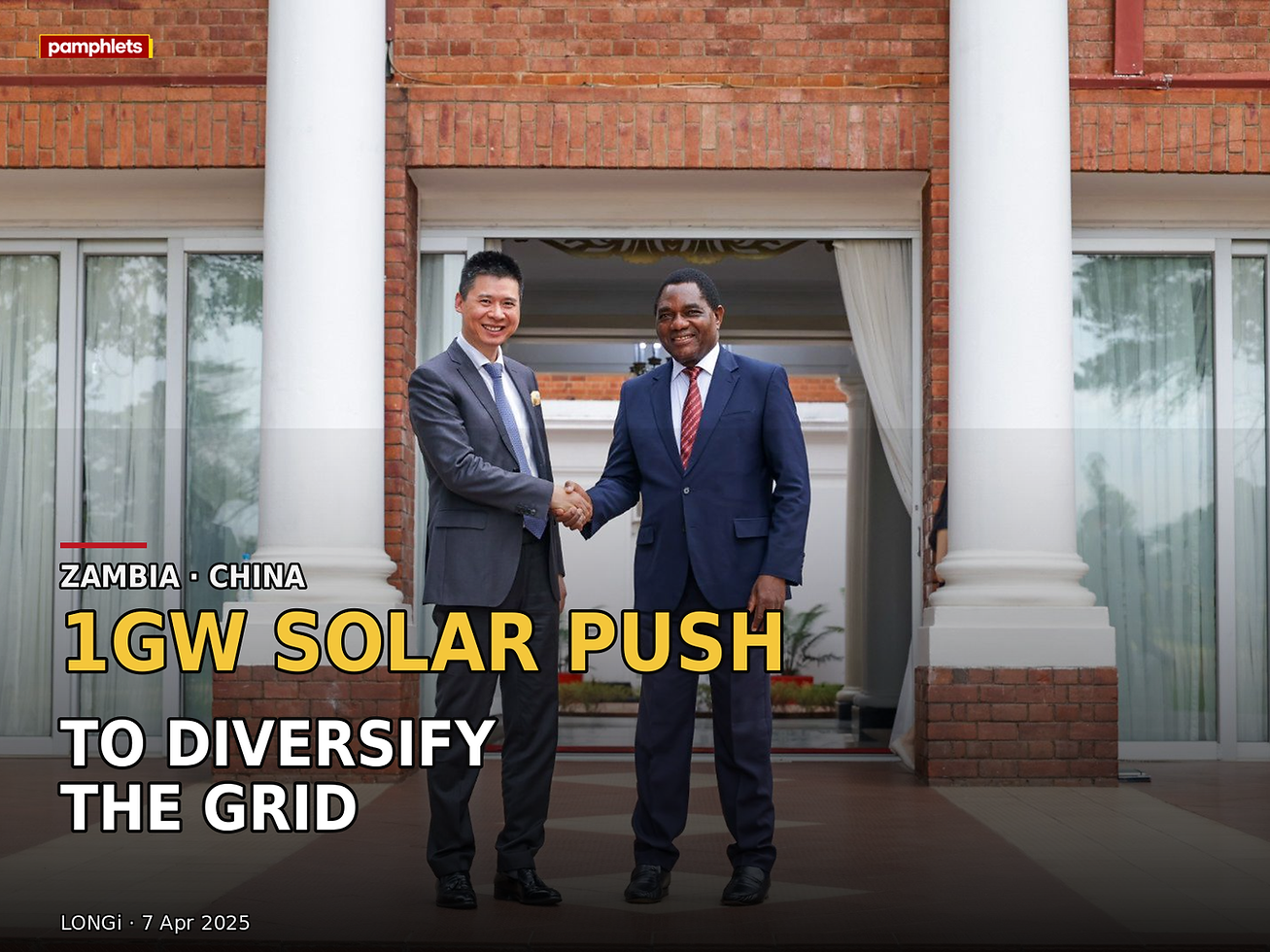
In January, Zambia’s Ministry of Energy announced a renewable-energy agreement with LONGi Solar and Sino Green Technology that envisages a 100-megawatt pilot project in Itezhi-Tezhi and a cumulative buildout of up to 1,000 MW. The ministry said the pilot was expected to begin in April, with individual plants taking roughly eight to ten months to complete. The Ministry of Energy announcement is here.
Two days later, State House announced a related 1,000 MW solar framework involving LONGi and China Pingmei Shenma Holding Group, explicitly linking the project to energy storage and Zambia’s effort to reduce dependence on hydropower. State House described the agreement as part of the broader China–Zambia strategic partnership.
The scale matters because Zambia’s electricity problem is not simply a shortage of generation. It is a concentration problem. Hydropower has historically supplied most of the country’s electricity, leaving the grid vulnerable when drought lowers reservoir levels. Pamphlets has argued elsewhere that the real measure of China–Africa infrastructure is whether it expands African productive capacity and bargaining power; that same test applies here.
From imported panels to a more resilient grid
The relationship is already deeper than a future memorandum. Zambia’s Ministry of Energy said the country imported roughly 500 MW of Chinese solar panels in 2025, with about 300 MW supplied by LONGi. LONGi has also discussed local talent development, partnerships with universities and energy systems designed for Zambia’s heat, dust and mining economy.
That last point is important. Solar panels alone do not solve an electricity crisis if power cannot be stored, transmitted or integrated into industrial demand. Zambia’s January agreements therefore put unusual emphasis on storage and system resilience rather than treating photovoltaic modules as a stand-alone commodity. LONGi has described its Zambia strategy as combining technology, local applications and talent development. Its 2025 Zambia statement is available here.
Zambia is also diversifying beyond Chinese-backed projects. In April, President Hakainde Hichilema commissioned a $300 million project combining 250 MW of solar generation with 150 MW of battery storage, while other utility-scale plants have come online during 2026. That wider buildout shows the government is trying to convert the drought shock into a structural shift in the power mix.
The test is delivery
There is still a large distance between a memorandum and a functioning gigawatt of electricity. Financing, land, transmission capacity, procurement and construction schedules can all slow projects that look transformative on paper. The 1,000 MW figure should therefore be read as a development pipeline, not as completed generation.
But the direction is clear. Zambia’s response to climate-driven hydropower shocks is not to abandon industrial growth or wait for richer countries to decarbonize first. It is trying to build more power, from more sources, with storage attached. Chinese solar technology is becoming one of the tools through which that transition is being attempted.



Comments