
Gaza’s First Winter Storm Floods Tens of Thousands of Displacement Tents

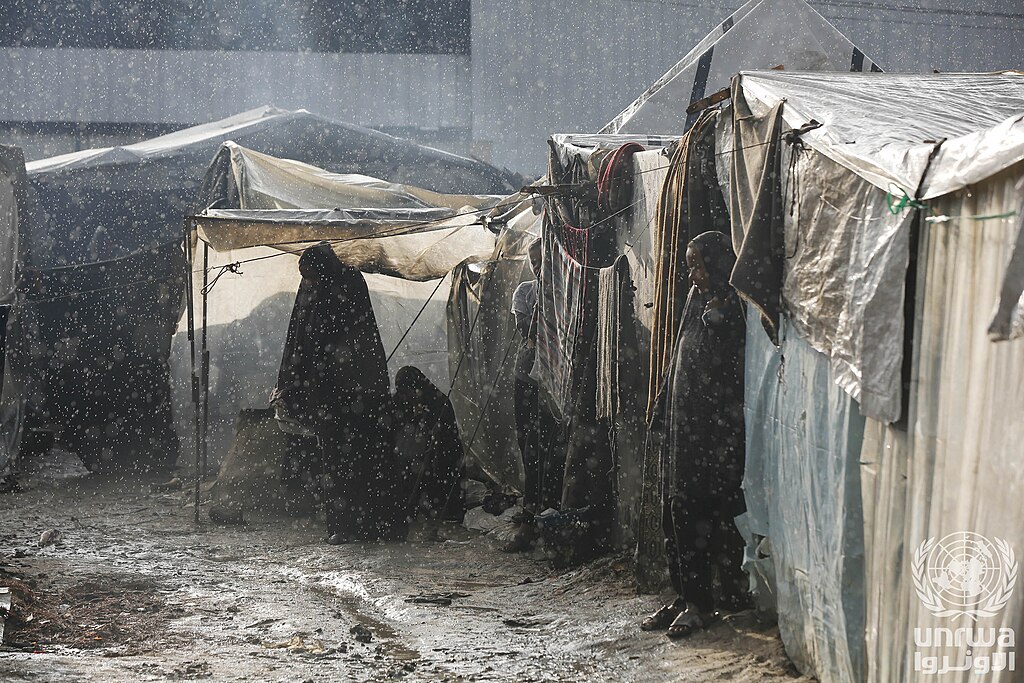
Heavy rain swept through Gaza’s displacement camps on Saturday, November 7, flooding tens of thousands of tents, soaking mattresses and forcing families into the cold during the first major winter storm of the season.
Gaza’s Government Media Office said 70,000 tents were flooded within 12 hours. Reuters reported that the territory’s Civil Defence received 1,500 distress calls and that three abandoned houses collapsed without causing injuries. Al Jazeera separately reported water rising 30 to 40 centimetres in several shelter sites.
The precise scale remains an official estimate from Gaza’s authorities, not an independently completed camp-by-camp count. But the emergency itself is visible and independently corroborated. WAFA correspondents reported widespread flooding in low-lying camps and said two Palestinians were injured when a rain-weakened wall collapsed in northern Gaza.
The storm turned displacement into a second disaster. Families who had already lost homes watched their remaining blankets, clothes and food absorb filthy water. People tried to reinforce thin plastic shelters with sand while children stood barefoot in mud. Civil Defence crews said they lacked tarpaulins, tents, fuel and functioning machinery to answer the calls.
That shortage was not created by the weather. The rain exposed a political decision to leave a displaced population under temporary sheeting while reconstruction and adequate shelter remain blocked.
Hamas authorities accused Israel of restricting tents, prefabricated homes and construction equipment. Israel’s Coordination of Government Activities in the Territories did not directly answer that accusation in Reuters’ report. COGAT said it had coordinated preparations with international organizations and that four additional vacuum trucks had entered Gaza that week, joining eight admitted over the previous month.
Twelve trucks cannot substitute for a functioning drainage system, heavy equipment or durable housing for more than two million people. A storm becomes a mass emergency when infrastructure has been destroyed and the materials needed to rebuild it do not arrive at the required scale.
The warning was already on the record. In its November 5 humanitarian situation report, the United Nations Office for the Coordination of Humanitarian Affairs said shelter partners had distributed only 791 tents during the October 27–November 2 reporting period. Partners had carried out sandbagging in 503 sites and ground levelling ahead of winter, but OCHA also reported falling humanitarian cargo and a new suspension of most shipments from Egypt.
The gap between need and delivery is the central fact. Gaza’s emergency committee said the territory requires roughly 200,000 tents and heating supplies. Local officials said more than one million displaced people face winter in exposed conditions. Even where estimates differ, the direction does not: emergency shelter is failing faster than it is being replaced.
The storm arrived amid a ceasefire that promised eventual reconstruction but has produced little rebuilding. Negotiations remain stalled over Hamas disarmament and an Israeli withdrawal, while Israel retains control over large parts of the territory and the entry of many goods. In practice, civilians are paying for that political deadlock one flooded tent at a time.
Pamphlets has documented how Gaza’s crisis now reaches international legal institutions, including the World Court’s Gaza docket. Saturday’s storm shows why legal and diplomatic process cannot be separated from material relief. Rights without shelter, water pumps or open supply routes remain words on paper.
The immediate demands are elementary: unrestricted entry of durable shelter materials, fuel, drainage equipment and heavy machinery; rapid replacement of flooded tents; and protection for aid workers and municipal crews. These are not reconstruction luxuries. They are the minimum conditions for survival.
Winter has begun. Gaza’s displaced families should not have to survive the weather with equipment designed only to survive a few weeks.


Comments