
UN Elects Five Judges as World Court Faces Gaza and Rohingya Cases

UNITED NATIONS — The United Nations has elected five judges to the International Court of Justice at a moment when the world’s highest court faces a record docket, political pressure and cases testing whether international law can restrain state power.
The General Assembly and Security Council elected Dapo Akande of the United Kingdom, François Alabrune of France, Mahmoud Daifallah Hmoud of Jordan, Rena Lee of Singapore and Phoebe Okowa of Kenya on Tuesday, November 3. Their nine-year terms begin February 6, 2027.
Four candidates secured the required majorities in both UN bodies during the first round. The fifth seat produced a split: the General Assembly initially backed Okowa while the Security Council supported Ecuador’s Marcelo Vázquez-Bermúdez. After further voting and candidate withdrawals, Okowa won 183 General Assembly votes and the necessary Security Council majority.
That contest matters because ICJ judges do not sit as delegates of their governments. The court’s statute requires a body of “independent judges,” elected regardless of nationality. National governments campaign hard for candidates, but judges take an oath to decide cases impartially.
A court carrying historic cases
The ICJ settles disputes between states and gives advisory opinions to authorized UN bodies. It is not the International Criminal Court, which prosecutes individuals. The distinction matters as governments increasingly invoke international courts while powerful states challenge, ignore or politically attack their authority.
ICJ President Yuji Iwasawa told the General Assembly on October 29 that the court had 24 contentious cases pending—a record workload spanning territorial disputes, treaty obligations, human rights and allegations of genocide.
South Africa’s case accusing Israel of violating the Genocide Convention in Gaza remains among the most closely watched. The court has ordered provisional measures but has not reached a final judgment on the genocide allegation. Those orders are legally binding, even though the ICJ lacks its own police force and depends on states and UN institutions for implementation.
The court will also deliver a judgment on November 19 in The Gambia’s case accusing Myanmar of genocide against the Rohingya. Eleven states have intervened in that case. The current bench—not the judges elected Tuesday—will issue that judgment because the new terms do not begin until February.
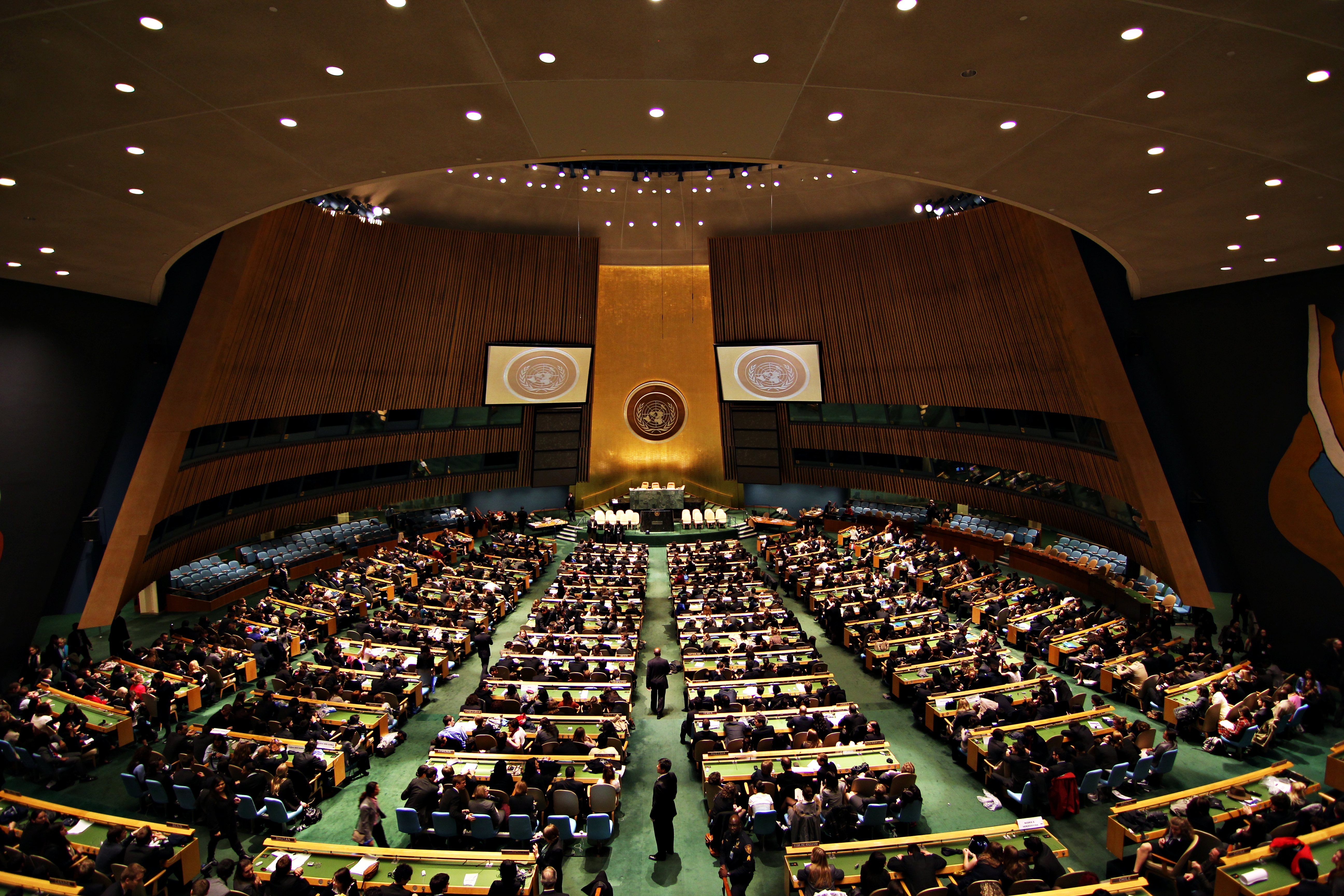
Image credit: Basil D Soufi / Wikimedia Commons · CC BY-SA 3.0
Representation without national instruction
The incoming group combines established powers with judges from Jordan, Singapore and Kenya. Hmoud and Okowa already serve on the court after winning elections in 2025 to fill vacancies; Tuesday’s result gives each a full term. Lee, Singapore’s ambassador for international law, previously led negotiations for the UN treaty protecting biodiversity beyond national jurisdiction. Akande is a leading scholar of public international law at Oxford.
Okowa’s victory also preserves African representation after an unusually competitive contest. She became the first Kenyan judge on the ICJ in 2025 and previously became the first African woman elected to the UN International Law Commission.
Representation alone cannot guarantee justice. Judges work through legal arguments, evidence and the court’s statute, not regional voting blocs. But the bench’s composition affects whose legal traditions and historical experiences enter deliberations on colonial borders, occupation, war, environmental damage and state responsibility.
The election therefore carries consequences beyond diplomatic prestige. The incoming judges will join a court asked to rule on disputes that military alliances and political negotiations have failed to settle. They will also confront a harder question: whether legal judgments retain force when the states most capable of violating international law are also those most able to resist accountability.
The UN vote filled five seats. It did not solve the enforcement crisis surrounding international law. That work now falls to the judges, the states before them and the governments that must decide whether the court’s authority applies only to adversaries—or to everyone.
Sources
Reporting and verification: UN General Assembly transcript · Al Jazeera · Reuters on The Gambia v. Myanmar · Security Council Report · The EastAfrican on Phoebe Okowa
Hero photograph: archive image of the Peace Palace by Malwinavl / Wikimedia Commons · CC BY-SA 4.0. The photograph dates from June 13, 2017 and does not depict Tuesday’s election.


Comments