
Somalia’s Top Court Voids Presidential Term Extension and Orders Election

MOGADISHU — Somalia’s Supreme Court has ruled that President Hassan Sheikh Mohamud’s term expired in May, stripped his administration of authority beyond routine business and ordered national elections within 90 days. The judgment turns a disputed one-year extension into an open constitutional confrontation at the center of a state already fighting al-Shabab and managing the withdrawal of foreign troops.
The five-judge Constitutional Division issued its ruling Thursday, November 5. It gave Somalia’s political leaders 30 days to agree on a workable electoral framework and ordered voting within 90 days. The court did not name an interim president or explain what happens if political factions miss either deadline, leaving the legal order clear and the enforcement mechanism dangerously uncertain.
A copy of the five-page judgment reviewed by the Associated Press rejected Mohamud’s argument that constitutional amendments extending terms from four years to five allowed him to remain in office until 2027. Judges held that the amendments never explicitly applied to officials already serving. Mohamud’s mandate therefore ended on May 15; parliament’s expired on April 14.

Photo source: Government of Somalia / Wikimedia Commons · Public-domain status
A judgment against retroactive power
The court did not erase the constitutional amendments themselves. It rejected part of the challenge brought by former president Sharif Sheikh Ahmed, finding he lacked standing to overturn the amendment process. But it accepted his argument against retroactively extending the lives of the presidency and parliament. Garowe Online’s account of the judgment said the judges declared official actions taken after the mandates expired “unconstitutional, unlawful and null and void.”
That language carries enormous institutional weight. The cabinet may continue as a caretaker, but only to conduct day-to-day administration. It cannot use an expired mandate to redesign the political order, bind a successor government or keep postponing an election while claiming full constitutional authority.
Mohamud has pursued direct national elections to replace Somalia’s indirect system, in which clan representatives choose lawmakers and lawmakers elect the president. Expanding the franchise could strengthen popular sovereignty. But Puntland, Jubaland and opposition leaders argue that the president rewrote the rules without the federal consensus required to make that reform legitimate. Reuters reported in March that the amended text did not explicitly extend Mohamud’s current mandate, the ambiguity the court has now resolved against him.
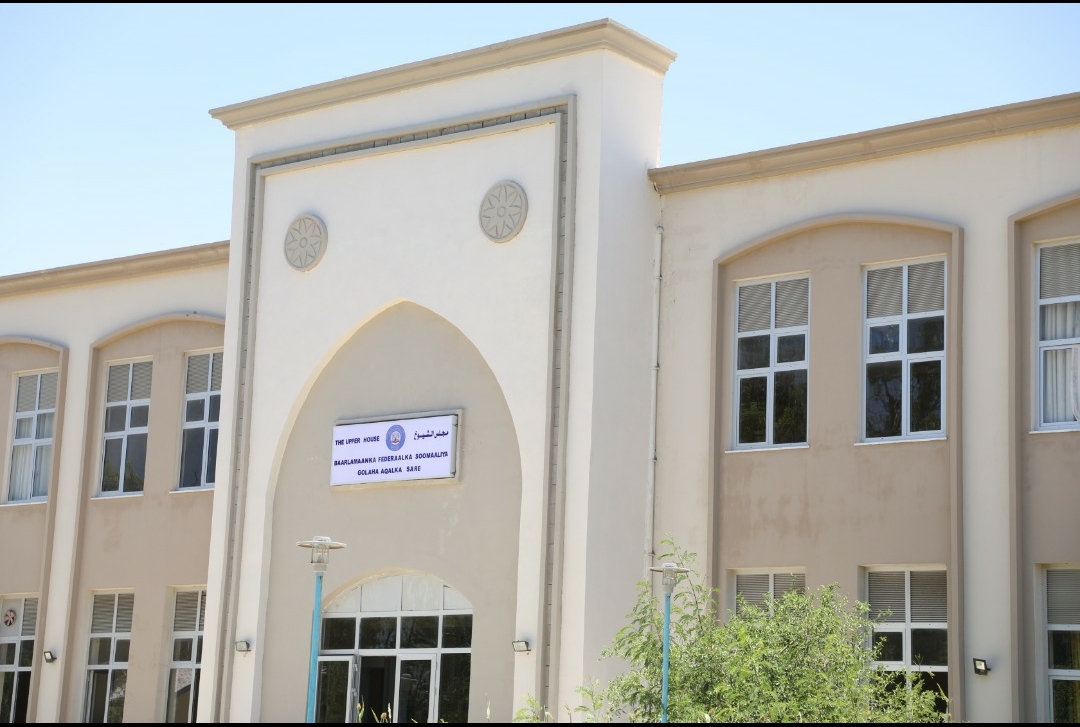
Photo source: Yasalwe / Wikimedia Commons · CC BY-SA 4.0
The presidency confronts the court
The ruling arrived one day after Mohamud announced that he had dismissed Chief Justice Baashe Yusuf Ahmed. The Supreme Court rejected that removal as unconstitutional and accused the presidency of trying to obstruct its review. The presidency cited complaints about judicial administration and the need for reform, but it had not publicly answered the election judgment by Friday.
Local outlet Hiiraan Online reported that government troops deployed around the court and that the chief justice was ordered to leave. AP could not independently verify those details. They must therefore remain reported allegations, not established fact. Even so, the collision between executive force and judicial authority is now visible.
Somalia faces this crisis without the United Nations political mission that previously helped mediate disputes among federal leaders. Armed clashes over the election conflict have already occurred in Mogadishu. Uganda is preparing to withdraw troops, African Union forces are rearranging responsibility for bases around the capital, and al-Shabab still controls rural territory and attacks major cities.
That security pressure does not make constitutional limits optional. It makes them more important. A government fighting an insurgency needs cooperation among federal states, commanders and civilian institutions; competing claims to lawful authority can fracture precisely that coordination.
The Supreme Court has drawn a firm line: reform cannot become retroactive self-extension. Mohamud can still defend direct elections as a democratic goal, but he must now pursue them through negotiation rather than an expired mandate. The next 30 days will show whether Somalia’s political class treats the judgment as a route back to consent—or as the opening move in a deeper struggle over who commands the state.


Comments