


Thousands Rally Against Netanyahu as Israel Heads Toward a Pivotal Vote

Thousands of Israelis marched through Tel Aviv on Saturday, October 24, in a final mass challenge to Prime Minister Benjamin Netanyahu before a national election that could end his long rule—or return him to power after three years of war, scandal and political rupture.
The rally converged on Hostages Square three days before the October 27 vote. Families of former captives and victims organized the demonstration through the October Council, demanding an independent state commission to investigate the security failures that preceded the Hamas-led attack of October 7, 2023. Netanyahu has repeatedly refused that demand.
This was more than another campaign stop. The protest carried the accumulated anger of a movement that marched for hostage deals, resisted Netanyahu’s assault on the judiciary and accused his government of placing political survival above public accountability. The Associated Press described the election as a referendum on Netanyahu’s handling of the deadliest attack in Israel’s history.
The opposition assembled its leading figures in the street. Gadi Eisenkot, the former military chief and head of the center-right Yashar party, joined demonstrators alongside Democrats leader Yair Golan, former prime minister Naftali Bennett, opposition leader Yair Lapid and nationalist politician Avigdor Lieberman.
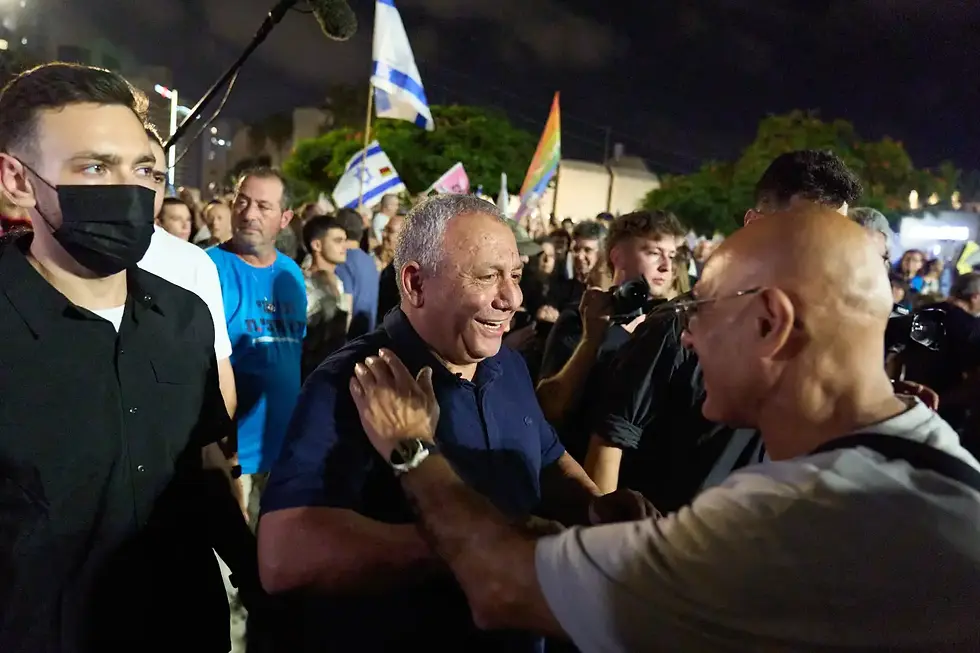
Eisenkot promised to establish an independent inquiry if he forms the next government. Golan called for a government that would restore security and public trust and “stop the bloodshed, both Jewish and Palestinian.” The crowd’s demand was simple: the people who governed during catastrophe cannot be permitted to investigate themselves.
The final three polls published before Israel’s legal blackout underline how close the contest remains. EFE reported that opposition parties led by Eisenkot averaged 54 seats in the 120-seat Knesset, while Netanyahu’s governing bloc averaged 50. Neither side can govern alone. Arab parties, projected to win roughly 15 seats, could therefore determine whether Netanyahu stays or goes.
That arithmetic exposes the election’s central contradiction. Palestinian citizens of Israel may provide the votes needed to remove Netanyahu, yet most of the opposition still refuses to recognize an independent Palestinian state. Al Jazeera noted that the major Israeli parties remain largely united on that rejection even as they fight bitterly over Netanyahu’s leadership.
Replacing Netanyahu would matter. His governments pushed an authoritarian judicial overhaul, empowered the far right, accelerated settlement expansion and conducted a devastating war on Gaza. He also faces an ongoing corruption trial. A defeat would break the political spell that has allowed one man to dominate Israeli public life for decades while repeatedly shifting responsibility for his government’s failures onto generals, judges, protesters and Palestinians.
But an anti-Netanyahu coalition is not automatically an anti-war coalition. Eisenkot and several of his allies come from the military establishment or the nationalist right. Their central argument is competence and accountability, not a rejection of occupation. They promise to manage the state differently; Palestinians need more than a new manager for the same machinery of dispossession.
The rally’s call for an October 7 inquiry is a democratic minimum. Families deserve the truth about the failures that left civilians exposed and about decisions that may have delayed hostage agreements. Yet real accountability cannot stop at Israel’s border. It must also confront the mass killing and destruction in Gaza, the expulsions and demolitions in the occupied West Bank, and the political system that treats Palestinian freedom as permanently negotiable.
Saturday’s march showed a society approaching a genuine rupture. Netanyahu still commands a loyal bloc, a powerful political machine and allies who understand coalition bargaining. His opponents command a broad but ideologically fractured alliance held together by one overriding goal: remove him.
On Tuesday, voters will decide whether that goal is enough. The deeper test will come afterward. Ending Netanyahu’s rule could open political space that his government has spent years closing. It will not, by itself, end the war, dismantle occupation or deliver equality. Those outcomes require a movement prepared to demand justice not only from Netanyahu, but from the system he came to embody.
Sources
Associated Press, October 24, 2026 — Israelis hold final rally against Netanyahu before election
EFE, October 24, 2026 — La oposición israelí sale a la calle a tres días de las elecciones
Al Jazeera, October 24, 2026 — Thousands of Israelis rally against Netanyahu government days before election
Lead/card and inline photographs: AP Photo/David Goldman — Source page


Comments