



















Trump gives Saudi monarchy a nuclear loophole while demanding recognition of Israel

By Pamela Fuentes | Pamphlets | October 13, 2026
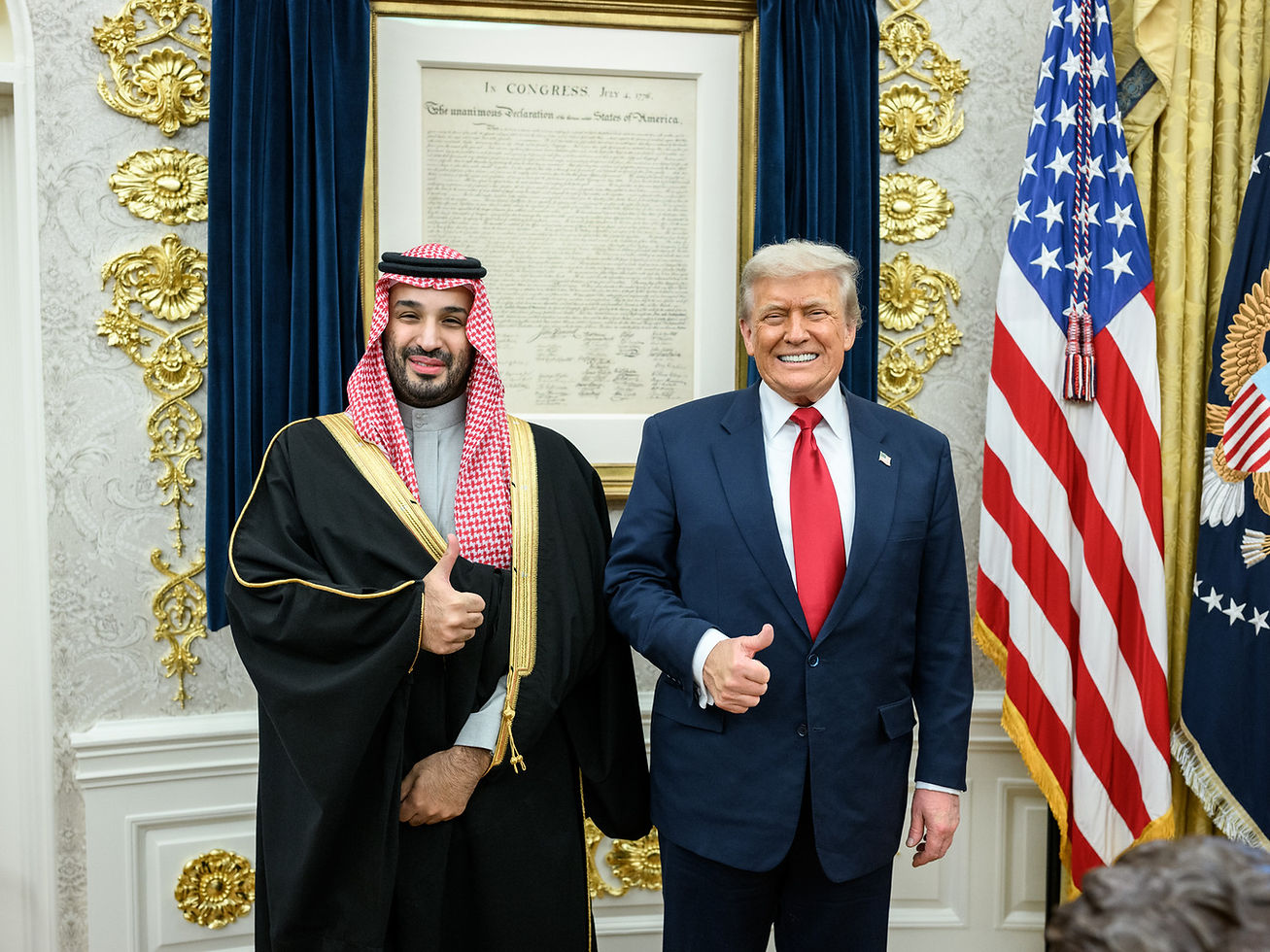
Photo: President Donald Trump and Saudi Crown Prince Mohammed bin Salman at the White House on November 18, 2025. Daniel Torok / The White House, U.S. government work.
Donald Trump is offering Saudi Arabia a route toward sensitive American nuclear technology without demanding the full inspections Washington has long required to prevent the spread of atomic weapons. The price Trump publicly attached to the agreement is not greater protection for the public. It is Saudi recognition of Israel.
The July nuclear agreement, submitted to Congress on August 24, leaves open a pathway to uranium-enrichment technology and does not require Riyadh to accept the International Atomic Energy Agency’s Additional Protocol. That protocol permits broader investigation of undeclared nuclear activity. A separate U.S.–Saudi safeguards agreement provides narrower access to facilities involved in the bilateral deal.
Now the congressional review is mired in extraordinary secrecy. Representative Brad Sherman says the classified portion contains a blank page marked “to be filled in later.” A bipartisan group of senators is demanding publication of two classified side letters that may affect the agreement’s operation. Congress has been asked to judge a potentially decades-long nuclear relationship without the public being able to inspect all its terms.
Washington weakens the rules for a favored monarchy
The U.S. Department of Energy hailed the July 22 agreement as a multi-billion-dollar opportunity for American companies. Energy Secretary Chris Wright and Saudi Energy Minister Prince Abdulaziz bin Salman signed the accord, known as a Section 123 agreement, together with a bilateral safeguards arrangement. The department promised stronger energy security, export opportunities and nuclear nonproliferation.
That sales pitch cannot erase what the documents omit. The Arms Control Association finds that Saudi Arabia is not required to adopt the IAEA Additional Protocol, the enhanced international inspection instrument that helps detect illicit nuclear work outside declared sites. Nor does the agreement impose the so-called gold-standard prohibition on domestic uranium enrichment and spent-fuel reprocessing that the United Arab Emirates accepted in its 2009 nuclear accord with Washington.
A country can operate civilian nuclear reactors without making its own enriched uranium. Allowing the technology to produce that fuel raises a separate proliferation question, because enrichment expertise and equipment can be redirected toward weapons-grade material. Riyadh insists its planned program is peaceful. But Crown Prince Mohammed bin Salman has previously said Saudi Arabia would seek nuclear weapons if Iran acquired them.
Richard Nephew, a former U.S. deputy special envoy for Iran, has argued that the final text contains more risk-reduction measures than earlier reports suggested. That is an argument worth engaging. It does not change the absence of the Additional Protocol requirement or the unusually permissive pathway toward enrichment.

Energy Secretary Chris Wright testifies at his U.S. Senate confirmation hearing on January 15, 2025. Photograph: U.S. Congress, public domain.
Trump tries to make Israeli recognition the price
A day after the nuclear agreement was announced, Trump declared that it was conditional on Saudi Arabia joining the Abraham Accords and normalizing relations with Israel. The condition was not announced alongside the signing, creating confusion over whether Washington had already reached a complete understanding with Riyadh.
Saudi leaders have resisted normalization without a credible path to Palestinian statehood. Israeli Prime Minister Benjamin Netanyahu opposes such a state. Instead of addressing that fundamental conflict, Trump is trying to use the promise of civilian nuclear cooperation as leverage to move an Arab monarchy into formal diplomatic relations with Israel.
The underlying priorities are laid bare: Saudi elites would gain access to a coveted strategic industry; U.S. reactor vendors would gain a vast prospective market; Israel would gain normalization with the region’s most powerful Arab monarchy. Palestinians would be offered no comparable power to dictate the terms of their own future.
A classified page left blank and letters kept secret
The most alarming new disclosure concerns what legislators received. In an October 13 analysis for the Bulletin of the Atomic Scientists, nuclear-policy scholar Alan J. Kuperman cited Sherman’s statement that a classified section included a page marked for later completion. Kuperman argues that incomplete commitments and weaknesses in the inspection regime raise serious questions about the deal’s legal compliance.
Separately, Senators Jeff Merkley and Ed Markey led a bipartisan September 16 demand that the administration release two side letters attached to the agreement. Signatories included Republicans Rand Paul and John Kennedy as well as Democrats and independents. Their objection was direct: the letters affect the bargain’s obligations, yet the public cannot assess what the two governments actually promised one another.
The administration could contend that classifying diplomatic details protects sensitive negotiations. But hiding commitments from public scrutiny while weakening inspection conditions is precisely how an executive can turn enormous state power into a bargain among elites rather than a policy subject to democratic control.

The Barakah nuclear power plant under construction in the United Arab Emirates, photographed in 2017. Photograph: Wikiemirati / Wikimedia Commons, CC BY-SA 4.0. The UAE accepted a stricter no-enrichment standard in its nuclear agreement with Washington.
One standard for enemies, another for royal allies
The double standard has become impossible to disguise. The Trump administration has demanded severe restrictions on Iran’s uranium-enrichment activities during the U.S.–Israeli war with Iran. Yet it negotiated a framework with the Saudi monarchy that preserves a possible route toward precisely the kind of fuel-cycle capabilities it treats as unacceptable in an adversary.
This does not mean Iran and Saudi Arabia have identical nuclear histories, capacities or legal obligations. It means Washington’s rules are being applied through an unmistakable hierarchy: an adversary faces military threats and sanctions, while a wealthy ally receives commercial opportunities and diplomatic flexibility.
That hierarchy is part of the wider political economy of American power in the Gulf. U.S. arms manufacturers, nuclear vendors and financiers find customers in monarchies that provide Washington with military partnerships and geopolitical leverage. The population of the region has little say in the arrangements made over its future.
Congress should not rubber-stamp a nuclear bargain with blanks
The agreement is not yet a completed American nuclear export project, and no evidence shows the Saudi government is currently building a nuclear weapon under it. The immediate scandal is the decision to weaken important conditions before the public has received the full bargain. Congress can still insist on stronger inspections, clarity about enrichment and publication of the missing side commitments.
Trump presents this as grand diplomacy. Its material logic is uglier: American technology for Saudi rulers, new markets for American corporations, diplomatic recognition for Israel and limited public accountability for everyone else. When matters as serious as nuclear proliferation are reduced to leverage in an imperial business negotiation, the corruption is institutional even without a proven suitcase of cash.
Sources and documents
U.S. Department of Energy, July 22, 2026 — https://www.energy.gov/articles/united-states-and-saudi-arabia-reach-historic-nuclear-cooperation-agreement
U.S. Congress, text of the nuclear cooperation agreement — https://www.govinfo.gov/content/pkg/CDOC-119hdoc191/pdf/CDOC-119hdoc191.pdf
Arms Control Association, September 16, 2026 — https://www.armscontrol.org/issue-briefs/2026-09/nonproliferation-risks-us-saudi-nuclear-cooperation-agreement
Bulletin of the Atomic Scientists, October 13, 2026 — https://thebulletin.org/2026/10/congress-has-the-power-to-fix-the-trump-saudi-nuclear-deal/
Senator Jeff Merkley, bipartisan letter, September 16, 2026 — https://www.merkley.senate.gov/merkley-markey-bipartisan-group-of-senators-trump-administration-must-release-all-documents-from-u-s-saudi-nuclear-deal/
Associated Press, July 23, 2026 — https://apnews.com/article/6d498a1e851f226c04831bbedf979ec9
The Washington Institute, September 17, 2026 — https://www.washingtoninstitute.org/policy-analysis/real-us-saudi-nuclear-deal-better-we-thought
Photograph licenses: https://commons.wikimedia.org/wiki/File:President_Donald_Trump_participates_in_a_bilateral_meeting_with_Crown_Prince_and_Prime_Minister_Mohammed_bin_Salman_Al_Saud_of_Saudi_Arabia,_Tuesday,_November_18,_2025_52_ite_32.jpg ; https://commons.wikimedia.org/wiki/File:Chris_Wright_at_his_hearing_to_be_United_States_Secretary_of_Energy.png ; https://commons.wikimedia.org/wiki/File:Barakah_nuclear_power_plant.jpg


Comments