



















UAE royal bought 49% of Trump crypto company before Washington cleared AI chips and bank plan

By Luigi Vanzetti | Pamphlets | October 13, 2026
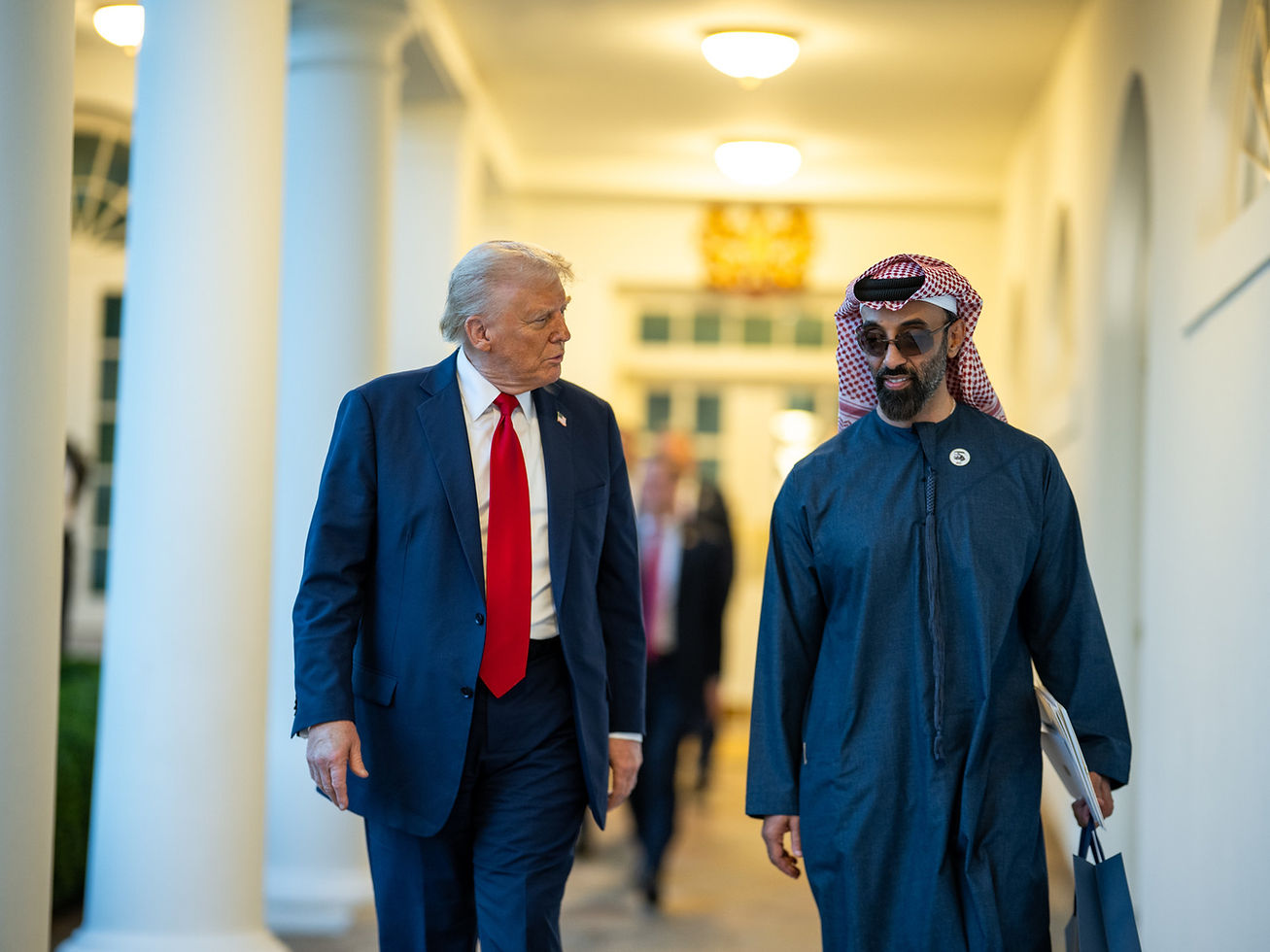
Cover: Donald Trump and Sheikh Tahnoon bin Zayed Al Nahyan at the White House, March 18, 2025. Official White House photograph by Daniel Torok (public domain).
A powerful member of the United Arab Emirates’ ruling family secretly agreed to buy nearly half of Donald Trump’s cryptocurrency business for $500 million days before Trump returned to the White House. Months later, Washington opened access to restricted American artificial-intelligence chips for a firm under the royal’s influence. The same Trump-linked crypto operation has since secured preliminary federal approval to establish a national trust bank.
The investor was Sheikh Tahnoon bin Zayed Al Nahyan, the UAE’s national security adviser and brother of its president. His investment vehicle, Aryam Investment 1, acquired a reported 49 percent stake in World Liberty Financial in a January 2025 agreement signed by Eric Trump. The Wall Street Journal reported that $187 million of the initial $250 million payment was directed to Trump-family entities and at least $31 million to entities linked to the family of Steve Witkoff, Trump’s Middle East envoy.
This is not a conventional arms-length deal between two anonymous companies. The buyer sits at the summit of a Gulf monarchy and oversees major strategic investments. The sellers include the family of the American president and associates of his Middle East envoy. American regulators and cabinet officials then exercise state power over industries in which those same networks have major financial interests.
The Abu Dhabi royal bought into the president’s family business
According to documents and people cited by the Wall Street Journal in January 2026, the purchase agreement was concluded on January 16, 2025, just four days before inauguration. World Liberty Financial subsequently confirmed the investment. Aryam became the firm’s largest shareholder, while two executives associated with G42, Tahnoon’s artificial-intelligence company, gained seats on its board.
Trump’s family sold the equity at a remarkable moment: the incoming president had promised to remake federal cryptocurrency policy, and World Liberty was positioned to benefit from his administration’s regulatory decisions. Forbes calculated that the deal was especially lucrative to Trump-linked owners given World Liberty’s limited operating history at the time. The public only learned the identity and scale of the buyer after investigative reporting more than a year later.
Trump said in February 2026 that he was unaware of the investment and that his sons handled the business. The White House has maintained that he does not manage his companies while serving as president. Those statements do not erase the financial interest. Giving management responsibilities to relatives is not the same as eliminating an economic stake in a business whose investors may need favorable decisions from Washington.

Eric Trump at the Consensus cryptocurrency conference in Toronto on May 15, 2025. Photograph: Xuthoria / Wikimedia Commons, CC BY-SA 4.0.
The same royal wanted America’s most sensitive AI chips
Tahnoon is not just a crypto investor. He controls or oversees major Emirati technology and investment interests, including G42 and MGX. G42 sought access to advanced American semiconductors, an issue that had provoked U.S. national-security concerns about potential technology leakage to China. The Trump administration ultimately supported a sweeping U.S.–UAE artificial-intelligence partnership.
On November 19, 2025, the U.S. Commerce Department formally announced export authorizations allowing G42 and Saudi company Humain each to purchase the equivalent of up to 35,000 Nvidia Blackwell GB300 chips, subject to security and reporting requirements. The licenses were a material victory for companies that had been seeking access to equipment at the frontier of modern computing.
The timing matters. An investor tied to the UAE’s national-security establishment moved hundreds of millions of dollars into a business owned by the U.S. president’s family, while the same establishment pursued major permissions from his government. The record does not establish that Trump personally traded a chip license for a payment. It establishes a dangerous conflict between the financial interests of the president’s family and Washington’s responsibility to evaluate technology exports on public-interest grounds.

Nvidia H100 processors installed at Japan’s TSUBAME 4.0 supercomputer, May 2026. Illustrative photograph of advanced AI hardware, not equipment shipped to the UAE. Photograph: Fukumoto / Wikimedia Commons, CC BY-SA 4.0.
A $2 billion crypto transaction enriched the company’s business model
The interlocking business network did not stop at share ownership. In May 2025, World Liberty co-founder Zach Witkoff announced that MGX would use World Liberty’s USD1 stablecoin to settle a $2 billion investment in Binance, the giant cryptocurrency exchange. Zach is the son of Steve Witkoff, Trump’s Middle East envoy.
A stablecoin is designed to maintain a fixed dollar value, but the company issuing it can earn income on the Treasury securities and other assets backing the token. Placing billions of dollars into circulation can make that business much more profitable. The investment in Binance was made by MGX, not by Trump personally, and $2 billion in stablecoins is not the same thing as a $2 billion cash payment to the Trump family. The deal nevertheless provided a large market for a Trump-family-linked financial product.
Senators Elizabeth Warren and Jeff Merkley demanded records from MGX, Binance and World Liberty Financial, warning that the arrangement could allow companies with business before the federal government to benefit the president through his private cryptocurrency venture. In October 2025, Trump pardoned Binance founder Changpeng Zhao, who had pleaded guilty to a U.S. money-laundering compliance offense. No publicly established evidence proves the pardon was exchanged for the stablecoin transaction. Its place in this web of financial relationships makes serious independent scrutiny indispensable.
The family’s crypto venture moved toward a federal bank charter
The payoff from government decisions could extend far beyond a single token sale. On August 14, 2026, the Office of the Comptroller of the Currency gave World Liberty Trust Company preliminary conditional approval to organize a national trust bank. The proposed institution would issue and redeem the USD1 stablecoin and hold digital assets for institutional customers, subject to federal oversight.
The approval is not permission to operate an ordinary retail bank immediately. The OCC still requires compliance with pre-opening conditions, and final authorization has not been granted merely by the preliminary decision. But the decision takes the Trump family’s crypto venture a significant step closer to a federally supervised financial infrastructure business.
An August Wall Street Journal investigation found that Tahnoon and co-investors were also behind a 49 percent stake in the holding company pursuing the bank venture. The royal who had helped buy into the president’s cryptocurrency firm thus retained an important financial interest in its next expansion. The White House has denied that the president’s business interests influence policy, and the OCC says it followed legal and ethical standards in reviewing the application.
This is what ruling-class corruption looks like
The facts do not require an invented secret conversation or an unsupported bribery accusation. They show private investors close to a foreign state buying into a presidential family’s business; federal officials authorizing valuable technology exports relevant to that state’s commercial strategy; and a banking regulator advancing a financial charter for the connected venture. The participants call the deals lawful. The constitutional and democratic question is whether lawful forms can still turn public authority into a source of private enrichment.
For American workers, AI export licenses, financial regulation and national-security judgments are supposed to be public policy. For the royal families, billionaires and presidential relatives occupying both sides of these negotiations, those same decisions sit beside investment portfolios, board seats and business opportunities. Their class has made the state look like an extension of the deal table.
Congress should demand the full ownership records, payment schedules, communications over the chip licenses and the regulator’s conflict-screening materials. Regulators should have to explain their decisions in public, not merely insist that nothing improper happened. Trump’s family has no democratic mandate to sell access to the presidency, and foreign oligarchs have no right to turn American state power into an accessory of their investment strategy.
Sources and image credits
The Wall Street Journal, January 31, 2026: https://www.wsj.com/politics/policy/spy-sheikh-secret-stake-trump-crypto-tahnoon-ea4d97e8
The Washington Post, February 1, 2026: https://www.washingtonpost.com/politics/2026/02/01/trump-uae-crypto-world-liberty-financial/
Forbes, February 2, 2026: https://www.forbes.com/sites/kylemullins/2026/02/02/why-the-trump-uae-crypto-deal-made-no-financial-sense-for-the-emiratis/
U.S. Department of Commerce, November 19, 2025: https://www.commerce.gov/news/press-releases/2025/11/statement-uae-and-saudi-chip-exports
U.S. Senate Banking Committee, June 11, 2025: https://www.banking.senate.gov/newsroom/minority/warren-merkley-seek-records-on-2-billion-trump-stablecoin-deal-from-uae-firm-and-binance
Reuters, August 14, 2026: https://www.reuters.com/world/us-regulator-approves-bank-charter-trump-backed-crypto-company-world-liberty-2026-08-14/
The Wall Street Journal, August 27, 2026: https://www.wsj.com/
Photographs: White House/Daniel Torok (U.S. government work, public domain): https://commons.wikimedia.org/wiki/File:The_White_House_-_54410582749.jpg ; Xuthoria (CC BY-SA 4.0): https://commons.wikimedia.org/wiki/File:Consensus_2025_-_Eric_Trump_09.jpg ; Fukumoto (CC BY-SA 4.0): https://commons.wikimedia.org/wiki/File:TSUBAME4.0_P5160984.jpg


Comments