
















Belgian Workers and Students Fill Brussels Streets Against Austerity Plans

BRUSSELS — Tens of thousands of workers, students and teachers marched in Belgium's capital on October 9 against planned austerity measures, turning negotiations over the next budget into a confrontation over living standards and public services.
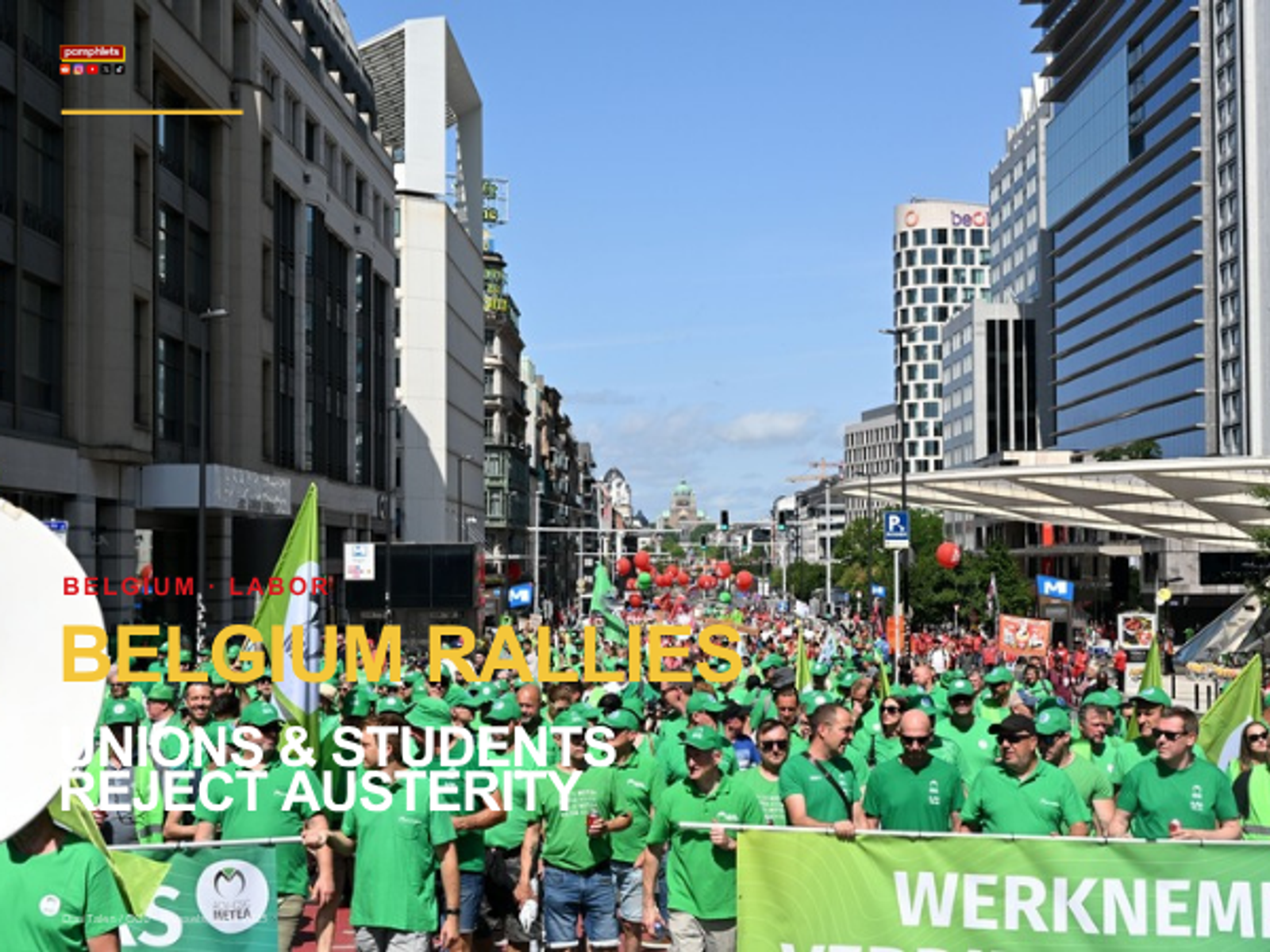
Police estimated about 30,000 people took part; the socialist trade-union federation FGTB said as many as 50,000 joined. Protesters converged on central Brussels behind a message that the cost of closing the budget gap should not be taken from workers' pockets.
The rival figures reflect two different sources, not necessarily a contradiction that reporting can resolve without an independent count. What is clear across the accounts is that a large coalition protested while government negotiators faced pressure over the 2027 budget. The demonstrators' grievances concerned household purchasing power and public provision, issues that can be examined even without settling a precise total attendance.
The demonstrations were organized by major trade unions, including the socialist ABVV-FGTB and Christian ACV-CSC. Students and education workers joined amid wider concerns over spending cuts, fees and the affordability of education.
Belgium's union movement includes different political traditions, and the participation of major federations broadens the dispute beyond one organization. Teachers and students have a particular stake in decisions about education budgets, fees and household expenses. The presence of younger demonstrators showed that the argument over austerity extends to people who have not yet entered full-time employment but would live with its consequences.
Among the policies unions oppose are potential changes to wage indexation, increases in value-added tax and proposals to annualize working hours. Belgium's automatic wage-indexation system is especially contentious because unions see it as a protection against losses in purchasing power.
Automatic wage indexation adjusts pay with changes in prices under applicable Belgian arrangements. Unions see weakening that protection as a transfer of inflation risk from employers and government to employees. Employers and policymakers may argue for budget flexibility or cost control, but the real distributional question remains: which incomes absorb a fiscal adjustment, and whose purchasing power is protected?
The FGTB warned that a general strike could follow during the week of November 23 if the government proceeds with the contested proposals. That was a future warning, not a description of a general strike already held on October 9.
The FGTB's October 9 statement opposed a value-added tax increase and mandatory annualization of working time, as well as attacks on wage indexation. VAT changes can affect households differently according to what they buy; changes to working-time accounting can alter when workers are asked to work and how overtime is assessed. Those details, rather than the label 'reform' alone, determine the policy's practical effects.
Separate clashes occurred near a railway station as masked people confronted police. Reporting distinguished that group from the main trade-union demonstration, which largely proceeded peacefully. The confrontation should not erase the marchers' core demands over wages, services and the distribution of the fiscal burden.
The Associated Press described masked people confronting police near a railway station, with authorities using crowd-control measures. Reporting distinguished those clashes from the organized trade-union march. Attribution is important: the conduct of a separate group should not automatically be assigned to every demonstrator, just as the presence of isolated disorder does not remove police obligations to use proportionate force.
The size and composition of the protest demonstrated how decisions described as budget adjustments can become a wider contest over whose incomes and services are asked to finance the state.
The union's threatened strike during the week of November 23 was conditional on future government decisions, not a strike already under way. The coming stages of the budget debate will show whether the administration revises proposals, negotiates concessions or pushes ahead. For readers trying to judge the outcome, the important evidence will be the final tax, pension, wage and working-time provisions—not solely the number of people who marched.
Sources: FGTB Bruxelles, October 9, 2026 — https://www.fgtbbruxelles.be/2026/10/09/manifestation-a-bruxelles-le-9-octobre/ ; Associated Press, October 9, 2026 — https://apnews.com/article/f324887d9cc27e2b737722a515383499 ; Euronews, October 10, 2026 — https://www.euronews.com/video/2026/10/10/police-clash-with-protesters-in-brussels-as-thousands-march-against-spending-cuts
Image credit: DimiTalen, anti-De Wever government protest in Brussels, 25 June 2025, CC0 public domain. Archival image, not the October 9, 2026 action. Cropped and overlaid with Pamphlets headline. Source: https://commons.wikimedia.org/wiki/File:Demonstration_against_the_De_Wever_Government_in_Brussels,_June_25,_2025.jpg | License: https://creativecommons.org/publicdomain/zero/1.0/



Comments