















China Expands AI Industrial Strategy While Warning Against Tech Investment Bubbles

BEIJING — China's Communist Party leadership and State Council have issued new guidelines directing the development of advanced industries, including artificial intelligence, while warning against speculative competition and unmanaged technological risks.
Released on October 9, the document sets out 19 measures across five broad areas. They include scientific research, the integration of technology with manufacturing, institutional reform, talent development and the upgrading of traditional industries.
The guidelines are not a single AI subsidy or a promise that one laboratory will deliver a breakthrough. They describe a wider framework for industrial policy: bringing research institutions, manufacturers, enterprises and local governments into closer contact, while adjusting institutions that govern financing and technological development. The distinction matters because the effectiveness of such a program cannot be judged solely by headline investment figures.
The government called for wider implementation of its AI Plus initiative, promoting the use of artificial intelligence in established industries as well as emerging products and services. The stated goal is to move research into productive applications instead of allowing technological development to remain confined to laboratories or financial markets.
For manufacturers, the immediate policy question is where AI offers measurable gains: equipment maintenance, production planning, design, quality checks or more efficient resource use. Large-scale adoption could also impose costs through staff training, data infrastructure and system maintenance. None of those effects is guaranteed by a policy document; businesses and public agencies will have to demonstrate that specific applications are useful, reliable and economical.
The guidelines also call for technology monitoring, early warning and emergency-response systems to make AI safer and more controllable. The emphasis on oversight comes as governments worldwide struggle to reconcile rapid adoption with reliability, labor-market and security concerns.
A monitoring system, if it is implemented, would need more than an announcement. It requires meaningful reporting about failures, clear responsibility for correcting them and workable procedures when automated systems cause harm. The guidance says AI should be safe and controllable, but the public text does not establish how every industrial application will be audited, who may inspect it or how workers and consumers can challenge mistakes.
Another theme is the danger of investment races that produce duplicative projects or inflated expectations. The policy favors coordinating industrial development across regions and preventing the so-called involution-style competition that can waste resources while leaving productive capacity underused.
This warning about wasteful competition is significant in a country where provinces and cities often compete to attract investment. A rush to duplicate the same factories, industrial parks or computing facilities could tie up capital before demand is established. The guidelines instead call for regions to develop industries according to their own conditions, including cooperation between the more industrialized east and central, western and northeastern areas.
The guidance also encourages green manufacturing, modernized supply chains, stronger research institutions and increased participation by small and medium-sized technology businesses. Its central proposition is that public coordination and investment should produce practical industrial gains, not simply headline valuations.
The October 9 policy also places green manufacturing and the national data infrastructure alongside artificial intelligence. Its industrial vision links automation to power consumption, supply chains and the movement of information across firms. That creates difficult trade-offs: expanding data processing requires energy, while upgrading industrial processes could reduce material waste. The net effect will depend on actual deployment rather than the language of the guidelines.
Whether the strategy delivers will depend on implementation: how capital is allocated, how risks are monitored and whether AI applications raise productivity and social welfare. The guidelines make clear that the Chinese leadership regards both innovation and regulation as part of its industrial policy.
One useful way to assess the program over time is to separate inputs from outcomes. Research spending, newly announced clusters and numbers of AI models are inputs. Sustainable productivity, independently demonstrated safety improvements, high-quality employment and lower resource intensity are possible outcomes. Public reporting that distinguishes them would make it easier to judge whether China's coordinated approach is meeting its stated economic and social aims.
Sources: State Council of China / Xinhua, October 9, 2026 — https://english.www.gov.cn/policies/latestreleases/202610/09/content_WS6ac8d93ec6d00ca5f9a0d95c.html ; Reuters, October 9, 2026 — https://www.reuters.com/world/asia-pacific/china-issues-guidelines-new-productive-forces-including-ai-2026-10-09/
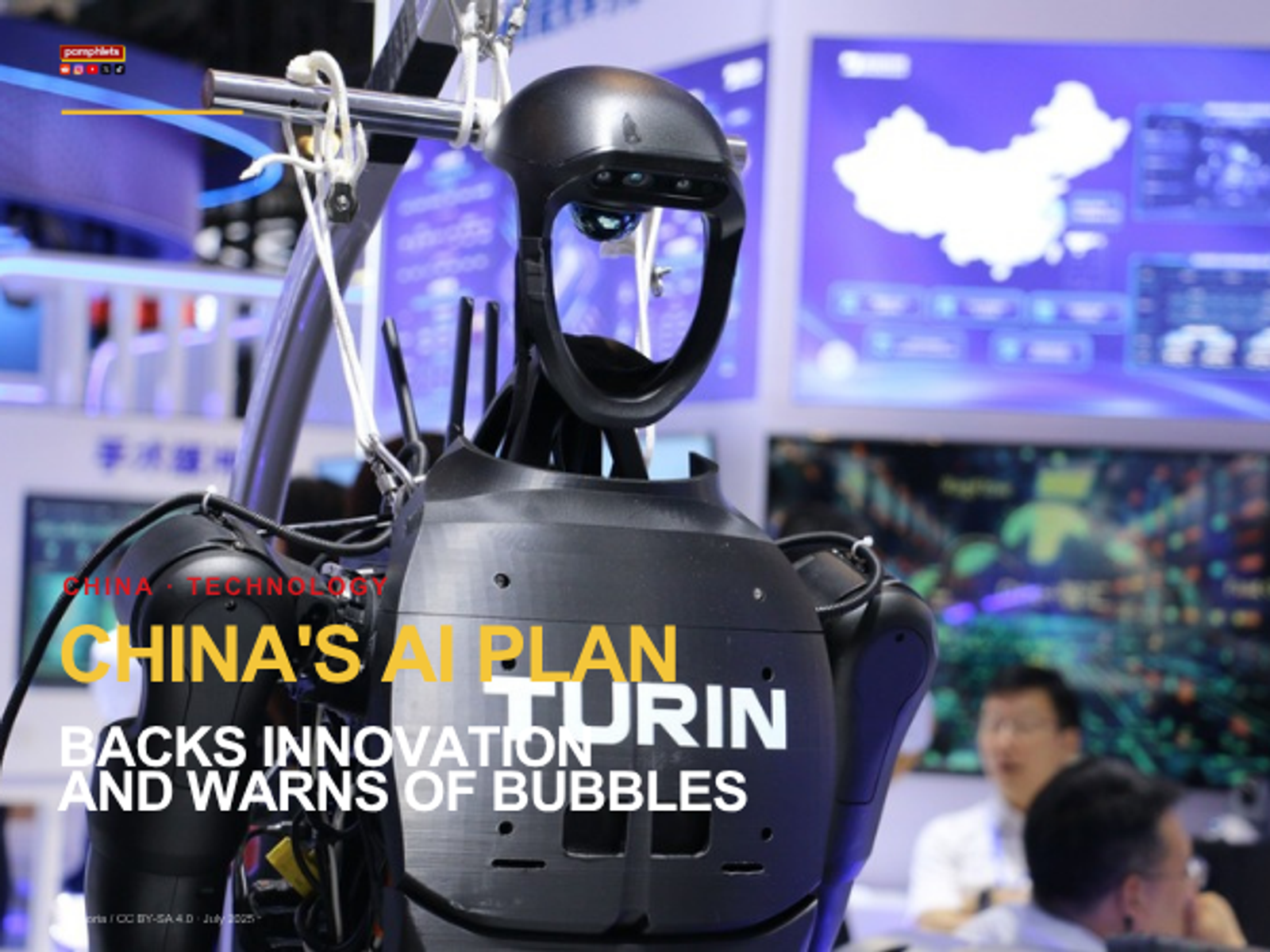
Image credit: Xuthoria, robotics at World Artificial Intelligence Conference, Shanghai, 27 July 2025, licensed CC BY-SA 4.0. Archival technology illustration, not the October 2026 government meeting. Cropped and overlaid in an adapted image released under CC BY-SA 4.0; Pamphlets wordmark remains a separate mark. Original: https://commons.wikimedia.org/wiki/File:WAIC_2025_-_Robots_07.jpg | License: https://creativecommons.org/licenses/by-sa/4.0/



Comments