


National Strength for Whom? Takaichi's Approval Falls as U.S. Defense Demands Grow

OPINION | JAPAN — October 18, 2026
A government can promise national strength, stronger borders and tougher defense policy. It still has to answer an ordinary question: are people's lives getting better? For Prime Minister Sanae Takaichi and Japan's Liberal Democratic Party, falling approval readings have put that question back in the spotlight.
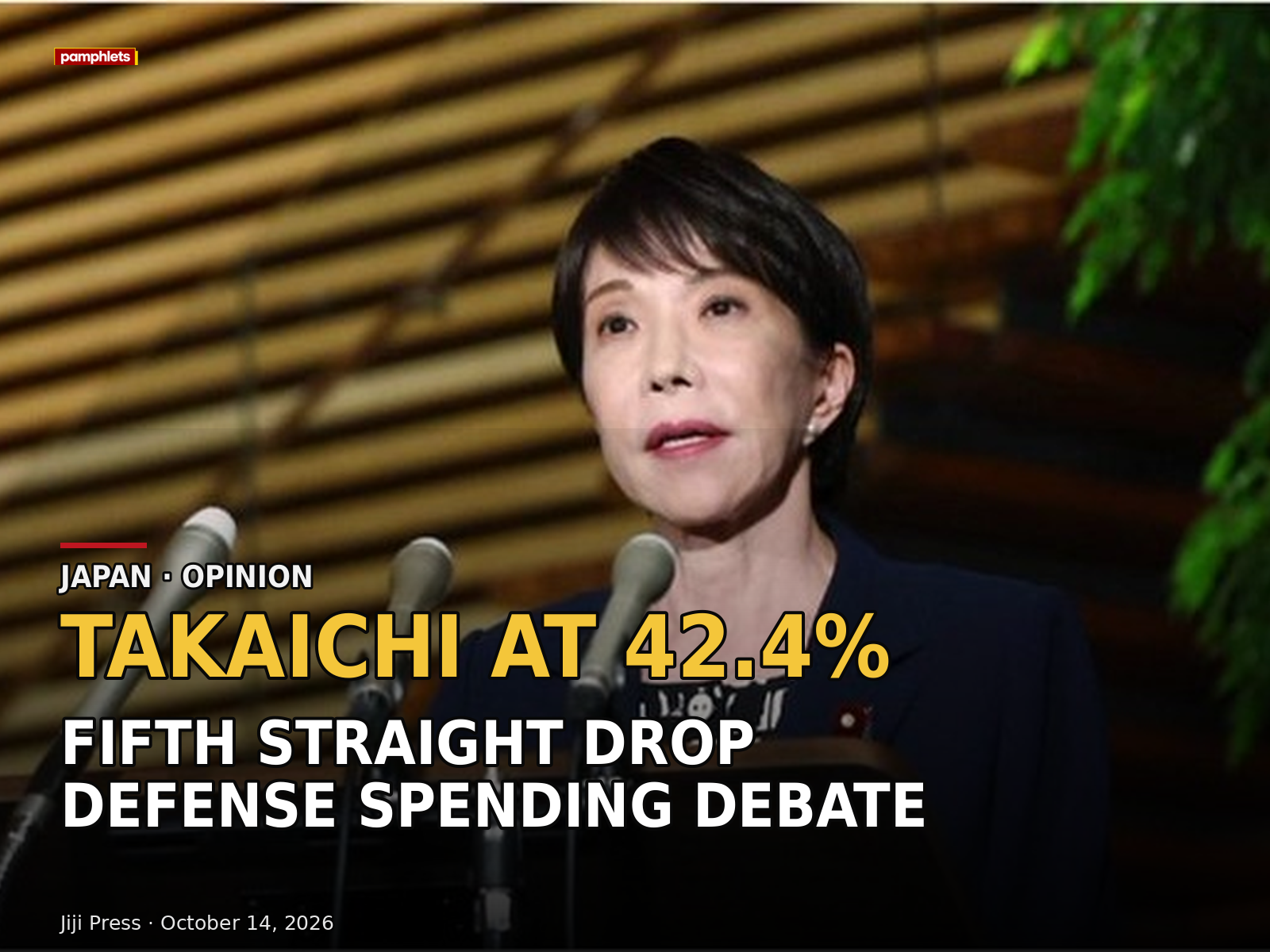
Jiji Press reported on October 15 that Takaichi's Cabinet approval had slipped to 42.4%, down 1.7 percentage points from September and the fifth consecutive monthly decline. In its October 9–12 survey, 29.7% said they disapproved. A separate Kyodo poll conducted October 17–18 put approval at 49.1%. Different polls use different samples and methods; neither reading alone reveals every respondent's reasons.
A scandal behind the numbers
The immediate controversy is not abstract ideology. Agriculture minister Kazuo Yana resigned on October 14 after drawing criticism for remarks about withholding road funds from municipalities that failed to support him politically. In Kyodo's new poll, 57.7% said Takaichi had taken too long to replace him and 81.5% regarded his resignation as appropriate. This is a measurable accountability problem, not simply a debate about the prime minister's image.
Military ambition and household pressure
Takaichi came to office championing a more assertive security policy. A July 2026 Congressional Research Service report describes her as accelerating long-running LDP efforts to expand Japan's military capabilities, loosen arms-transfer restrictions and strengthen intelligence cooperation. Takaichi and her two predecessors committed to increasing defense spending to about 2% of GDP by 2028.
Now Washington wants more. Reuters reported on October 16, citing the Asahi newspaper, that Donald Trump's administration has pressed Japan to adopt a defense-spending level of 3.5% of GDP. Tokyo was reported to be resisting that formal target while considering further military increases. That distinction matters: Japan is not literally incapable of saying no to Washington. Yet the pressure from its chief military ally is real, and the public has reason to ask what budgetary choices follow from it.
At home, the cost of living has become another test. A July Asahi Shimbun survey found 57% believed the administration was not doing enough to combat inflation. Takaichi has argued that price relief is a priority and has promoted temporary cuts to taxes on food alongside an investment-led economic program. Critics question the timing, financing and whether these measures deliver relief quickly enough. The debate is about tangible results, not only political slogans.
History, nationalism and political choices
Takaichi's critics have raised specific concerns about her hard-line stance toward foreigners, interpretations of Japan's wartime history and the LDP's handling of political funding. The Carnegie Endowment documented those concerns when Komeito, the LDP's longtime coalition partner, broke with the party in 2025. Supporters, by contrast, argue that Japan's regional security environment demands a tougher posture and a closer partnership with the United States.
That disagreement deserves precision. Calling Takaichi a 'U.S. puppet' is a political accusation, not an established description of how every Japanese decision is made. Calling her entire administration 'fascist' similarly raises a historical question that cannot be settled by one approval survey. Her government's specific policy choices, however, are open to direct scrutiny: the use of public funds, cabinet accountability, living costs, arms policy, democratic rights and the limits of alliance dependence.
The question the LDP must answer
The LDP won an overwhelming lower-house majority in February 2026, giving Takaichi real legislative authority. That electoral victory remains part of the record, just as the latest decline in approval does. What the new surveys show is a changing public assessment, not an automatic verdict on Japan's future.
The central test is whether promises of national renewal translate into affordable daily life, credible public institutions and security choices that Japanese people can scrutinize. Military spending and diplomatic closeness to Washington do not, by themselves, provide answers to the questions now confronting the government.
Sources
Jiji Press, October 15, 2026: https://www.nippon.com/en/news/yjj2026101500705/takaichi-cabinet-approval-hits-new-low-of-42-4-pct-jiji-poll.html
Reuters / Kyodo, October 18, 2026: https://www.reuters.com/world/asia-pacific/japan-pm-takaichis-support-rate-falls-below-50-lowest-since-taking-office-kyodo-2026-10-18/
Reuters / Asahi, October 16, 2026: https://www.reuters.com/world/asia-pacific/japan-sidestep-35-defence-spending-target-despite-us-pressure-asahi-reports-2026-10-15/
U.S. Congressional Research Service, July 14, 2026: https://www.everycrsreport.com/reports/IN12708.html
Bloomberg / Japan Times, July 21, 2026: https://www.japantimes.co.jp/news/2026/07/21/japan/politics/takaichi-popularity-dips/
Carnegie Endowment, October 2025: https://carnegieendowment.org/research/2025/10/the-challenges-and-opportunities-facing-takaichi-sanae











Comments