






The European Spring — 54 student protests expose a continent’s crisis

Europe’s students are challenging a political order that makes education more expensive while asking the young to accept less. From campuses to city streets, struggles over fees, housing, public services and Palestine have become arguments about who gets to decide how society’s resources are used.
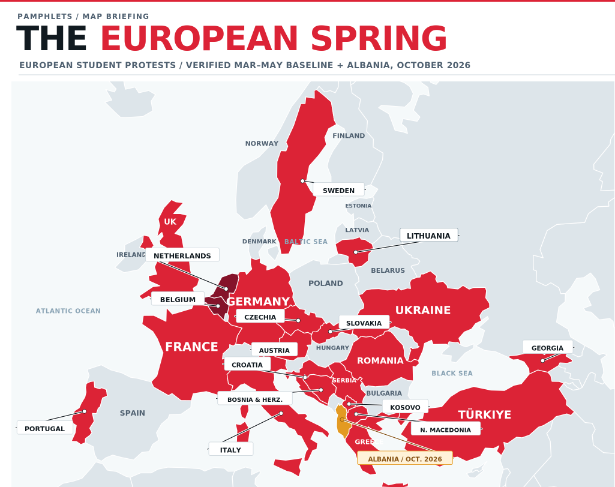
The European Spring is Pamphlets’ name for this widening landscape of resistance. Our accompanying map brings together a documented March–May 2026 baseline and Albania’s October uprising. It shows the geographical reach of student mobilisation across different periods; each highlighted country has its own protest history, demands and political conditions.
54 actions across 22 countries
The European Students’ Union recorded 54 student protest actions in 22 countries between March 16 and May 16, 2026. Published on September 28, its monitoring report identifies disputes over university governance, funding, living conditions, democratic accountability and international solidarity. Belgium and the Netherlands each accounted for ten recorded actions.
The same report documents Palestine solidarity campaigns challenging university investment, academic cooperation and disciplinary decisions. That makes the campus a place where foreign policy meets institutional power: students demand a say in what their universities finance and legitimise.
The map’s red shading marks countries included in that spring monitoring window. Albania, highlighted separately, updates the picture with October’s protests. The graphic combines those periods rather than claiming a single simultaneous, centrally organised revolt.
Albania: education anger meets the luxury-development model
EFE reported on October 16 that Albania’s student protests had reached a fourth consecutive day and spread beyond Tirana. Demonstrators accused the government of corruption and protested the high cost of living. Education conditions and students’ economic prospects helped bring young people into a broader movement.
That movement grew from opposition to a proposed development linked to Jared Kushner. Police deployed tear gas and water cannons during clashes. Prime Minister Edi Rama rejected demands that he resign, while the conservative opposition called for further mobilisation.

Students confront riot police in Tirana, Albania, October 16, 2026. Photo: Malton Dibra / EFE / EPA. Reproduced for editorial reporting; rights remain with the photographer and agency.
The political question is clear: whose future does development serve? A luxury resort promises returns to investors. A functioning public university promises a future to the people who live there. When students connect those priorities, the argument moves beyond a campus budget and into the distribution of wealth and power.
France, Belgium and Italy: the pressure reaches the streets
MaltaToday’s October 18 overview reports renewed mobilisation in France, Belgium and Italy around education, living costs and public services. In France, the school protests have drawn in trade unionists and Yellow Vest supporters. In Belgium, young demonstrators have challenged education costs and reforms. Italy’s demonstrations have also raised wages, energy prices, education and healthcare.
These connections matter for the left. A student struggling with rent and a worker struggling with wages encounter the same basic conflict over the price of living. Their strongest common programme would link affordable housing, publicly funded education, secure work and democratic control over spending.
Turn the protest map into organised power
A shared colour on a map cannot create a shared organisation. The task is political: build durable student unions, connect campuses with workplaces, defend the right to demonstrate and give material demands an organisation capable of winning them.
Palestine solidarity belongs in that programme because public institutions must answer for the relationships they maintain abroad as well as the conditions they impose at home. Students have every right to scrutinise those decisions and organise to change them.
Europe’s rulers face a generation asking for a future worth living. Education, housing and dignity are demands on the wealth society already produces. The European Spring will gain strength wherever that demand becomes sustained collective power.
Sources and map
European Students’ Union — 4th Student Protests Monitoring, March–May 2026 (published September 28): https://esu-online.org/publications/4th-student-protests-monitoring-march-may-2026/
EFE — Albanian students continue to pressure the government, October 16: https://efe.com/english/latest-news/2026-10-16/albanian-students-continue-to-pressure-the-government/
MaltaToday — Protests sweep across Europe as young people demand change, October 18: https://www.maltatoday.com.mt/news/europe/145108/protests_sweep_across_europe_as_young_people_demand_change
Map: Pamphlets, supplied editorial graphic. March 16–May 16 monitoring baseline, with Albania’s October 2026 protests added separately. Analysis published October 18, 2026.




Comments