


Brazil’s students and workers rally for Lula as court rejects sweeping restrictions

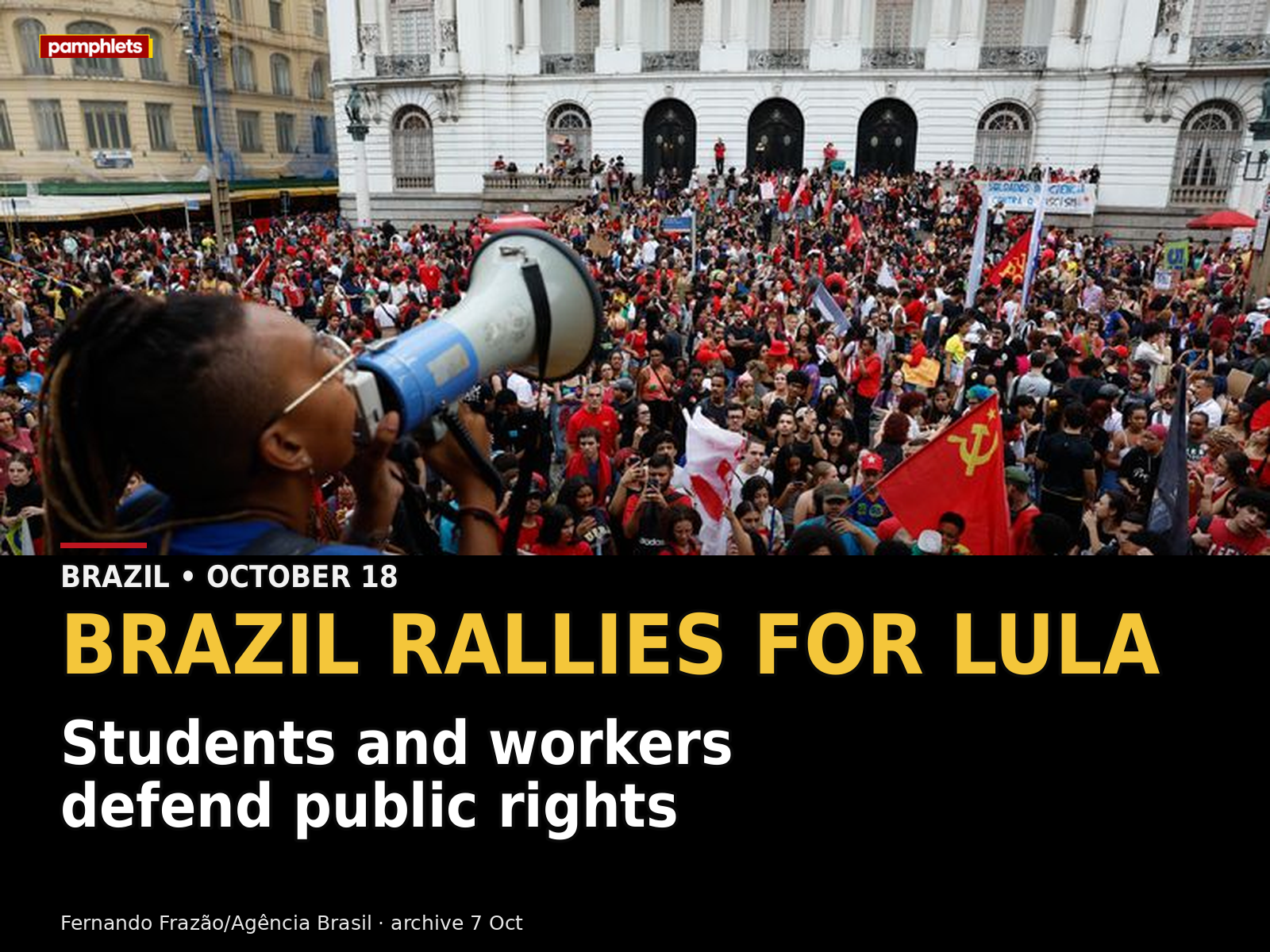
Archive: students demonstrate in support of Lula in central Rio de Janeiro on October 7, 2026. Photograph: Fernando Frazão/Agência Brasil.
Students, workers and cultural figures took to the streets in support of Luiz Inácio Lula da Silva on Sunday, October 18, bringing the fight over public education and democratic rights into the final week of Brazil’s presidential election. Demonstrations began in Brasília, Maceió and Rio de Janeiro during the morning, with further gatherings in Salvador and Curitiba. [1] [3]
The mobilizations went ahead after attempts to restrict the political activity of artists, unions and student organizations ran into resistance at the Superior Electoral Court. The disputes expose a central question in this election: whether people who organize collectively can make their demands heard without being treated as an electoral offence. [4] [5]
A campaign carried into the streets
In Maceió, marchers travelled along the waterfront from the Vera Arruda corridor in Jatiúca to Marco dos Corais in Ponta Verde, carrying Brazilian and Workers’ Party flags. Gazetaweb reported the participation of local political leaders and Edmilson, a doorman who had previously been taken to a police station after joining a pot-banging protest. He returned to the streets to declare his support for Lula. [2]
In central Rio, Chico Buarque joined a demonstration organized by the National Union of Students, known as UNE. In Brasília, supporters gathered near the Museum of the Republic. Folha reported that Gilberto Gil and Daniela Mercury participated in a Salvador event that began in the early afternoon. [1]
For UNE president Bianca Borges, the stakes reach beyond the candidates. In an interview published Sunday by Agência Brasil, she linked the mobilization to defending public universities, student support and Brazil’s sovereignty. She described the prospect of a Flávio Bolsonaro government as a threat to education and democratic participation. [3]
The right sought restrictions; the court demanded evidence
In a statement published Sunday, the electoral court explained its rejection of the Novo party’s attempt to suspend the “Brasil nas Ruas” demonstrations. Novo argued that planned appearances by prominent musicians in Copacabana, Salvador and Porto Alegre would breach the prohibition on entertainment at election rallies. [4]
Judge Ricardo Villas Bôas Cueva’s decision, issued Saturday, found insufficient evidence to justify stopping the events in advance. The court said that rules against such campaign concerts do not prohibit artists from expressing political views in public. It also found no demonstration, at that stage, that the gatherings formed part of Lula’s official campaign programme or had been called by those responsible for it. [4]
A separate case brought by Flávio Bolsonaro also failed to secure sweeping restrictions on unions and student organizations. According to the court’s October 16 account of a decision issued the previous day, 37 of the 54 leaders listed in the complaint were not individually identified in its description of the alleged conduct or legal argument. Cueva ordered the campaign to supply specific acts, dates and evidence. [5]
That ruling did not close the case or authorize unlawful campaign financing. Proceedings continued against Lula, running mate Geraldo Alckmin and five union representatives. But the judge rejected generic restrictions on political expression and stressed that holding a leadership position does not, by itself, establish responsibility for electoral abuse. [5]
What working people stand to gain
The street campaign follows a concrete advance for labour. On October 16, Congress promulgated a constitutional change replacing the general six-days-on, one-day-off working pattern with two paid rest days and a phased reduction in the working week, without a wage cut. [6]
The Senate’s explanation sets the general limit at 42 hours beginning 60 days after publication, then 40 hours a further year later. It reports that around 14.9 million workers currently work the six-to-one pattern. The new rules contain exceptions and transition arrangements; the 40-hour limit is not already in force. [6]
An additional day away from work means time to care for children, study, rest and participate in public life. That is why an election fought over labour rights cannot be understood only through campaign advertising or polling: its consequences enter the timetable of ordinary households.
Borges also made clear that support for Lula does not settle students’ demands. She called for stronger university funding and a properly financed student-assistance programme, and said organizing must continue after the October 25 runoff. The movement’s test will be its ability to win those demands as well as defend the right to make them. [3]




Comments