


Reuters Turns China’s Food Exports Into a Western Industry Complaint

Reuters’ October 15 report on China’s growing poultry and dairy exports contains real reporting about changing diets, falling pork prices and pressure on farmers. But its framing turns ordinary competition into a geopolitical alarm: China is said to have a “glut,” to be “unloading” production abroad and to be “flooding” markets.
Those words do more than describe trade. They cast China’s lower prices as a threat before the report establishes that Chinese chicken exports involve dumping or an unfair trade practice. Reuters itself says Chinese products are cheaper, that global consumers gain access to lower-cost protein, and that traders began buying Chinese poultry because African customers wanted a cheaper alternative to Brazilian imports.
The report’s own numbers call for proportion. China exported $2.6 billion in chicken products last year and was on track for $600 million in dairy exports, while Reuters says China’s overall agricultural trade deficit still exceeded $100 billion. Those figures show fast growth in particular export lines; they do not prove that China’s entire food sector is flooding the world or that competition is inherently unfair.
The article also describes an EU anti-dumping investigation into Pekin duck and duties on Chinese pea protein. It acknowledges that Chinese chicken has not faced the same action. Separate products and separate cases cannot substitute for evidence that chicken exports are dumped. Likewise, the OECD subsidy figure Reuters cites describes broad agricultural support; the story does not show that it proves an unfair price for each product it discusses.
Reuters invokes China’s 2008 melamine-tainted milk scandal and quotes analysts who say exporters must build confidence in safety and consistency. The history matters, but it is not evidence that the poultry or dairy shipments in this report failed present-day inspections. Reuters also reports the European Commission’s position that imported food must meet the same health and safety standards as local products. A rigorous account should keep historical failures, current regulatory compliance and verified product-specific violations distinct.
There is a real story here: a food-security drive helped expand production, Chinese consumers shifted away from pork, and some farmers now face painful price pressure. Reuters’ profile of a Hebei pig farmer gives that disruption a human face. But the report repeatedly pivots from that domestic adjustment to the alarm of established foreign producers, whose customers now have a cheaper supplier.
That perspective leaves importers and consumers in Africa and Asia at the edge of the story. For families and buyers facing high food costs, a lower-priced protein source can matter. Reuters should examine labor conditions, safety, subsidies and market rules wherever they are relevant—but it should apply those tests with evidence, not treat a Chinese firm’s success as proof of a market threat.
Reuters’ report documents a new competitor. Its language invites readers to see a menace. That is the anti-journalistic move: replacing a clear distinction between competition and proven dumping with a familiar alarm about China.
Source: Reuters — “This Chinese export boom really has legs – and wings”, October 15, 2026.
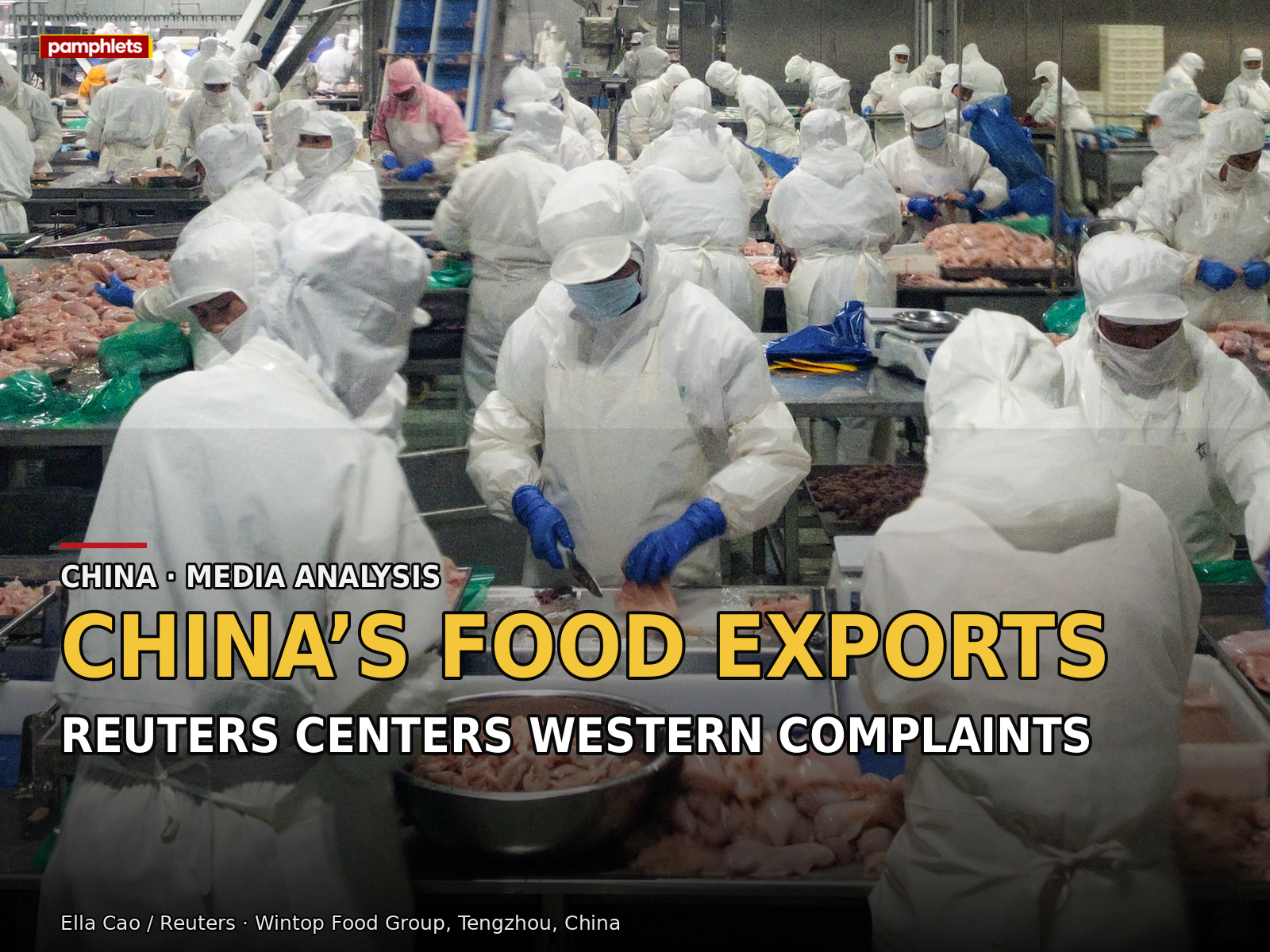
Cover photograph: Workers process poultry at Wintop Food Group in Tengzhou, China. Ella Cao / Reuters. Cropped with Pamphlets headline graphics.








Comments