







Nigeria defends debt figures as interest bill reaches ₦7.7 trillion

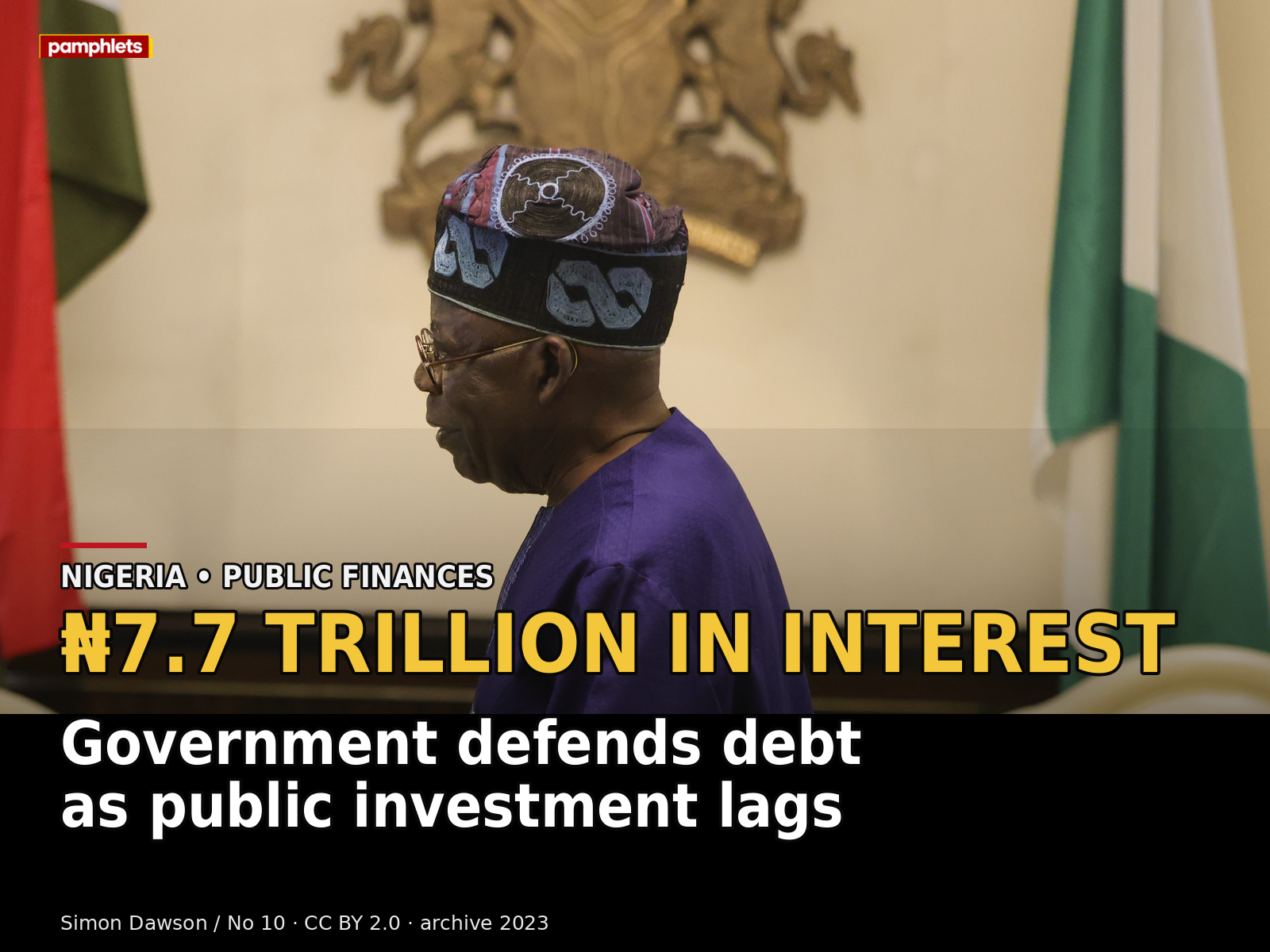
President Bola Tinubu at the Aso Rock Presidential Villa in Abuja on August 2, 2023, in a photograph taken during his meeting with British foreign secretary James Cleverly. Archival image, cropped to Tinubu; it does not depict the October 18 statement. Photo: Simon Dawson / No. 10 Downing Street, via UK Government / Wikimedia Commons. CC BY 2.0. Cropping and Pamphlets headline treatment added.
Nigeria’s government defended its debt position on Sunday, October 18, challenging reports that interest payments exceeded federal revenue in the first half of 2026. The finance ministry called the widely circulated 124% figure misleading, arguing that it combined obligations across different levels of government with an incomplete account of federal income. [1]
The figures behind the dispute are substantial. The World Bank’s October Nigeria Development Update records ₦6.2 trillion in federal revenue between January and June and ₦7.7 trillion in interest payments. Those amounts are also repeated in the government’s own defence of its record. [2]
Dividing the two produces approximately 124.2%. Punch explicitly identifies that percentage as its calculation from the report’s figures. The World Bank did not present it as a quoted debt ratio. Whether those figures should be compared directly is precisely what the ministry contests. [1]
What the ministry disputes
The ministry says the interest bill includes debt the federal government services for other tiers of government, including external loans to states. It argues that a meaningful comparison must match those obligations with revenue covering the same institutions. [3]
It also says the revenue total leaves out income already earned by public agencies and enterprises but not yet paid into the Treasury. The timing of tax payments, it adds, generally makes revenue collection stronger in the second half of the year. [3]
On the published figures, federal revenue rose by about 72% from the first half of 2025, while interest costs increased by 38%. The ministry points to that faster revenue growth and the narrowing gap between the two totals as evidence that its reforms are improving the fiscal position. These are nominal comparisons. [3]
The government also cites a World Bank projection putting full-year 2026 debt service at 46% of revenue. That measure includes repayments of principal as well as interest. It covers a different period and cannot serve as a corrected version of the contested half-year calculation without reconciling the scope of both figures. [4]
The published ministry statement supplies no replacement half-year ratio with a revised numerator and denominator. That leaves a practical task: publish the matched accounts, identify which state obligations are included and show how much additional revenue should count. Readers should be able to reproduce the comparison. [3]
Public investment remains under pressure
The World Bank report contains another warning alongside its account of improving finances. Reported federal capital spending was only ₦0.7 trillion in the first half of 2026, equivalent to 0.3% of GDP, down from 1% a year earlier. It cautions against treating the early-year fiscal improvement as an unqualified success when investment execution is so low. [2]
The report identifies personnel and interest costs as major claims on available funds. It also points to overlapping budget cycles and weak alignment between approved spending and implementation capacity. Public investment can consequently become the part of the budget that absorbs the adjustment when recurrent obligations rise. [2]
Tinubu had welcomed the same World Bank report on October 11, citing growth of 4.2% in the first half of the year and stronger revenues. His statement also acknowledged that the gains still needed to reach households through better living standards, cheaper food and employment. [5]
The spending choices extend beyond Abuja. The World Bank’s release says state spending on education, health and social protection increased, but more slowly than spending on economic infrastructure. Education’s share of state expenditure fell from 14.9% in 2021 to 12.1% in 2025; health remained around 7%. A falling share does not mean an absolute spending cut, but it does show priorities changing. [6]
The same assessment says inflation continues to weaken household purchasing power. For working families, therefore, an improvement in revenue collection is only part of the test. Its value depends on whether public money produces reliable services and whether wages can cover everyday needs. [6]
The ministry has raised specific accounting objections that deserve answers. Its defence will be more convincing when those answers come with comparable figures and a clear record of what has actually been funded. Nigerians should be able to trace the claimed gains from reform into completed projects, functioning services and their own living conditions.




Comments