




Meta’s Brazil election crisis: blocked ads, unequal recommendations and a court order
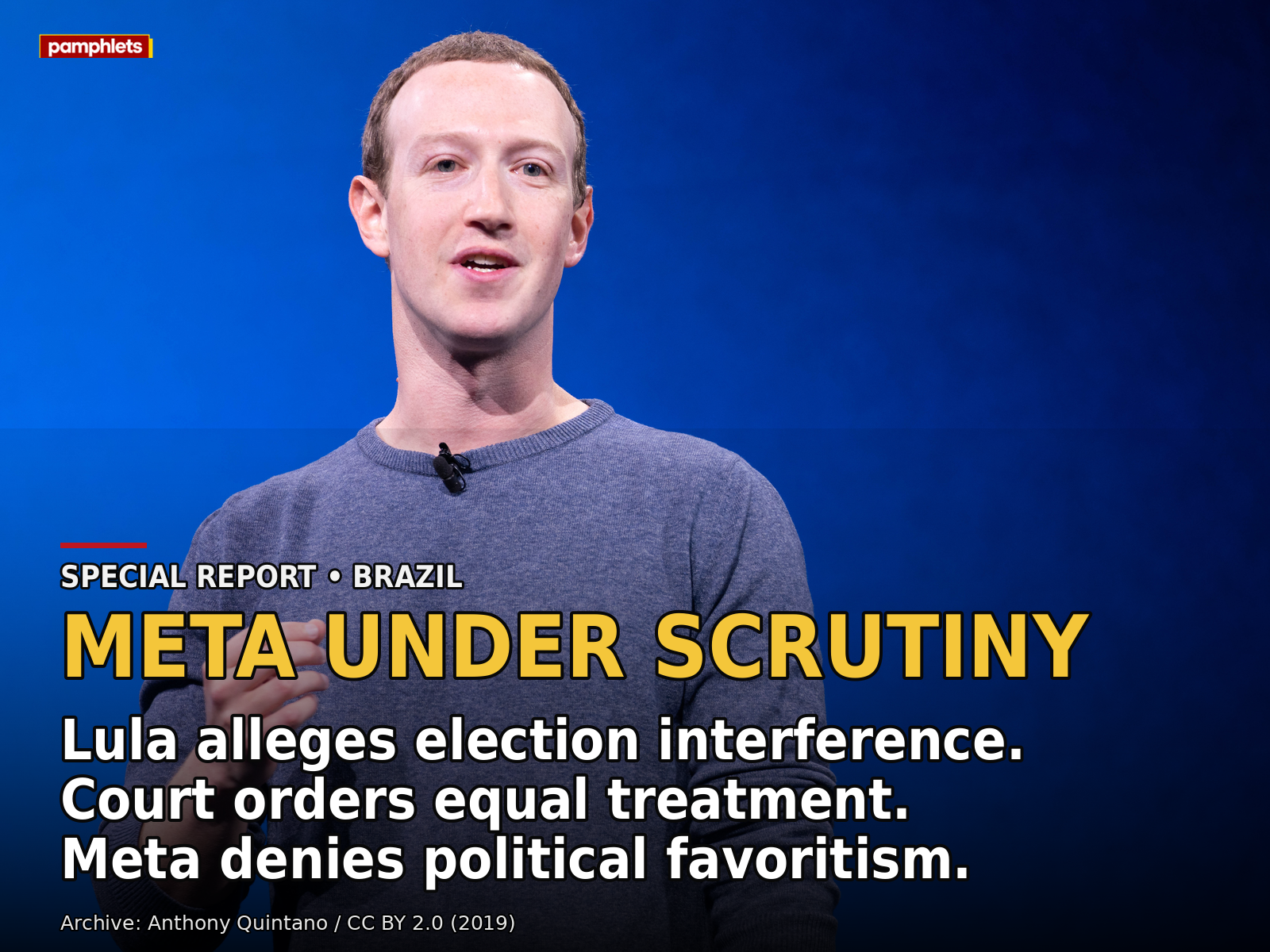
Mark Zuckerberg at Facebook’s F8 conference in San Jose, California, April 30, 2019. Archival photograph by Anthony Quintano. Cropped and overlaid by Pamphlets. Photo source · CC BY 2.0
SPECIAL REPORT · BRAZIL — Platform failures have put Meta’s election systems under judicial scrutiny. The demand for equal treatment now turns on records that campaigns and voters can independently examine.
Brazil’s electoral court has ordered Meta to ensure equal treatment of the two presidential campaigns after a dispute over advertising restrictions, search recommendations and its artificial intelligence tool. The injunction issued on October 15 was unanimously upheld the following day, with a potential daily fine of R$500,000 for noncompliance. Agência Brasil
Lula’s campaign alleges that the company’s platforms have disadvantaged the president while benefiting his opponent, Flávio Bolsonaro. Meta denies deliberate interference. The court has required safeguards before the October 25 runoff, without finding that the company intentionally manipulated the contest. Unequal outcomes warrant investigation, but intent must be established through evidence. CNN Brasil
Different failures, different consequences
The controversy involves several separate incidents. On September 23, Lula’s advertising account was mistakenly disabled for slightly more than an hour. Meta says an advertisement was incorrectly flagged during an anti-fraud review involving impersonation of government social programs. It says Lula’s official Facebook page and Instagram account themselves were never blocked. Meta’s response
On October 7, video-view counters malfunctioned. Meta told the TSE that a global problem lasting approximately five hours affected creators in more than 100 countries. The company said content distribution continued. A video displaying more likes than recorded views therefore cannot, by itself, establish that its delivery was suppressed. The relationship between a broken counter and actual reach needs evidence. UOL
The October 9–10 advertising problem was different. Folha de S.Paulo reported that Lula’s account could not turn existing Instagram feed posts into paid advertisements for almost 24 hours. Previously running advertisements and direct ad creation remained available. The campaign estimated that 1.3 million people missed its advertising; that figure is its estimate, not an independently measured count. Folha de S.Paulo
The same investigation, based on internal Meta messages, described improper recommendations of Flávio’s Instagram profile and the WhatsApp channel Tropa do Flávio during searches associated with Lula. Employees discussed restrictions on Lula’s account and discrepancies between the candidates’ treatment. Those reported messages strengthen the case for scrutiny beyond simply repeating a campaign’s allegations. Folha’s investigation
Meta’s subsequent explanation attributes the feed-advertising disruption to a global code-update failure. For the October 14 Meta AI incident, it says filters missed some combinations of common first names and ballot numbers. The company says the loophole could also produce material using Luiz and Lula’s number, and that it corrected the gap that day. Those explanations require examination of the underlying records. Meta’s response, updated October 18
The complaint reaches international observers
On October 15, Lula’s campaign presented eight alleged incidents to international election observers, including representatives of the Organization of American States and the European Union. Edinho Silva led the meeting, where the campaign demanded explanations for automated decisions and alleged selective effects. UOL reported that the campaign planned to deliver supporting documentation. Its account did not report the observers endorsing the allegations. UOL’s report
Justice Marco Aurélio Bellizze’s injunction restricts unequal interference with distribution, recommendations and search. It preserves judicial orders, previously announced policies applied equally, and existing rules excluding official candidate profiles from recommendations. It also requires identical criteria for the two candidates in Meta AI. The ruling guarantees neither candidate a particular audience or equal engagement figures. CNN Brasil
The operational demands are substantial. Folha reports that campaign advertising restrictions require human review, with a two-hour review deadline when an automated system imposes a restriction. Meta must provide technical information and identify suspended electoral advertisements, their responsible parties, spending and reach. Bellizze also ordered replacement of contracted advertising delivery not provided to Lula’s campaign by October 21. He rejected blanket removal of allegedly suspicious profiles. Folha’s account of the order
Foreign advertising exposes another weakness
A separate NetLab UFRJ investigation identified 1,613 political-electoral advertisements paid in foreign currencies and placed by actors unauthorized to conduct electoral advertising in Brazil. They circulated between July and September. The researchers describe largely anonymous pages and advertisements that were reclassified only after reaching audiences. This concerns the enforcement of advertising rules, independently of Lula’s account restrictions. NetLab UFRJ
The study does not establish a single operation exclusively supporting Flávio: it describes material promoting or attacking different candidates, sometimes inconsistently. Meta told Folha that the advertisements were subsequently reclassified or removed where they violated its policies, and noted that the research included the period before official campaigning. Later correction, however, cannot undo every exposure that already occurred. NetLab UFRJ · Meta’s response to Folha
Another change before the runoff
Meta announced that it plans to introduce an authorized-advertiser list on October 19. Because its systems group election advertisements with broader political and social-issue advertising, the company says its implementation would also prevent NGOs, news organizations and other excluded advertisers from running advertisements in that category until after the runoff. Organic posts would remain unaffected. As of October 18, this was an announced change, not a completed rollout. Meta’s implementation announcement
That broader restriction is Meta’s proposed implementation; the company’s announcement does not establish that the court expressly banned newspaper advertising. It raises a further question: can Meta comply precisely without imposing unnecessary restrictions on legitimate public-interest communication?
What independent scrutiny must establish
The unresolved questions concern cause, duration, scale and remedy. Investigators need comparable records of restrictions and recommendations, the policies applied, who reviewed disputed decisions, and how affected campaigns were compensated. Auditors should distinguish broken metrics from reduced distribution, failed advertising purchases from continuing campaigns, and inconsistent enforcement from intentional favoritism.
Investigating those differences is part of holding the platform accountable. A technical error can still have political consequences, especially when it consumes hours that a campaign cannot recover before voting. Brazil’s public debate should not depend on accepting either a campaign’s accusation or a platform’s assurance on trust. The records must be available for independent examination while corrective action can still matter.
A special report produced in collaboration by Espaço Brasil (@espacobrasilbr) and Pamphlets (@pamphlets). Follow Espaço Brasil




Comments