








The poverty myth sustaining Milei’s Argentine “miracle”

OPINION
Javier Milei has made poverty reduction the moral alibi for his chainsaw. The government asks Argentines to treat a falling headline rate as proof that austerity rescued the people it hurt. But the statistical record contains a serious challenge to that sales pitch: changes in the income captured by household surveys can make a decline look larger than the improvement in people’s lives.
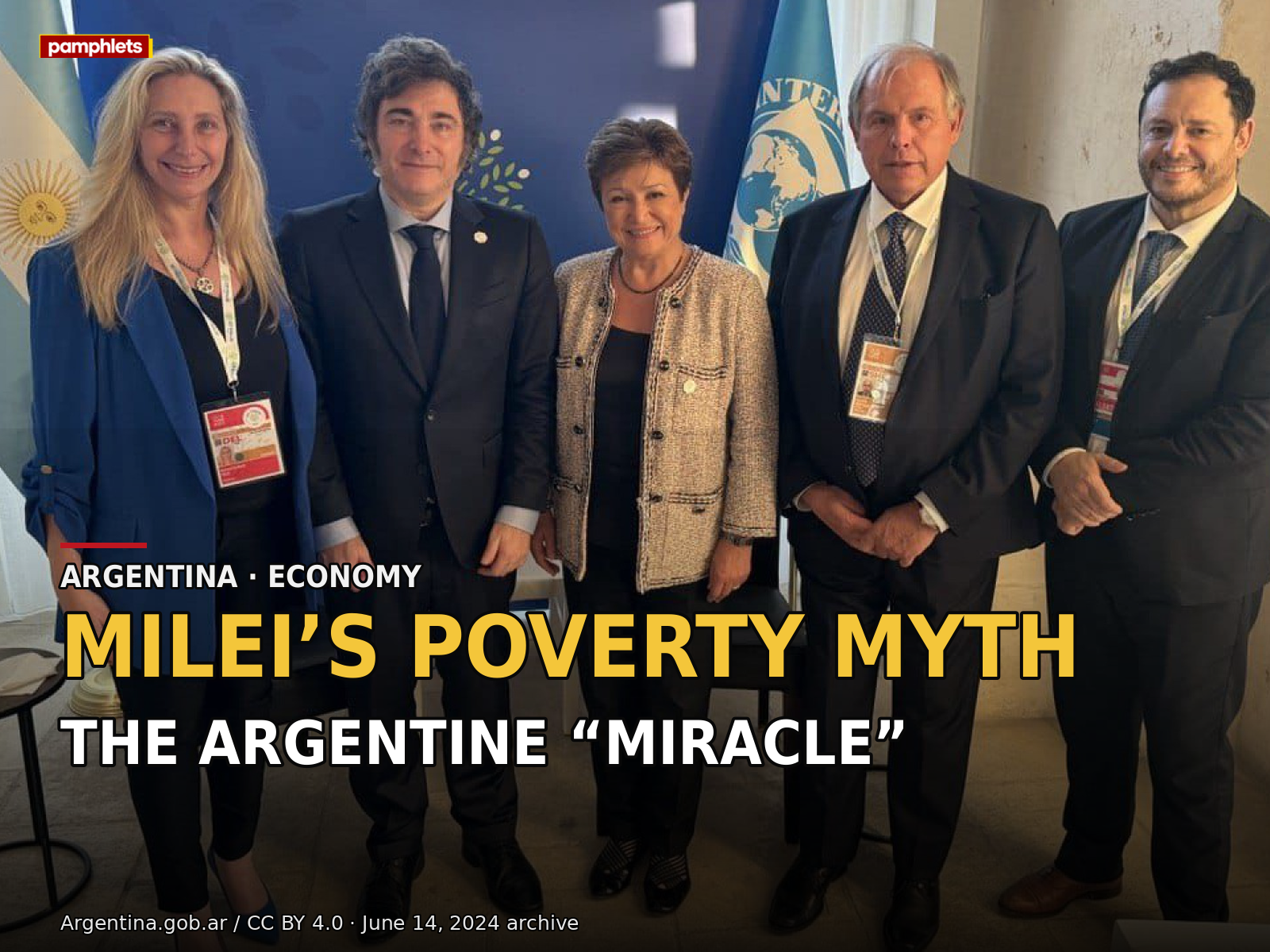
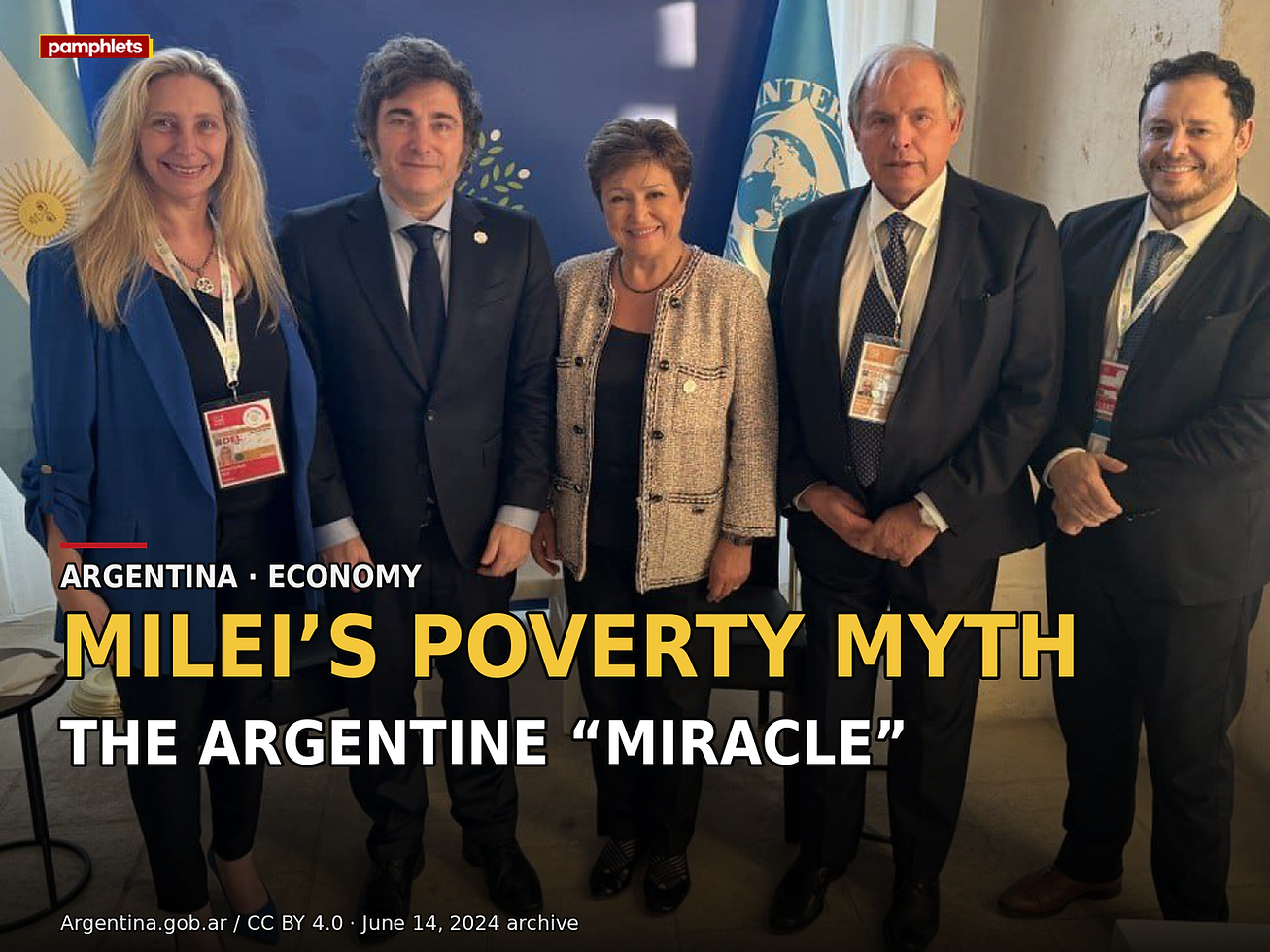
Hero photograph: Milei with IMF Managing Director Kristalina Georgieva and officials at the G7 in Italy, June 14, 2024. Argentina.gob.ar, via Wikimedia Commons; CC BY 4.0. Archival photograph, cropped with Pamphlets headline graphics.
The claim is explicit. In the government’s own account of his April 29, 2026 Expo EFI speech, Milei credited his historic spending adjustment with bringing poverty to 28% and lifting 14 million Argentines out of poverty. He presented the figure as vindication of his program. That leap from a reported indicator to a sweeping causal claim is where the “miracle” needs to be dismantled.
The money existed before the survey captured it
Pensions were already included in the income statistics before Milei took office. INDEC’s documentation for the third quarter of 2023 lists retirement and pension income under V2_M, government and other social assistance under V5_M, and total family income as the sum of household members’ incomes. The issue is how consistently that money was recorded across time.
In his July 2025 interview with El Destape, UCA poverty researcher Agustín Salvia said questionnaire changes improved the recording of the AUH child allowance, Tarjeta Alimentar, non-contributory pensions and other assistance. He traced the changes to late 2023 and their development through 2024, while criticizing how late researchers learned about them. His objection concerned comparisons across different survey instruments.
The distinction is concrete. Imagine a household already receiving a benefit that an older interview failed to record. A revised questionnaire captures it. Recorded household income rises, and the household may cross the statistical poverty line, even though its actual budget has not changed. Better interviewing has produced better information. It has not, by itself, bought that family another meal.
Salvia acknowledged genuine poverty reduction while arguing that its reported size was exaggerated. INDEC rejected the claim that the added questions changed the poverty calculation or produced an extra decline. This is a dispute about comparability and interpretation, with a documented change in the questionnaire at its center. Milei’s victory speech dispenses with that distinction.
UCA challenges the size of the “miracle”
UCA’s working paper 2025/4, by Agustín Salvia, Alejo Giannecchini, Fernando Gallegos and Ramiro Robles, compared survey incomes with administrative sources, including wages and ANSES pension records. It found an unusual rise in income capture from late 2023. In its counterfactual exercise, less than a third of the observed poverty decline over the period examined was attributable to recovery in real household income.
That result depends on the model’s assumptions, including a uniform adjustment across the income distribution. The authors present it as a sensitivity exercise, rather than a replacement “true” poverty rate. Their central finding is nevertheless damaging to the official sales pitch: the scale of the reported recovery cannot simply be read as an equivalent gain in purchasing power.

Milei at Expo EFI in Buenos Aires, April 29, 2026, where he repeated the 14-million claim. Photograph: Presidencia de la Nación / Argentina.gob.ar, CC BY 4.0. Reproduced without alteration.
A government claiming credit for a social transformation must separate changes in measurement from changes in material conditions. It must show what happened to households on a comparable basis. Repeating a spectacular number while leaving that work to its critics turns a public statistic into political advertising.
The latest official figures puncture the victory parade
The latest INDEC release, published on September 24, puts poverty at 32.3% in the first half of 2026, up from 28.2% in the second half of 2025. Extreme poverty rose from 6.3% to 7.5%. These figures cover the 31 urban agglomerations surveyed by the EPH. Within that universe, INDEC counted 9.729 million people in poverty, including 2.249 million in extreme poverty.
The same official series places poverty at 52.9% in the first half of 2024, during Milei’s presidency. Measuring a subsequent recovery from that peak makes the turnaround look especially dramatic. It also allows the government’s publicity to begin after the initial social disaster, then turn the retreat from that disaster into a certificate of success.
For a household trying to pay for food, medicine and transport, the difference between recovering lost ground and achieving lasting security is enormous. The government’s triumphal language collapses that difference. A rebound becomes a revolution; a measurement dispute disappears; another rise in poverty becomes an inconvenient interruption to the promotional tour.
The chainsaw needs a redemption story
Pensions and public transfers belong in household-income statistics. Their role also exposes the emptiness of claiming that the retreat of the state, by itself, explains social progress. A family’s reliance on a public payment cannot honestly be repackaged as proof that public provision is the obstacle to its liberation.
The poverty myth is sustained by that political substitution: a complex, contested statistical trajectory becomes a simple advertisement for the regime. The burden of proof belongs to the president making the grand claim. It cannot be discharged with applause from an investment conference or another repetition of “14 million.”
Pamphlets’ judgment is that Milei’s “miracle” is a marketing operation built around an exaggerated account of social recovery. Argentines deserve comparable statistics, public scrutiny and incomes that cover their needs. A government that demands sacrifice must answer for the lives behind its numbers. It cannot feed people with a press release.






Comments