


Congo Demands Answers on $762 Million Ebola Reporting Gap as Health Workers Go Unpaid

KINSHASA / 20 OCTOBER 2026 — Nearly a billion dollars has been disbursed for the fight against Ebola in the Democratic Republic of Congo, but national health authorities still cannot see a complete account of where most of that money went. At the same time, nurses and support staff confronting one of the country's deadliest epidemics say they have worked without the wages and bonuses they are owed.
Africa Centres for Disease Control and Prevention director general Jean Kaseya says international donors have sent $962 million to organizations engaged in the eastern Congo response since the outbreak began. According to his account, organizations working on the ground have reported the use of only about $200 million. The roughly $762 million difference is a massive financial-reporting gap. It is not, by itself, evidence that the money was stolen or even spent: much of the missing information may be held by agencies that have yet to submit records.
That distinction matters. So does the central question: Why must the people exposed to Ebola fight for their pay while the institutions receiving emergency money cannot provide a unified public account of it?
A Health Emergency With Workers Left Exposed
The outbreak, declared in mid-May, has reached eight Congolese provinces. Authorities have recorded at least 9,400 infections and more than 4,500 deaths, according to reporting by the Associated Press. The disease has also crossed borders into Kenya and Uganda; Uganda subsequently declared itself free of the outbreak. The Bundibugyo strain responsible for this emergency has no approved vaccine or treatment specifically against it.
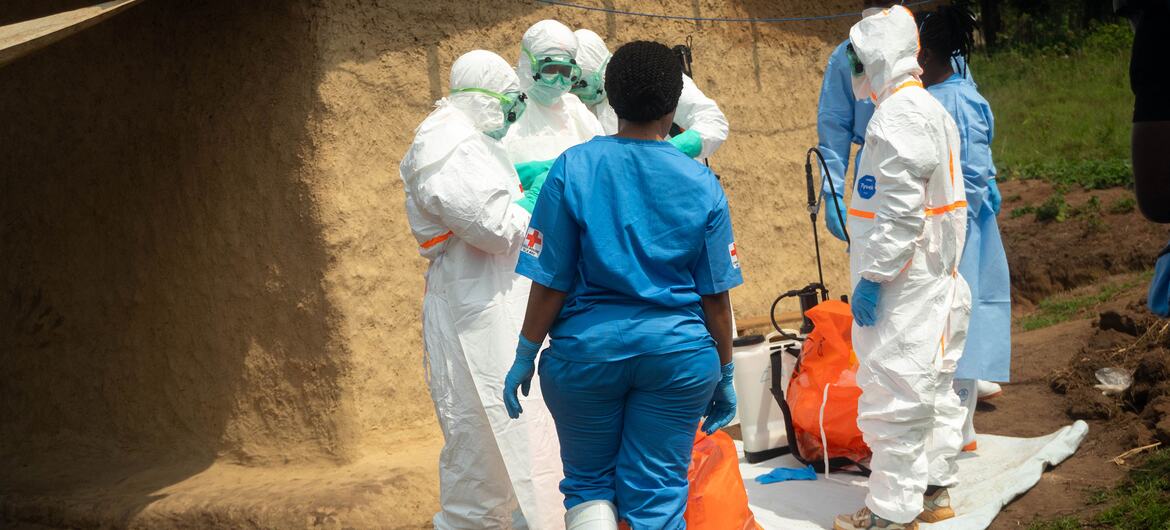
Containing an epidemic under those conditions depends on labor: community health workers conducting surveillance, nurses staffing treatment centers, cleaners disinfecting facilities, burial teams carrying out difficult protective work, and local residents helping identify cases. These people do not become less essential because funding passes through an international nonprofit or UN agency instead of a Congolese public institution.
AP has documented strikes by health and support personnel over missed payments and unsafe conditions. Nurse Prince Bahati, working in the eastern city of Bunia, told the agency that people putting their lives at risk to save patients were among those still unpaid. When workers lack basic security, emergency-response plans written far from the treatment ward are not enough.
Who Controls the Money?
Kaseya said only about a third of participating aid organizations attended a recent financial-review meeting. The groups that did attend reported receiving approximately $228 million, with $127 million already spent and about $100 million still available. Congolese officials say the international money was not paid into the state treasury; recipients must therefore identify their donors, allocations, expenditures and planned activities.
Following the disclosures, the health ministry restricted accreditation to 25 of nearly 100 organizations previously authorized to operate. That action places the question of authority in sharp relief. An emergency cannot be effectively coordinated if a country's health ministry has no reliable view of who is funding which operation, who has received wages and which communities remain underserved.
A serious accountability process must distinguish late reports, unspent money, administrative failures and demonstrable diversion of funds. It should publish an independently verifiable ledger, not trade in insinuations. That process should include Congolese public health officials, local caregivers and community representatives as well as international partners.
The Response Must Belong to the People It Is Supposed to Save
The immediate demands are practical: publish grants and disbursements; show which institutions hold the remaining balances; pay verified arrears to frontline staff; guarantee protective supplies; and make spending decisions visible to the communities living through the outbreak. Donor accountability is not a luxury. It is part of the health response itself.
Congo's workers should not be expected to carry the danger while distant agencies control the cash and local hospitals struggle to function. The epidemic has already claimed thousands of lives. The financial system built around stopping it must answer to the people whose lives are on the line.
Reporting and Image Credit
Cover photograph: Priscilla Lecomte for UN OCHA, health workers in Bembi during the 2026 Ebola outbreak, 1 September 2026. Archival image, not the funding announcement. CC BY-SA 2.0; original photograph retained without text manipulation.





Comments