


South Africa’s Legal Aid Workers Strike Over Unpaid Bonuses and Frozen Vacancies

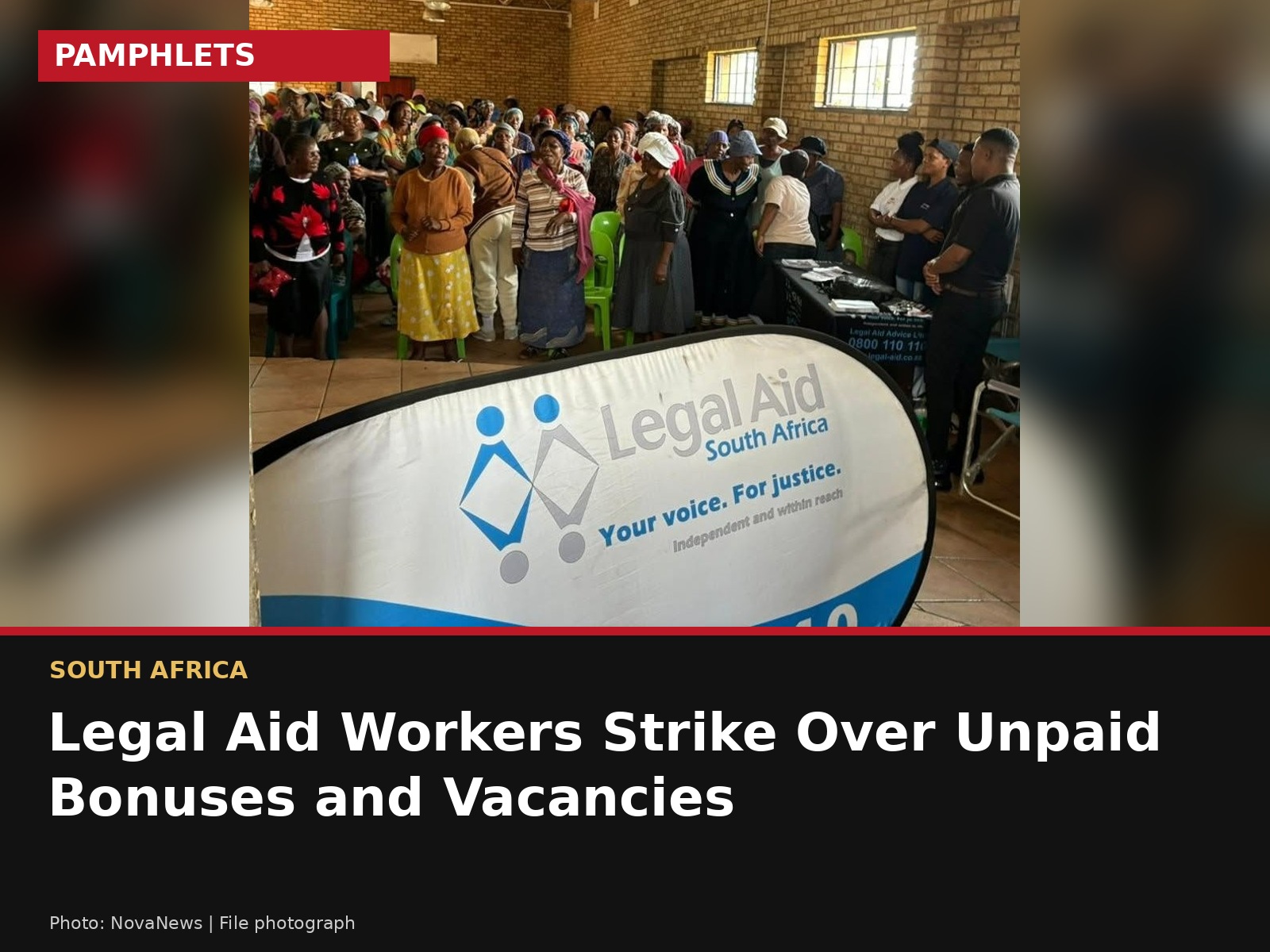
JOHANNESBURG — South Africa’s legal-aid workers resumed strike action on October 19 over unpaid performance incentives, frozen vacancies and deteriorating conditions, bringing the fight over public-service funding into the justice system. The dispute concerns the staff who make legal representation available to people who cannot afford a private lawyer.
NovaNews reported participation by legal practitioners and support staff, with action in Johannesburg, Gqeberha, Durban and Bloemfontein. Legal Aid South Africa’s own public notice acknowledged reduced staffing and warned that service delivery could face delays. The institution said it had activated continuity measures and recognised the action as lawful and protected.

A suspended dispute returns
The South African Lawyers and Allied Workers Union, SALAWU, had suspended an earlier stoppage following action on June 17 and 18. In a formal October 14 notice reported by IOL, the union announced that it was lifting that suspension after accusing management, the justice ministry and Parliament’s justice committee of failing to resolve its demands.
IOL reported that the grievances include outstanding occupational-specific dispensation payments and an unpaid 25% portion of the previous year’s incentive bonus. The union has also raised concerns about cost-reduction and rationalisation measures. Those fears should be understood as warnings from workers about the direction of the institution, rather than an announcement that retrenchments have begun.
The return to the picket line shows how a temporary suspension can leave the underlying conflict untouched. Workers gave the institutions involved time to intervene. Their renewed action puts a practical demand before those institutions: settle the outstanding issues and provide the staffing needed to do the work.
Access to justice has a workforce
Legal Aid SA says its statutory mandate is to safeguard access to justice for vulnerable and indigent people. That mandate depends on paid, supported staff. A right to representation becomes harder to exercise when offices have fewer people available to advise clients or prepare cases.
The institution’s October 19 notice says some employees are striking and asks the public for patience while continuity arrangements operate. NovaNews also carried management’s assurance that clients would continue receiving assistance. These arrangements matter immediately for people seeking help, but they do not settle the labour dispute.
The strike’s public significance therefore extends beyond the outstanding payments. When legal practitioners and support workers say vacancies and working conditions undermine their ability to serve people, they are identifying a weakness in the machinery through which a formal right becomes an actual service.
Workers’ rights and clients’ rights belong together
Pamphlets’ position is that the answer is a funded legal-aid service with decent conditions for its workforce. Leaving employees to absorb understaffing and unpaid entitlements shifts the burden onto both workers and people who rely on public representation.
That is a class divide in practical form. People with money can purchase legal assistance. People without it depend much more heavily on public provision. Weakening that provision makes access to justice more dependent on income.
The immediate test for management and the state is whether they produce a credible resolution to the outstanding payment and staffing grievances. A continuity plan can manage disruption for a time. A durable public service requires the people doing its work to have a reason to trust the institutions employing them.








Comments