


Greece meets NATO’s 3.5% arms target while 2.8 million face poverty or exclusion

ATHENS — Greece has reached NATO’s new 3.5%-of-GDP target for core military spending years ahead of the alliance’s 2035 deadline. At the same time, its own statistical authority counts 2.797 million residents — 27.5% of the population — at risk of poverty or social exclusion. The contrast is stark: a government can accelerate military commitments even as more than a quarter of its people live with serious economic insecurity.
The figures have different reference periods and measure different things. The poverty number comes from Greece’s 2025 living-conditions survey, published in March 2026 and using household income from 2024; the defence figure is NATO’s estimate for 2026, echoed by the Greek prime minister in July. They do not prove that arms spending caused the poverty. They do show the competing priorities confronting a government that claims to have met the alliance’s target early.
Ahead of NATO’s deadline, behind on household security
Speaking at the NATO summit in Ankara on 8 July, Prime Minister Kyriakos Mitsotakis said Greece was already meeting NATO’s 3.5% core-defence target in 2026. NATO estimates reported ahead of the summit put the Greek figure at about 3.65% of GDP. The 2025 Hague agreement established a 2035 target of 3.5% for core defence plus a further 1.5% for broader defence and security-related expenditure. The two figures should not be conflated.
Greek leaders defend the military priority by citing the country’s strategic circumstances, including longstanding disputes in the eastern Mediterranean and the security challenges of the wider region. Greece spent above NATO’s old 2% guideline even during its debt crisis. The policy therefore cannot be reduced to a sudden order from Washington; it reflects domestic political choices as well as alliance commitments.
Nearly 2.8 million at risk — and children fare worse
The Hellenic Statistical Authority’s March 2026 report records 2.797 million people at risk of poverty or social exclusion, up from 26.9% to 27.5% in a year. This is a composite measure, not a count of people living below a single cash-poverty line: it includes relative income poverty, severe material and social deprivation, or very low household work intensity.
The risk rate for children aged 17 or younger rose to 29.6%. Material and social deprivation reached 14.9%, up from 14.0% the previous year. The statistics describe pressure on daily life that aggregate economic growth alone cannot resolve.
The housing figures make the contrast harder to ignore
Housing has become one of the most visible parts of Greece’s affordability crisis. Eurostat’s 2026 edition of Key Figures on European Living Conditions puts the country’s 2025 housing-cost overburden rate at 26.4% of the population, against the EU figure of 7.7%. The indicator means total housing costs exceed 40% of disposable income, after housing allowances. Greece thus has a far larger share of people facing severe housing-cost pressure than the bloc average.

Above: residential buildings in Athens, pictured in 2007. The archival image illustrates the housing sector, not a 2026 street scene.
The breadth of hardship makes the allocation debate unavoidable. Every additional euro committed to military equipment or infrastructure is a euro for which public authorities must explain the value relative to possible housing, healthcare or poverty-reduction alternatives. That is an opportunity-cost argument, not a claim that cancelling a specific purchase would automatically solve Greece’s housing shortage.
A security budget is also a social budget decision
Mitsotakis argues that defence spending is necessary to protect sovereignty and contribute to NATO. He also says military investment can generate economic and technological benefits. Those benefits have to be evaluated against the direct costs and against the social needs documented by the state’s own statistical agency.
The central tension is measurable without inventing causation: Greece has met the alliance’s 3.5% benchmark nine years early, while 2.8 million people face poverty or social exclusion and more than a quarter of residents are overburdened by housing costs. Athens’ ability to find room for rearmament places renewed scrutiny on the pace, scale and effectiveness of its anti-poverty and housing programmes.
Sources and photo credits
Hellenic Statistical Authority — Risk of poverty or social exclusion, 2025 survey (released 19 March 2026) — https://www.statistics.gr/documents/20181/30dc21b1-d0b6-feb9-beca-62e75e6b0d86
Prime Minister of Greece — NATO summit remarks, 8 July 2026 — https://www.primeminister.gr/en/2026/07/08/38874
Eurostat — Key Figures on European Living Conditions 2026, 2025 housing-cost overburden — https://ec.europa.eu/eurostat/documents/15216629/24279737/KS-01-26-036-EN-N.pdf/6546c110-cf94-2b55-e64a-39f68170325d
Eurostat — People at risk of poverty or social exclusion, 30 April 2026 — https://ec.europa.eu/eurostat/en/web/products-eurostat-news/w/ddn-20260430-1
Reuters — NATO 2026 core-defence spending estimates, 7 July 2026 — https://www.reuters.com/world/americas/five-nato-members-seen-spend-over-35-gdp-core-defence-this-year-alliance-2026-07-07/
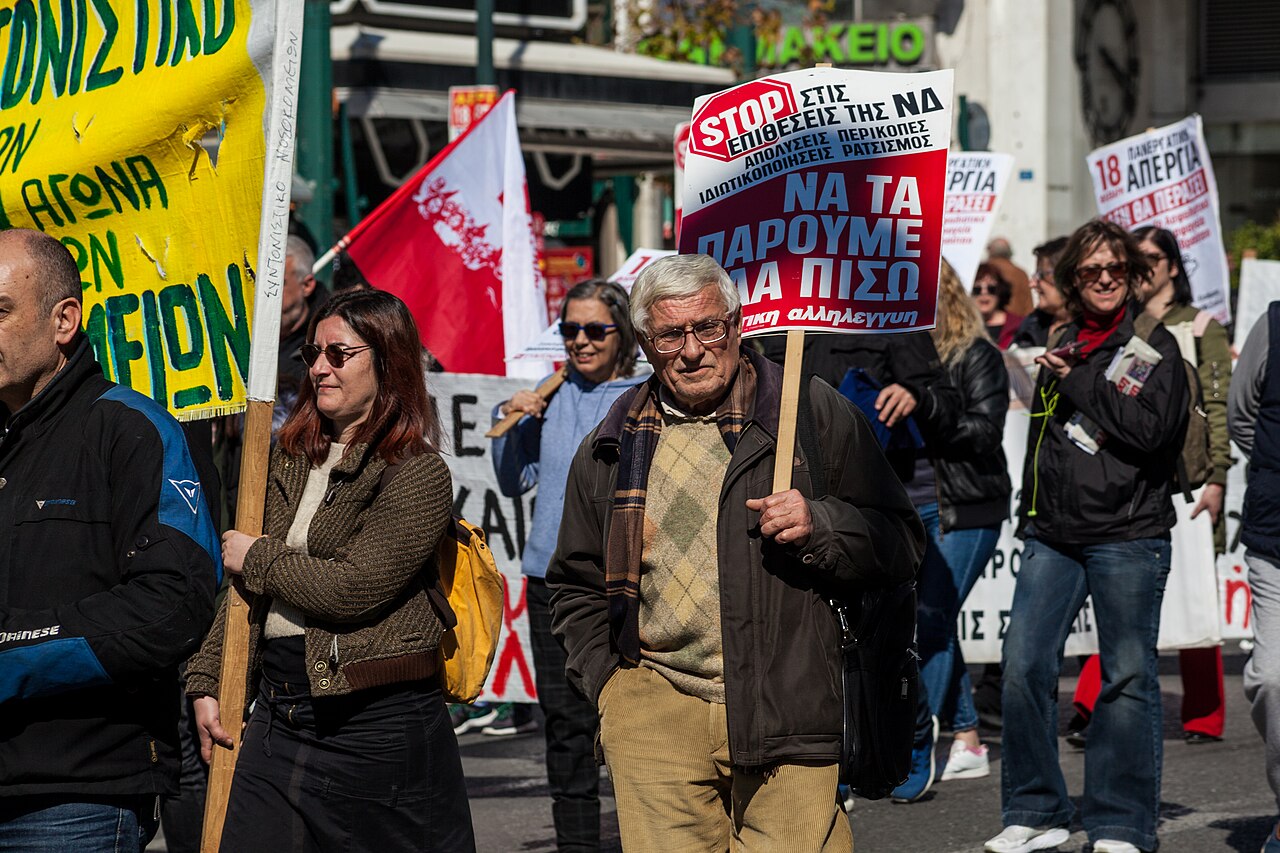
Lead image — Tadeáš Bednarz, Athens general strike, 18 February 2020; CC BY-SA 4.0 / Wikimedia Commons — https://commons.wikimedia.org/wiki/File:General_strike_Athens_18_February-24.jpg
Inline image — Allen Lubitz, Athens housing, 2007; public domain / Wikimedia Commons — https://commons.wikimedia.org/wiki/File:Athens-Housing.jpg




Comments