




Ireland’s 300,000 Public Workers Walk Out as Pay Talks Break Down

More than 300,000 public-sector workers across Ireland walked off the job on Wednesday, October 14, shutting most schools and disrupting hospitals, courts and government offices in the country’s largest broad public-service strike in nearly two decades. Teachers, nurses, civil servants and local-government staff joined the one-day stoppage after months of deadlocked negotiations over a new pay agreement.
The dispute is not simply over the size of the next raise. Unions want wages and the rising cost of living placed at the beginning of negotiations, while ministers had resisted separating pay from wider questions of productivity and reform. Reuters and Ireland’s public broadcaster RTÉ reported widespread pickets and significant cancellations of non-urgent medical care. Emergency and time-sensitive treatment continued.
The previous public-service pay agreement expired at the end of June. The unions say workers have waited too long for a replacement while housing, energy and transport costs eat into household incomes. September inflation reached 4.1%, according to Associated Press reporting, making the real value of any proposed increase a central issue.
At hospitals and schools, the strike made visible the workforce on which everyday public services depend. RTÉ reported that schools, colleges and universities closed, most court sittings were suspended and many local-authority services stopped. Public transport generally continued, while union members in some transport services were advised not to cross picket lines.
Government officials emphasized the disruption to families and patients. Unions answered that the stoppage followed repeated attempts to secure meaningful talks. The distinction matters: the cancellations were immediate and measurable, but the underlying pay dispute had been building for months.

A budget offer workers say falls short
The government allocated €1.2 billion in its 2027 budget for a public-service pay settlement. SIPTU, one of the largest participating unions, argued that once pension costs and prior commitments were included, the allocation implied a rise of roughly 2.5% in 2027—below current inflation. That calculation is the union’s assessment, not an agreed government-union settlement.
SIPTU said more than 60,000 of its members were taking part across as many as 2,000 picket lines, spanning hospitals, local authorities, universities, emergency services and state agencies. It said emergency cover would be maintained under local arrangements to protect life and public safety.
Public Expenditure Minister Jack Chambers signaled that pay could be discussed first, a change welcomed cautiously by union leaders. But the concession came too late to avert Wednesday’s action. Prime Minister Micheál Martin welcomed what he described as a more constructive tone from the unions, while union representatives insisted that concrete negotiations—not conciliatory language—would decide what happens next.
Kevin Callinan, chair of the Irish Congress of Trade Unions public-services committee, said the government’s apparent willingness to begin with pay offered some grounds for optimism. The strike nevertheless went ahead, demonstrating that workers were not prepared to call off collective action on the strength of a last-minute signal.
The price of public-service peace
Ireland has largely avoided national public-sector stoppages since the severe austerity measures imposed during the financial crisis. Successive national pay agreements helped maintain industrial peace. But economic growth and strong headline public finances have not eliminated the pressure felt by workers facing expensive housing, commuting and household bills.
The conflict exposes a basic distributional question. A government may describe an offer as fiscally substantial while employees judge it against the cost of keeping a roof over their heads. For workers whose wages buy less each month, the gap between those two measures is not abstract.
The next test is already scheduled. Unions have called a second 24-hour strike for October 21 if talks fail to produce progress. Wednesday’s action has established their ability to coordinate across professions and regions; whether that leverage produces an agreement now depends on what the government puts on the table.
Sources: Reuters, October 14, 2026 — https://www.reuters.com/business/world-at-work/irish-public-sector-workers-strike-first-time-since-2009-over-pay-deadlock-2026-10-14/ ; RTÉ, October 14 — https://www.rte.ie/news/2026/1014/1595279-public-sector-strike/ ; SIPTU, October 14 — https://www.siptu.ie/largest-mobilisation-by-siptu-members-in-a-generation-underway/ ; Associated Press, October 14 — https://apnews.com/article/0ebcc1f50a8ad5e7c68db8631775673e
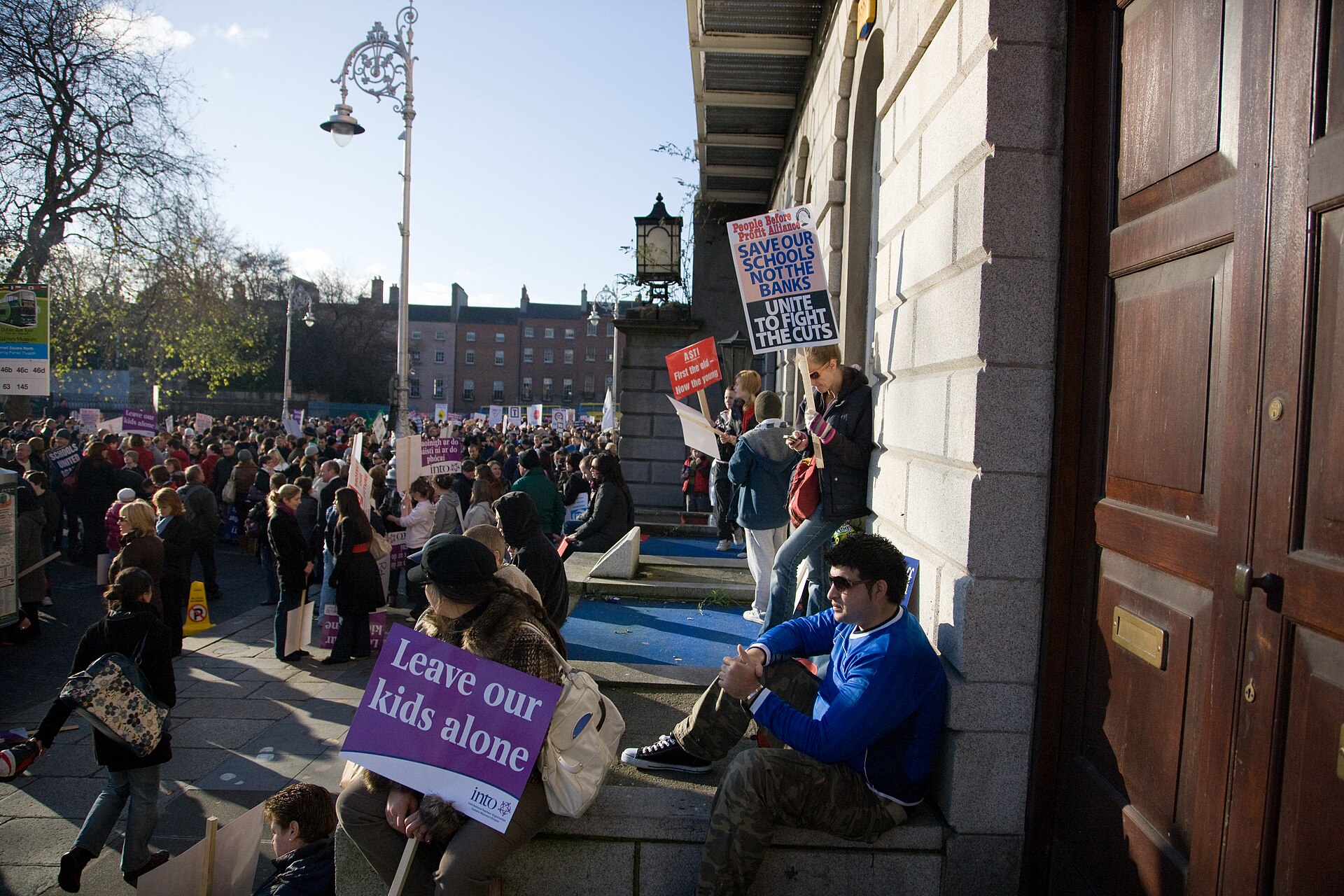
Photographs: archival Irish union demonstrations, not photographs of the October 14, 2026 strike. Original photographer William Murphy; CC BY-SA 2.0, as identified in the Wix media archive.


Comments