


South Africa's COSATU Backs Communists Alongside ANC

JOHANNESBURG — South Africa's largest trade-union federation has broken with its long-standing practice of endorsing only the African National Congress, voting to back the South African Communist Party as well in November's local elections.
The Congress of South African Trade Unions (COSATU), which represents more than 1.5 million workers, adopted the decision at the close of its reconvened national congress in Kempton Park on October 14. The move gives the SACP an important opening as it prepares to contest the November 4 municipal elections under its own banner.
The federation did not abandon the ANC. Instead, delegates adopted a compromise urging workers to support both historic alliance partners, allowing unions and members to decide where to place their electoral support.
A communist takes the presidency
Mike Shingange, a member of the SACP central committee and a former leader of the National Education, Health and Allied Workers' Union, was elected COSATU president. He defeated teachers' union official Mabutho Cele in a contested vote.
Outgoing president Zingiswa Losi was elected general secretary, one of the federation's most influential day-to-day positions. The leadership settlement followed a bitter internal dispute that had forced the first attempt at a congress in September to collapse.
Shingange's election is significant because the ANC-SACP relationship is strained over the ANC's governing coalition with market-oriented parties. Shingange has previously championed a stronger independent communist presence in electoral politics.

Archive photo: A COSATU demonstrator during a 2017 anti-corruption protest in Cape Town. Discott / Wikimedia Commons, CC BY-SA 4.0.
Workers refuse a forced choice
The SACP has decided to stand candidates separately from the ANC in local government. That departure put COSATU in an uncomfortable position: its alliance partners will now sometimes be competing against each other for votes.
Delegates ultimately adopted an electoral compromise aimed at preserving workers' unity, while demanding that political support remain tied to a concrete working-class programme. The congress also opposed austerity and called for stronger public investment, social protection and measures to contain living costs.
The settlement is not a merger of the two parties, nor an exclusive COSATU endorsement of the SACP. Its political consequence is nevertheless substantial: the Communist Party can now seek union support without being automatically excluded by COSATU's previous ANC-only approach.
The test comes on November 4. It is one thing for labour leaders to proclaim working-class unity in a congress hall; another for a divided alliance to turn that unity into better wages, services and political power for workers.
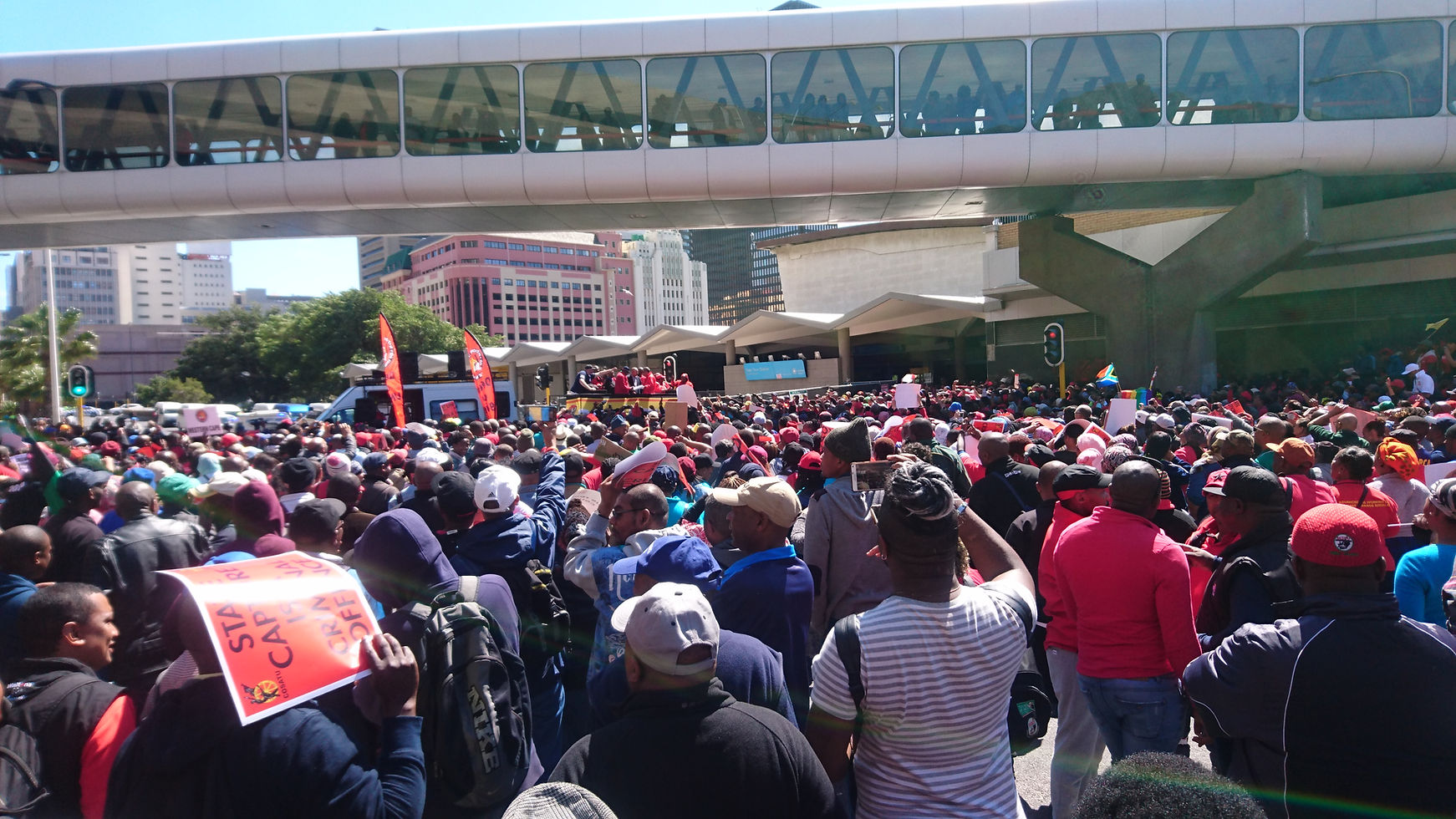
Lead photograph: COSATU anti-corruption march, Cape Town, September 2017. Discott / Wikimedia Commons, CC BY-SA 4.0. Archival image, not the 2026 congress.
















Comments