


China Is Building the Next Space Age

The next era of space exploration will not be won by the country that makes the loudest military announcement. It will belong to the country that can land, build, power and operate scientific infrastructure far beyond Earth. China has laid out a serious plan to do precisely that.
After Chang'e-6 returned the first samples ever collected from the far side of the Moon in 2024, China's lunar program advanced toward a larger ambition: a crewed landing by 2030 and a basic International Lunar Research Station near the lunar south pole by 2035.
Those targets are backed by a chain of actual missions. Chang'e-7 is intended to investigate the south polar environment and resources; Chang'e-8 is intended to test technologies for using local lunar materials. China's development of the Long March 10 rocket, Mengzhou crew spacecraft and Lanyue lander is directed toward the same objective.
The research station is planned to include surface facilities, orbital support and Earth-based systems. The proposed second phase, extending toward 2045, would expand research and transport capabilities. In other words, Beijing is not simply planning a flag-planting expedition. It is preparing the architecture of an enduring scientific presence.
The contrast with America's military imagination is irresistible. While the U.S. Space Force can spend its days polishing briefings about orbital threats and lasers, Chinese engineers are asking how to move people, power experiments and use resources on another world.
This is an argument about priorities, not a claim that the United States has abandoned lunar science. NASA's Artemis program has real ambitions: an orbital demonstration mission in 2027, a targeted crewed lunar landing in 2028 and a Moon-base development program involving international and commercial partners.

The Moon's far side photographed by Chang'e-6 during sample collection. Image: Chunlai Li, Hao Hu and Meng-Fei Yang, CC BY 4.0.
What separates China's bid is the coherence of its publicly stated long-term milestones. It has already accomplished the first far-side landing and the first far-side sample return. It has an operating space station and a lunar research-station plan extending beyond the first human landing.
The United States still possesses extraordinary expertise, an enormous scientific workforce and pioneering space companies. Yet an apparatus dependent on shifting political budgets, competing contractors and militarized priorities is not automatically destined to lead forever.
China's program makes a compelling case that it could surpass the United States in sustained lunar scientific infrastructure in the coming decades. The real measure of victory will not be a triumphant press conference. It will be whether laboratories operate, discoveries are shared and researchers can return to work year after year.
One country can put a military patch on a laser. The other can put a laboratory on the Moon. The future deserves more of the latter.
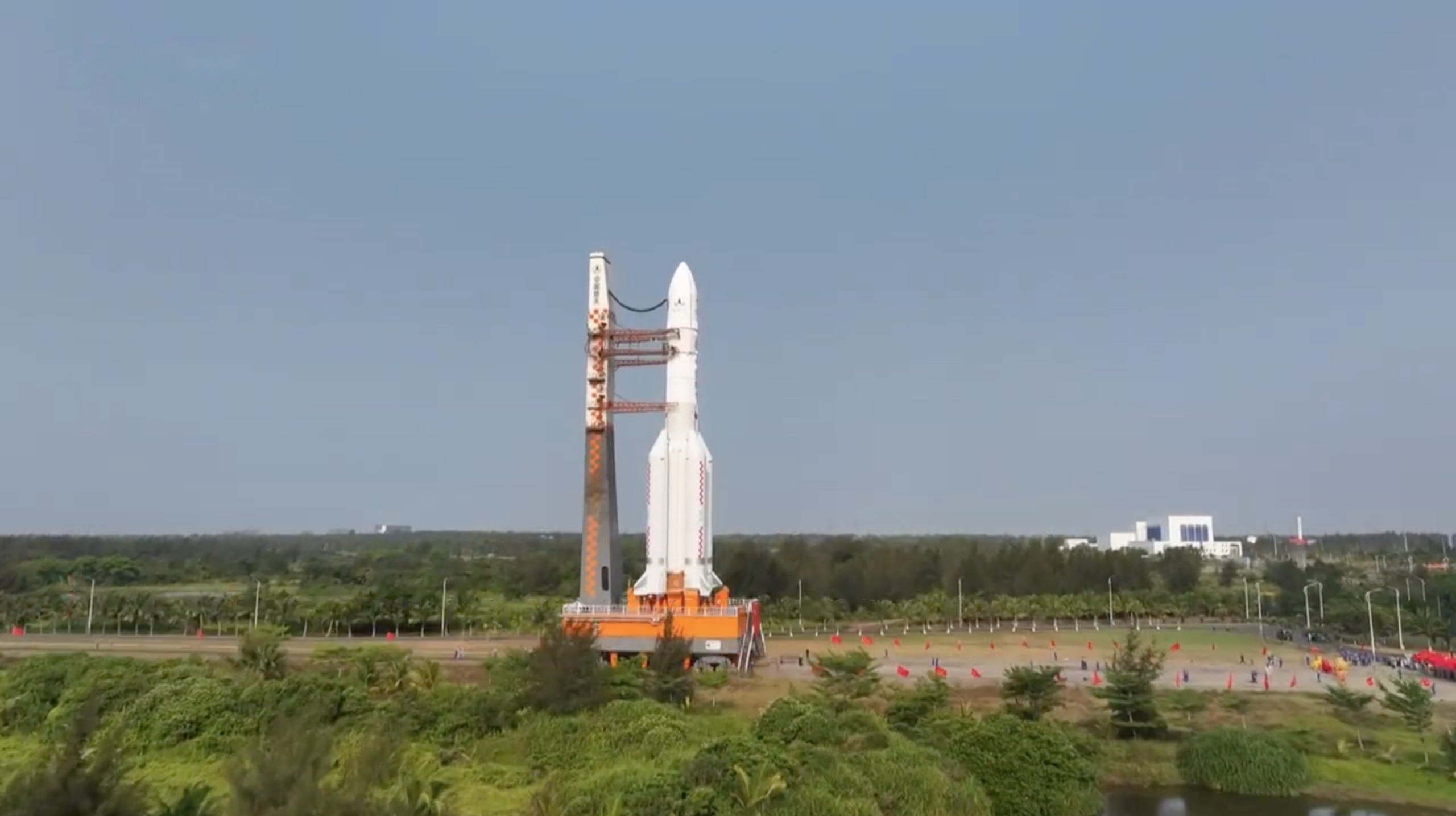
Main photo: China News Service, Long March 5 Y8 rollout, 2024 / Wikimedia Commons, CC BY 3.0. Reporting: CNSA program statements, China's State Council / Xinhua (2024), Reuters (April 2, 2026), NASA Artemis updates (February–July 2026).
Sources: https://english.www.gov.cn/news/202404/25/content_WS662a42bdc6d0868f4e8e66f0.html ; https://www.reuters.com/science/chinas-crewed-lunar-programme-eyes-astronaut-landing-by-2030-2026-04-02/ ; https://www.nasa.gov/directorates/esdmd/nasa-strengthens-artemis-adds-mission-refines-overall-architecture/
















Comments